


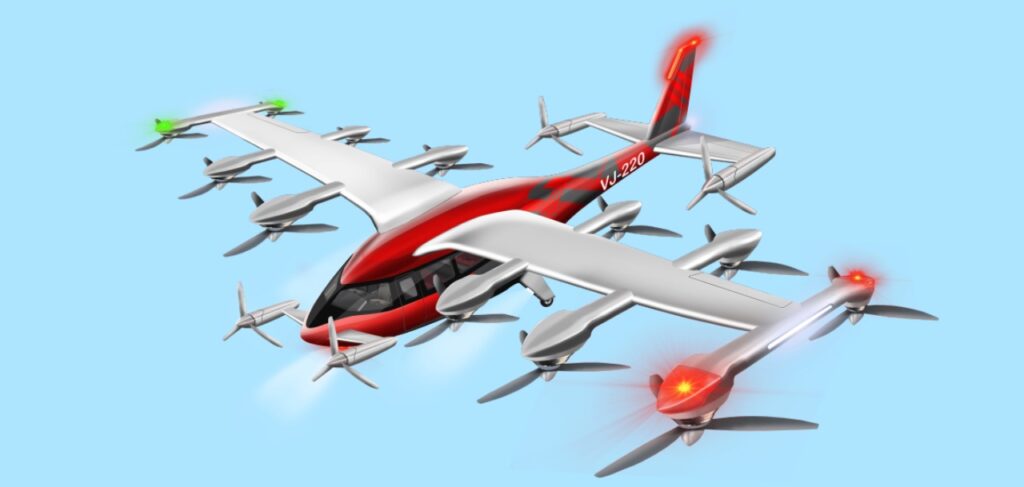
Vjaitra Air Mobility is redefining the very essence of flight. Established in 2023 under Darsh Dronobotics Systems Pvt. Ltd., the company has boldly positioned itself at the frontier of urban aviation with a transformative pledge, safe, sustainable, and future-ready air travel. At the heart of this mission stands its crown jewel: a hydrogen-powered, five-seater VTOL air taxi. Built to fly farther, faster, and cleaner, it delivers a 600-kilometer range with whisper-quiet efficiency. This is not merely an aircraft; it represents a paradigm shift in mobility, engineered for bustling commercial corridors as well as strategic defence applications.
By fusing cutting-edge engineering with an unwavering commitment to safety, Vjaitra transcends the role of a technology company. It emerges as a vanguard of India’s green aviation revolution. Each innovation carries the firm closer to its vision of seamless urban connectivity: air taxis that ease congestion, shrink travel times, and reshape how the world moves. Vjaitra is not waiting for the future of flight. It is building it.
In an exclusive interaction with The Interview World during FIIT Forward 2025, hosted by FITT and IIT Delhi, Ratandeep Tripathi, Founder of Vjaitra Air Mobility, Country Head of the Advanced Air Mobility Institute USA, and Member of the Sky Alliance of Automated Air Mobility (SALAAM), Austria, as well as the BRICS Centre for Industrial Competencies, shared compelling perspectives. He spoke of the inspiration that drew him to Urban Air Mobility (UAM) and Vertical Take-Off and Landing (VTOL) technology. He outlined how Vjaitra distinguishes its approach from other players, and he explained the breakthroughs driving its VTOL designs.
Tripathi also revealed the unique advantages of the hydrogen-powered V600x VTOL over conventional battery-electric air taxis. He shed light on the status of regulatory certifications, detailed ongoing collaborations with aviation authorities, and discussed pathways to accelerate VTOL adoption. Beyond India, he highlighted the company’s ambition to expand into global markets while reinforcing his vision of making zero-emission aviation a mainstream reality.
What follows are his most compelling insights from this thought-provoking conversation.
Q: What inspired Vjaitra Air Mobility to focus on Urban Air Mobility (UAM) and VTOL technology as the future of transportation in India?
A: India stretches across vast distances, burdened by dense populations and chronically congested roads. In this reality, we recognized an urgent need for sustainable mobility solutions: ones that could reclaim countless hours each day while cutting emissions at scale. Urban Air Mobility offers precisely that opportunity. It allows India to leapfrog decades of traditional infrastructure constraints and step directly into a cleaner, aerial-first era of transport. Yet for us, the vision extends far beyond technology. It is about reshaping accessibility. It is about making air travel not a luxury, but an everyday reality: faster, greener, and affordable for every Indian.
Q: What differentiates Vjaitra’s approach to UAM and VTOL from other global players in this space?
A: Many companies chase electric VTOLs as the sole future of mobility. Yet our early research and prototype trials revealed a hard truth: electric aircraft often deliver only 50–60% of their promised range. We refused to ignore this reality. Instead, Vjaitra treated it as a challenge to solve. Consequently, we are engineering a hybrid model that unites electric and hydrogen propulsion, pushing achievable ranges up to 600 kilometers. But our ambition does not stop at technological novelty. We aim to democratize aerial mobility: scalable, affordable, and designed for India’s people, at a cost as low as $0.25 per kilometer.
Q: Can you explain the key technological breakthroughs behind your patented VTOL designs?
A: We hold two pioneering patents on full-aircraft VTOL architecture, the first of their kind in India. These patents embody innovations in distributed propulsion, lightweight composite structures, and advanced aerodynamic optimization. Together, they enhance efficiency, elevate safety, and redefine passenger comfort. The true breakthrough lies in the seamless integration of vertical lift with forward flight. This design not only lowers energy consumption but also builds in redundancy, ensuring uncompromising reliability and passenger safety.
Q: What makes the hydrogen-powered V600x VTOL unique compared to battery-electric air taxis?
A: Battery-electric VTOLs work well for short urban hops, yet they remain constrained by limited energy density and restricted range. The V600x, powered by hydrogen fuel cells, overturns these limitations and redefines what aerial mobility can achieve. It delivers up to 600 kilometers of range, compared with just 100–200 kilometers for all-electric models. It produces near-zero emissions, releasing only water vapor. It also enables rapid refuelling, driving greater operational efficiency. In effect, the V600x expands the horizon. It connects not only neighbourhoods within cities but entire regions, unlocking urban-to-regional mobility at scale.
Q: Where does Vjaitra currently stand in terms of certification with aviation regulators such as DGCA, FAA, and EASA?
A: Certification is not a destination but a disciplined journey. We advance deliberately, step by step. In India, our immediate focus lies with the DGCA, where we are actively pursuing UAV and drone certifications as the first pathway. This effort establishes both credibility and a proven safety record. Building on this foundation, our VTOL program will follow an equally rigorous, structured pathway under Indian regulations. From there, we will expand towards global benchmarks. Early dialogues with the FAA and EASA are already underway through international collaborations, ensuring alignment from the outset. At every stage, safety and compliance remain the unshakable pillars of our roadmap.
Q: How do you plan to work with city planners, regulators, and governments to ensure VTOL adoption at scale?
A: We believe the ecosystem is as vital as the aircraft itself. Therefore, Vjaitra has already forged collaborations with FITT–IIT Delhi, IIM Lucknow–EIC, and SALAAM (Sky Alliance of Autonomous Air Mobility) Austria, alongside the Advanced Air Mobility Institute in the USA. Together, we are shaping air traffic management systems, vertiport planning, and policy frameworks. At the same time, we work closely with governments, city planners, and regulators. The goal is clear: to embed VTOLs seamlessly into urban life. They must be safe. They must be regulated. And above all, they must be accessible.
Q: Beyond India, which international markets hold the strongest potential for Vjaitra’s VTOL solutions, and why?
A: We see powerful opportunities emerging across the Middle East, Europe, and the United States. The Middle East, with its decisive focus on green hydrogen and smart-city development, offers a natural home for our hydrogen-powered VTOLs. Europe, driven by rigorous regulation and an uncompromising sustainability agenda, provides fertile ground for adoption. Meanwhile, the United States, birthplace of Advanced Air Mobility, remains the fastest-moving market, where certification pathways are maturing at pace. Against this backdrop, our affordable, long-range hybrid model stands uniquely positioned to address the distinct needs of these diverse regions.
Q: Looking ahead, what role do you see Vjaitra playing in making zero-emission aviation a mainstream reality?
A: Our mission is clear: to emerge as India’s first mover in sustainable aviation and take that leadership to the world. We intend to prove that clean flying is not only possible but also affordable. By uniting homegrown innovation, proprietary technologies, and hydrogen–electric propulsion, we will make zero-emission aviation a mainstream choice rather than a niche privilege. Looking ahead to the next decade, we envision Vjaitra evolving beyond an aircraft manufacturer. We will act as a catalyst for a new mobility ecosystem: one that redefines how millions of people move across cities and nations.








1 Comment
This content is really helpful, especially for beginners like me.
Comments are closed.