
Zerowatt is an AI-powered energy and operational intelligence company that helps industrial facilities cut energy costs, improve equipment performance, and accelerate their sustainability goals. Its platform, positioned as a “digital brain for energy efficiency,” continuously analyses energy, equipment, and process data to uncover inefficiencies, identify root causes, quantify savings opportunities, and recommend corrective actions.
Rather than requiring costly infrastructure replacement, Zerowatt integrates with existing industrial systems, including SCADA, PLC, BMS, and sensor networks. This enables facilities to deploy intelligence across their operations while preserving their existing technology investments. Its solutions span energy monitoring, predictive maintenance, GHG accounting, and net-zero planning, bringing energy and operational intelligence into a unified platform.
By combining deep industrial expertise with AI-driven analytics, Zerowatt says it now serves more than 100 manufacturing groups and delivers average energy-cost reductions of 20–30%. The company’s proposition therefore extends beyond monitoring: it aims to help industrial enterprises turn operational data into measurable efficiency gains, cost savings, and sustainability outcomes.
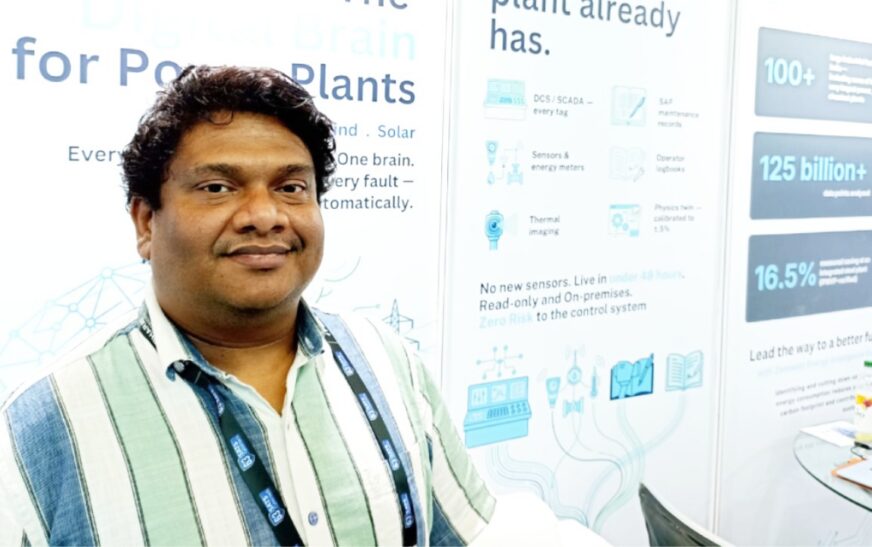
In an exclusive conversation with The Interview World at Powergen India 2026, Sooraj Surendran, Director/COO, Zerowatt, discussed how the company’s technology solutions are helping the power industry improve operational and energy efficiency. He explained the commercial deployment of Zerowatt’s solutions across India and international markets, and outlined the company’s approach to expanding innovation and differentiation beyond its current portfolio.
Surendran also shared his vision for the next five to ten years, covering market expansion, product innovation, technology adoption, and the evolving role of AI in industrial energy management. The following are the key takeaways from the conversation.
Q: Could you elaborate on Zerowatt’s technology offerings and how your operational intelligence solutions are empowering the power industry to improve efficiency?
A: Our solution is what we call a “digital brain for industries.” We bring data from a plant into a central data platform, analyse it using a combination of advanced analytics and AI agents, and convert that data into actionable business insights.
In simple terms, we tell the customer three things: this is the problem, this is what is causing it, and this is what you can do about it. More importantly, we quantify the impact: this is the expected saving in rupees.
We primarily work with energy-intensive industries such as steel and cement, where energy consumption is a significant operating cost. The energy can come from multiple sources, including electricity, solar, wind, LPG, and other forms of energy. Our platform brings all of this information together in one place.
We integrate energy, water, temperature, steam, and production-process data into a single dashboard. This gives the customer a unified view of the plant and, more importantly, enables us to analyse the data continuously and identify opportunities for improvement.
Traditionally, industrial monitoring systems are designed to display data. They present information through tables, charts, and dashboards, but they largely leave the interpretation to the customer. Someone still has to sit down, study the data, identify anomalies, understand the underlying problem, and determine what action to take.
That creates two fundamental challenges.
The first is the data problem. In many cases, the required data is fragmented across SCADA or DCS systems, sensors, spreadsheets, and even manual logbooks. Sometimes the customer does not have the data readily available in a usable form.
The second is the expertise problem. Even when the data exists, the customer may not have the specialised expertise required to interpret it and translate it into an operational decision.
Our platform addresses both problems: data availability and domain expertise.
Once the relevant data is available online, we build an intelligence layer on top of it. The system has two core layers.
The first is the monitoring and analytics layer. It uses advanced rule-based analytics grounded in engineering principles, physics, formulas, and established process knowledge. Not every problem requires AI. If we already understand the underlying physical relationship, a deterministic model can identify an anomaly faster, more reliably, and more transparently.
This layer continuously monitors the plant and identifies where something is abnormal, where performance is deteriorating, and where an issue requires attention.
The second is the AI intelligence layer. This is where our AI agents analyse the broader context behind the data.
These agents are context-aware and domain-specific. Instead of relying on one generic AI model, we can have specialised agents for different industrial assets and systems, for example, a compressor agent, capacitor agent, motor agent, or other equipment-specific agents.
The AI can analyse data collected from existing SCADA and DCS systems, sensors, and even manual logbooks. It brings these different sources together, interprets them in context, and translates complex industrial data into language that an operator or business leader can understand.
Instead of simply showing a graph and leaving the customer to interpret it, the system can say:
This is the problem you are facing. This is the most likely reason for it. Here is the action you can take. And if you implement that action, this is the potential saving you can expect in rupees.
That is the fundamental difference between a conventional industrial monitoring system and our approach.
We are not just giving customers more data. We are turning industrial data into decisions, actions, and measurable financial outcomes.
Q: Has this solution been commercially deployed in India or international markets, and what has been its market adoption?
A: We have been fully operational in India for the past three years. In the previous financial year, we generated revenue of approximately ₹2 crore, and we are now seeing strong traction beyond the domestic market, with POCs and customer orders progressing in other countries as well.
Internationally, we have deployed our solution in Vietnam, Kuwait, Serbia, and Uruguay. These deployments are currently at the POC stage rather than commercial scale. In India, however, our presence is much broader. We have established a strong footprint across all four southern states, with significant installations in Coimbatore and Chennai. More recently, we have expanded into northern and eastern markets, with installations in Gurugram, Manesar, Haridwar, Kolkata, and several other locations.
This growing footprint demonstrates that our product is not merely conceptual. It has been deployed, tested, and validated across real industrial environments, and the results have strengthened our confidence in its ability to deliver measurable value.
Our immediate focus, therefore, is to move beyond the POC-led adoption model. Enterprises understandably want to see the solution working within their own operations before committing to a larger deployment. We have used POCs effectively to establish that proof, but we are now converting that validation into broader enterprise deployments.
We are already at an advanced stage of discussions with several large organizations, including power plants and cement companies. We are also close to completing the process with one of India’s largest fertilizer companies. These engagements indicate that the market is moving from experimentation toward commercial adoption.
At the same time, we have strengthened our financial foundation. We recently raised our first round of investment from Mudhal Ventures, founded by Zoho co-founder Kumar Vembu. The investment came through Startup Singam, a Tamil Nadu-based startup television show, and marks an important milestone in our journey from product validation to scalable commercial growth.
Q: What is your strategy for driving the next layers of innovation and differentiation beyond the solutions you offer today?
A: When we started, AI was not yet part of the equation. Our energy auditors manually analysed the data and used their expertise to advise customers on what actions they should take to improve energy efficiency.
The advent of AI over the past two to two and a half years has transformed the business. Our growth has been tremendous, and, frankly, even we have been surprised by the level of savings we are now able to achieve. AI has significantly enhanced our ability to analyse large volumes of data, identify inefficiencies, and recommend actions that deliver measurable savings.
The next layer of innovation could emerge from the wealth of industry data we have accumulated. We now have extensive insights into different types of equipment, their performance, the challenges industries face, and the solutions that can address those challenges. That knowledge itself could become a new business vertical.
For example, we see an opportunity to build an aggregation platform that connects industries with energy-efficiency equipment manufacturers and solution providers. We understand the problems industries face, and we know which technologies and solutions can address them. Therefore, we can potentially bridge the gap between customers who need energy-efficiency solutions and the vendors who can provide them.
This could become a distinct vertical for us, one where we leverage our industry knowledge, data, and customer relationships to connect the right solutions with the right customers.
Q: As Director/COO, what is your five-to-ten-year vision for market expansion, product innovation, technology adoption, and the company’s long-term competitive positioning?
A: I may not have thought about it in those exact terms, but over the next one to two years, we are confident that we can become the best in the industry. The solution is still very new, and we believe we are already ahead of the curve. Our immediate ambition, therefore, is to establish a strong presence across India within the next two years. From there, we aim to take the solution to global markets and build a presence around the world.