
Neysa is an Indian AI acceleration cloud platform that streamlines the end-to-end lifecycle of artificial intelligence workloads. It enables organizations to build, deploy, and scale AI systems through a tightly integrated infrastructure stack. At the core of this ecosystem is Neysa Velocis, the company’s flagship platform. It delivers GPU-as-a-Service, unified observability, production-grade inference endpoints, and comprehensive AI Platform-as-a-Service capabilities. As a result, enterprises and developers can train, deploy, and manage models efficiently from a single, consolidated dashboard.
Moreover, Neysa embeds operational governance, security controls, and architectural simplicity into the platform by design. Consequently, it reduces execution risk and infrastructure complexity across AI initiatives. The solution supports a broad spectrum of sectors, from banking and financial services to advanced research and data-intensive enterprises. Backed by experienced technology leadership, Neysa pursues a clear mandate: democratize access to high-performance AI infrastructure at a global scale.
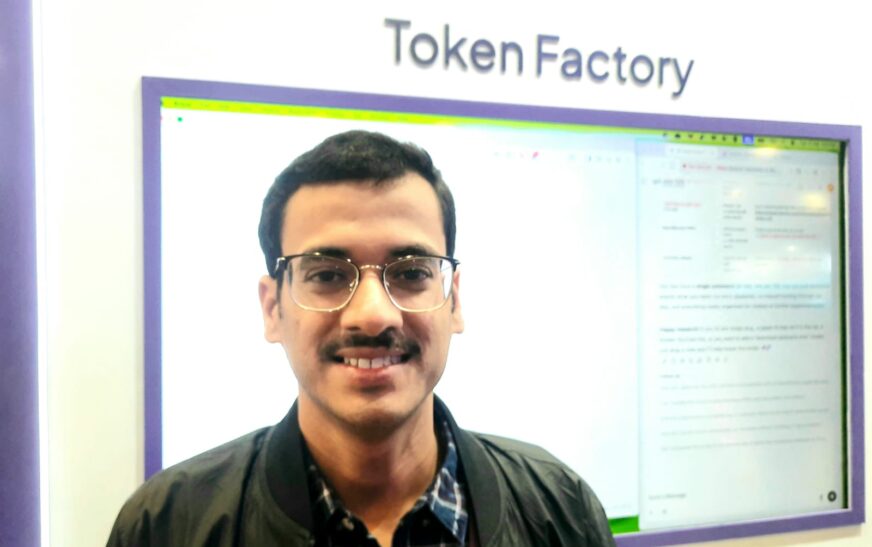
In an exclusive interaction with The Interview World at the India AI Impact Expo 2026, Rohit Sharma, Senior Manager – Product Management at Neysa, provided a strategic perspective on the company’s Token Factory and its broader AI portfolio. He articulated the foundational attributes of tokens, examined how artificial intelligence will structurally transform industries, economies, and society, and assessed the competitive positioning of Indian startups and technology firms within the global AI ecosystem. The following insights distil the most significant takeaways from that discussion.
Q: Can you provide a concise overview of Token Factory, and the AI solutions offered by Neysa?
A: Neysa’s Token Factory is a shared inferencing service designed to address a structural constraint in the generative AI economy: access to affordable, consumable tokens. In the GenAI paradigm, tokens function as the fundamental unit of computation and billing. Every model processes inputs and produces outputs as tokenized fragments of text. Therefore, token consumption directly determines cost.
However, running large language models at scale often proves prohibitively expensive, particularly for startups and mid-sized enterprises. To remove this barrier, Neysa introduced Token Factory. The platform liberalizes access by enabling prepaid, metered usage. For example, a user can provision $100 in credits and consume tokens incrementally, on demand. This metered architecture transforms generative AI into a utility-style service, predictable, controllable, and economically accessible. In essence, Token Factory operationalizes shared inferencing as a scalable, consumption-based model.
At the same time, Neysa provides dedicated inferencing for enterprises that require isolated, high-performance environments. In this model, infrastructure resources are provisioned exclusively for a single organization, ensuring workload isolation, compliance alignment, and performance guarantees. For instance, Nemotron, an advanced model from NVIDIA, and Param 2, a 17B-parameter multilingual sovereign model developed under BharatGen, currently operate on Neysa’s infrastructure in dedicated configurations. These deployments exemplify Neysa’s enterprise-grade inferencing capabilities.
Beyond inferencing, Neysa strengthens the AI stack through integrated security controls, network architecture optimization, and full-stack observability. Together, these capabilities create a resilient, secure, and performance-driven environment for deploying and managing AI workloads at scale.
Q: What are the fundamental characteristics of a token?
A: Tokens will define the economic and computational backbone of the generative AI ecosystem. They already serve as its fundamental unit of processing; increasingly, they also function as its unit of consumption and monetization.
Large language models do not interpret language the way humans do. They do not “understand” complete words or sentences in semantic wholes. Instead, they operate on token vocabularies: structured dictionaries of subword units. Just as humans rely on an English lexicon, models rely on token dictionaries. Crucially, meaning does not reside solely in a full word; it often emerges from smaller linguistic fragments and, more importantly, from contextual arrangement.
Consider the sentence: “Those are flying planes.” This construction is inherently ambiguous. It could describe aircraft that are capable of flying. Alternatively, it could refer to aircraft currently in flight. It might also denote individuals piloting aircraft, people who are flying planes. The lexical components remain constant, yet the meaning shifts with syntactic structure and contextual emphasis.
Tokenization addresses this complexity by decomposing text into smaller, computationally tractable units. Models then recombine these tokens in varying sequences and weight them contextually. Through this process, they abstract meaning not merely from isolated words but from relational patterns among tokens. This dynamic weighting is governed by the attention mechanism, the architectural core of transformer models.
The Generative Pre-trained Transformer architecture, commonly associated with systems such as ChatGPT developed by OpenAI, operationalizes this principle at scale. It processes tokens, evaluates contextual dependencies through attention layers, and generates probabilistically coherent outputs. Every prompt, completion, and dialogue exchange reduces to token sequences processed through this framework.
Therefore, tokens constitute the primary unit of functionality in generative AI. At the same time, as pricing models increasingly meter usage per token, they are becoming the primary unit of economic exchange in the AI economy. Computational logic and commercial logic now converge at the token level, and that convergence will shape the future trajectory of generative AI.
Q: How will AI reshape industries, economies, and society?
A: The trajectory remains unfolding; however, global sentiment reflects unmistakable optimism. Industry leaders, policymakers, and technologists widely anticipate that generative AI will reshape society at a foundational level. Some commentators even compare its transformative potential to the invention of electricity, a general-purpose technology that reconfigured entire economic systems.
Early evidence already supports this thesis, particularly in knowledge distribution. Generative Pre-trained Transformer models, such as ChatGPT developed by OpenAI, have evolved into personalized cognitive assistants. They augment research, accelerate learning, and democratize access to structured insight. Consequently, information scarcity has diminished as a structural constraint for many professionals. The barrier is no longer access to knowledge; rather, it is the disciplined and strategic application of that knowledge.
However, sustainable enterprise value will not emerge automatically. Organizations must deliberately re-engineer workflows, decision architectures, and operating models to extract measurable returns. In other words, businesses must realign around AI-native processes if they expect ROI to materialize. This transformation will require structural adjustments, rethinking cost centers, redefining productivity metrics, and integrating AI as a core operational layer rather than a peripheral tool.
Initially, AI will function as an augmentation layer, an efficiency multiplier embedded within existing systems. Over time, however, it will catalyse deeper reinvention. Companies that treat AI as a strategic capability, rather than an experimental add-on, will capture disproportionate value.
The global economy is still in the discovery phase of this transition. Yet the inflection point is approaching rapidly. Within the next two to three years, the tangible impact of AI, across productivity, innovation velocity, and competitive dynamics, will become materially visible.
Q: Where do Indian startups and tech companies stand in the global AI ecosystem?
A: India is performing credibly, and, in several dimensions, strategically, in the global AI landscape. The policy posture signals clear governmental intent. Recent initiatives demonstrate that AI is not a peripheral agenda item but a national priority.
For example, the BharatGen program has catalysed the development of indigenous models such as Param 2, while enabling subsidized access to compute and research support. These interventions reduce entry barriers for academic institutions and early-stage innovators. Although the startup ecosystem could benefit from tighter coordination and stronger capital orchestration, the policy scaffolding from the government side remains robust and forward-leaning.
Further, the IndiaAI Mission has introduced a centralized AI Mission portal. Functionally, it operates on procurement principles similar to the Government e-Marketplace model. The portal transparently displays L1 (lowest) pricing, thereby streamlining access to high-demand GPU infrastructure. As a result, universities and research institutions can procure compute resources with greater speed, price clarity, and procedural efficiency. This materially lowers friction in model development and experimentation.
Moreover, India’s AI forums increasingly attract global participation. Leading ecosystem players, including NVIDIA, OpenAI, and Anthropic, actively engage alongside domestic stakeholders. Such multilateral collaboration reinforces India’s positioning as a serious AI participant rather than a peripheral market.
Simultaneously, regulatory architecture is shaping infrastructure strategy. The Digital Personal Data Protection Act, 2023 mandates stricter data governance and reinforces data localization considerations. Consequently, sovereign AI data centers are gaining strategic relevance. This regulatory environment creates incentives for domestic cloud builders, model developers, and infrastructure providers to architect AI systems within India’s jurisdictional boundaries.
Taken together, these initiatives reflect a coherent direction: build sovereign capability, lower structural barriers, and integrate India into the global AI value chain. While ecosystem optimization remains a work in progress, the underlying momentum is substantive and positive.