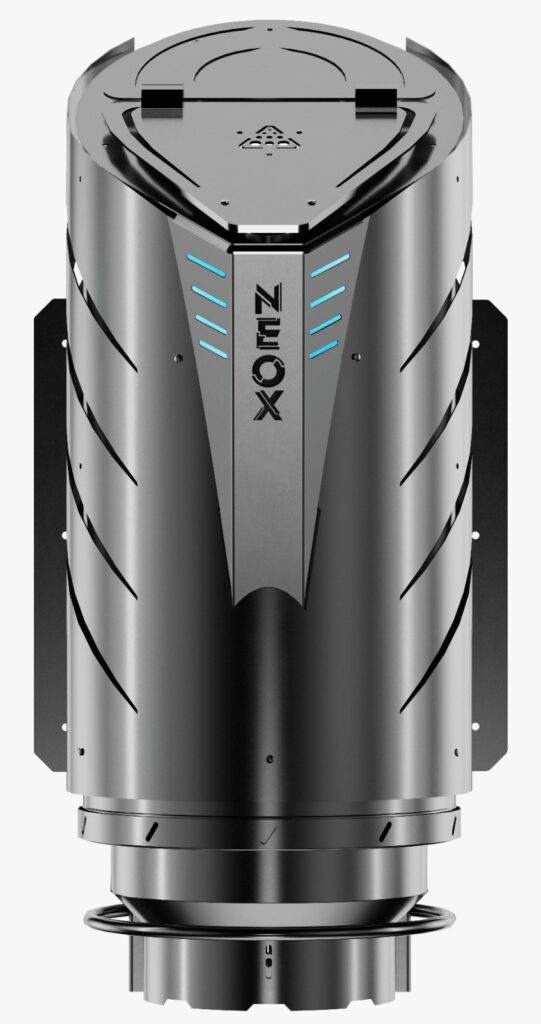

NEO SAN Pvt. Ltd., founded in 2022, is an Indian clean-technology company redefining hazardous waste management through advanced, decentralised systems. At the core of its portfolio stands the Neo-X incinerator, a compact, high-performance solution engineered to treat reject and non-recyclable waste at the point of generation. By operating at ultra-high temperatures, Neo-X significantly reduces harmful emissions. At the same time, it eliminates the logistical, financial, and environmental burdens associated with long-haul transportation and landfill disposal.
Through this approach, NEO SAN directly addresses the carbon intensity of conventional waste handling. Consequently, the company strengthens environmental safeguards while advancing measurable public health outcomes. It designs its technology for operational safety, regulatory compliance, and process efficiency. Moreover, it has secured substantial seed capital to accelerate deployment and scale operations nationwide.
In an exclusive interaction with The Interview World at Municipalika 2026, Nitin Padmanabhan, Head of Marketing, outlines the defining capabilities of the newly launched small-scale incinerator and articulates its clear points of differentiation. He further details the commercialization roadmap, explains the post-incineration waste management protocol, and presents the company’s innovation pipeline for the next five years. Finally, he elaborates on NEO SAN’s export strategy and global market ambitions. What follows are the principal insights from that discussion.
Q: What are the key features of your small-scale waste incinerator, and how does it differentiate itself from other similar products?
A: We are, fundamentally, a thermal energy and power-efficiency company. We develop proprietary heating technologies and hold patents in high-performance thermal systems. However, as we assessed adjacent markets, we identified a structural gap in the incineration landscape. Conventional waste management relies on a fragmented chain: a third party collects waste, transports it to a centralized facility, deploys additional labour and logistics, and ultimately consigns it to landfill or burns it. This model consumes fuel, increases emissions, and compounds operational inefficiencies.
Accordingly, we engineered a decentralized, building-level solution. By enabling facilities to treat waste at the point of generation, we eliminate transportation, reduce fuel consumption, and compress the entire disposal value chain into a controlled, on-site process.
Moreover, traditional small-scale incinerators typically depend on resistive heating. Such systems are inherently power-inefficient and incapable of achieving sufficiently high combustion temperatures. As a result, incomplete combustion leads to elevated greenhouse gas formation and toxic emissions.
In contrast, our technology reaches 1,200°C in under 90 seconds. This rapid thermal escalation ensures complete combustion. Consequently, it significantly suppresses the formation of harmful by-products during the burn cycle. The outcome is not incremental improvement but systemic emissions reduction.
When benchmarked against prevailing government emission standards, our system performs approximately 98 percent cleaner. Consider nitrous oxide, a greenhouse gas roughly 270 times more potent than carbon dioxide. While regulatory thresholds permit concentrations of up to 400 milligrams per cubic meter, our technology reduces that figure to 0.3 milligrams per cubic meter. This level of reduction illustrates the scale and precision of our engineering advantage.
Q: Has the product been commercially launched, and if so, could you specify the government bodies or private sector organizations that have adopted or deployed this solution?
A: We have successfully commercialized a small-scale model and deployed it across multiple operational environments. At the same time, we are engineering two higher-capacity variants tailored for industrial bulk waste generators and municipal-scale applications. This phased product expansion enables us to address both decentralized and high-volume waste streams with precision.
With our existing small-scale systems, we actively collaborate with government institutions as well as private enterprises. For instance, we are executing ongoing projects with the Bruhat Bengaluru Mahanagara Palike. Through these engagements, we support government schools and public hospitals in systematically reducing sanitary and biomedical waste at the source.
In parallel, we partner with leading corporates such as Royal Enfield and Airtel. We also operate within major technology parks and collaborate with prominent real estate developers, including Embassy Group, RMZ Corp, and Salarpuria Sattva. Additionally, we work closely with global facility management firms such as CBRE and JLL to integrate decentralized waste solutions into large commercial ecosystems.
Our operating thesis is clear. Wherever footfall is high and human activity aggregates at scale, waste generation is inevitable. Therefore, the imperative is not merely collection but structured, decentralized management at the point of origin. We design our systems to deliver precisely that outcome efficient, compliant, and systematically embedded waste treatment within the built environment.
Q: Could you detail the post-incineration waste management process, including ash handling, emission control residues, environmental safeguards, and compliance mechanisms?
A: Our system delivers exceptionally high combustion efficiency. For every kilogram of waste processed, it generates only 2 to 3 grams of residual ash. This minimal output reflects near-complete material oxidation.
Moreover, the ash is fully sterile. It contains negligible carbon content and qualifies as non-toxic and non-hazardous under applicable classifications. Consequently, it does not require specialized hazardous handling protocols.
Importantly, this by-product is not waste in the conventional sense. It presents tangible reuse potential. We are actively evaluating its integration into tile manufacturing and brick production processes. At scale, the ash can support structured secondary applications and even develop into a viable commercial stream.
At present, we aggregate the ash and route it to municipal processing facilities. In large commercial campuses and technology parks, for instance, operators already consolidate similar inert residues, such as cigarette ash. Accordingly, our ash currently moves through those established channels. However, as volumes increase, we intend to formalize higher-value reuse pathways.
Q: What is your five-year innovation and product development roadmap?
A: Over the next several years, we will scale beyond our current footprint with deliberate intent. First, we are advancing larger-capacity models designed specifically for industrial facilities and municipal deployments. These systems will address high-volume waste streams and complex operational environments with the same efficiency and emissions discipline that define our existing technology.
In parallel, we will broaden the spectrum of waste types we process. Today, we manage defined categories effectively. Next, we will expand into more diverse and technically demanding streams, including chemically intensive and other hazardous materials. To achieve this, we are mapping waste generation patterns industry by industry and engineering targeted solutions aligned with sector-specific risk profiles.
However, our ambition extends beyond waste incineration alone. As a research-driven enterprise, we are building a broader sustainability portfolio. Accordingly, we are investing in technologies that address air pollution, water contamination, and soil degradation. Each of these domains demands precision engineering, regulatory alignment, and measurable environmental impact.
In short, the coming years will mark a transition from focused waste treatment solutions to an integrated environmental technology platform, one designed to confront pollution at its source and deliver systemic, scalable outcomes.
Q: Do you have any plan for entering international markets?
A: Yes, we intend to enter international markets. We are preparing for that transition deliberately and methodically.
From the outset, we have engineered our devices to meet CE requirements. Accordingly, we design and manufacture them in alignment with European safety protocols and regulatory standards. This compliance is not an afterthought; it is embedded in our product architecture.
At present, we operate exclusively within the Indian market. However, once we consolidate domestic scale and distribution, we will expand outward. Over the next one to two years, we plan to enter select export markets that value high-efficiency, standards-compliant environmental technologies.