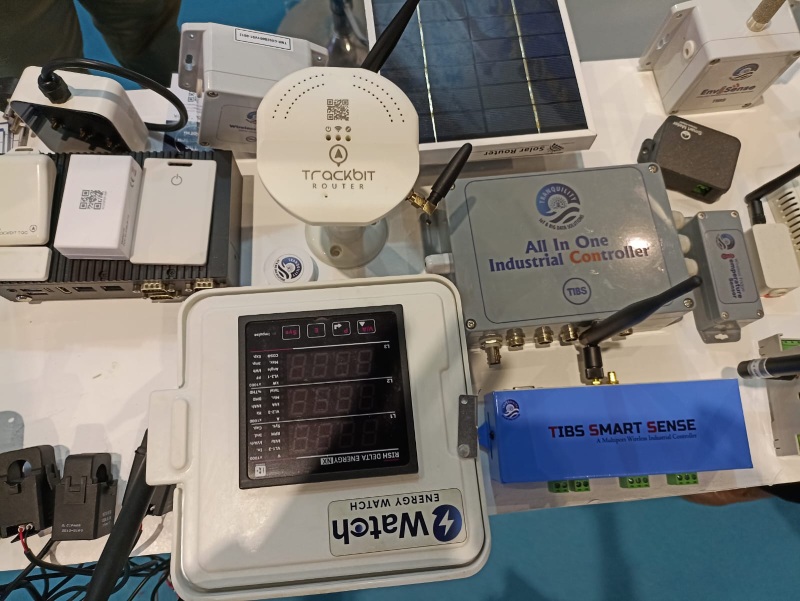


Tranquility IoT and Big Data Solutions (TIBS Global) operates as a full-stack technology provider focused on integrated Internet of Things (IoT) and big data analytics. The company designs, engineers, and deploys IoT-enabled devices, sensors, and middleware; consequently, it captures, streams, and processes both real-time and historical data across diverse industries. Moreover, its proprietary platforms, the Tranquility Bigdata Framework (TBDF) and Dynamic Dashboard (TD2), power advanced analytics, intuitive visualization, and predictive modelling through machine learning. As a result, TIBS enables high-impact applications such as smart homes, energy management, healthcare monitoring, asset tracking, and industrial automation. Ultimately, it delivers scalable, interoperable, and data-centric decision intelligence.
At the 33rd Convergence India Expo, The Interview World engaged in an exclusive conversation with Dr. Shiju Sathyadevan, Director of Tranquility IoT and Big Data Solutions. During the discussion, he outlined the company’s IoT products, clarified their core functionalities and real-world use cases, and detailed their commercialization trajectory. In addition, he provided insights into the company’s geographic footprint and articulated its technology roadmap for the next five years. Furthermore, he emphasized a forward-looking vision centered on innovation at the intersection of AI, robotics, and computer vision. The following are the key takeaways from this insightful exchange.
Q: Could you provide an overview of the IoT products you have developed, along with their core functionalities, target industries, and specific use cases that demonstrate how they address key operational or business challenges?
A: We adopt a user-friendly, plug-and-play architecture; therefore, integration remains seamless across use cases. For any sensor requirement, we enable rapid retrofitting onto existing machines and, in turn, allow continuous monitoring of critical machine vitals.
Moreover, we design highly customizable hardware. Because we develop everything in-house, we tailor each solution precisely to client requirements and execute modifications with speed and precision, this remains our core strength.
In addition, we deliver comprehensive energy monitoring solutions. These systems track consumption patterns, evaluate machine efficiency, and provide clear visibility into asset utilization. At the same time, we deploy environmental monitoring sensors to capture and analyse ambient conditions.
Finally, we implement robust indoor tracking solutions that enhance visibility and control within facilities. Collectively, these capabilities define our primary focus and value proposition.
Q: Have all these products been commercially deployed, and could you specify which industry sectors are currently adopting them along with examples of their real-world applications?
A: Yes, we have fully commercialized all these products; consequently, they deliver measurable value across real-world deployments. We serve manufacturers and, more broadly, any enterprise that operates machinery. In particular, organizations focused on energy efficiency, machine health, and operational continuity engage with us. They seek to monitor critical equipment vitals, anticipate potential failures, and, therefore, prevent unplanned breakdowns. Accordingly, these customers turn to us to strengthen reliability, optimize performance, and minimize downtime.
Q: Are your products currently limited to the Indian market, or have you expanded internationally through exports, and if so, which regions or markets are you serving?
A: Beyond India, we have expanded into the United Kingdom and, accordingly, established a local office to drive market penetration. We are actively introducing and scaling our product portfolio across the UK market. In parallel, we have secured a growing customer base in the Middle East, thereby strengthening our international footprint.
Q: What emerging technologies or innovation areas are you planning to invest in or develop over the next five years?
A: We are actively diversifying into robotics; therefore, we are expanding the scope of industrial automation beyond conventional machine-level optimization. Rather than limiting ourselves to process automation, we are integrating robotics to drive higher autonomy and operational precision.
At the same time, we have already established a strong foundation in AI, particularly in predictive maintenance. Our AI engine is fully operational and continuously analyses data to anticipate failures and optimize performance. Building on this capability, we are now incorporating vision-based solutions into our existing portfolio, thereby enhancing real-time perception and decision-making.
Consequently, robotics emerges as our next strategic focus, as we advance toward more intelligent, autonomous, and integrated industrial ecosystems.
Q: With Physical AI emerging as the next layer of innovation and reducing the need for human intervention, are you planning to develop or integrate robotics and AI-driven systems for the manufacturing sector, and if so, what specific applications or capabilities are you targeting?
A: Our primary objective is to simplify and enhance the working environment for industrial professionals, particularly in logistics and manufacturing. In the domain of product quality monitoring, organizations still rely heavily on human inspection; consequently, error tolerance remains high and inconsistencies persist.
Therefore, we are not replacing human vision but augmenting it. We are introducing an additional layer in which AI continuously monitors and validates visual inspections. In this hybrid model, AI complements human judgment and, in turn, captures anomalies that may otherwise go unnoticed. As a result, we significantly improve accuracy, consistency, and overall quality assurance.