
Taikisha Engineering India Pvt. Ltd. (TEI) was established in 1995 as a joint venture with Taikisha Ltd., Japan. It is a leading engineering company headquartered in Gurugram, India. The company delivers turnkey industrial solutions with a strong focus on precision and performance. It designs and executes advanced systems for automotive paint finishing plants, HVAC installations, clean-room environments, and electrical control panels. Moreover, it integrates automation, robotics, and Industry 4.0 technologies into core engineering applications. TEI serves key sectors such as automotive, railways, aerospace, and advanced manufacturing. In addition, it maintains end-to-end capabilities spanning in-house design, manufacturing, and commissioning. As a result, it consistently delivers global-standard projects across India and international markets. The company further anchors its operations in innovation, sustainability, and high-precision engineering for industrial infrastructure.
In an exclusive interaction with The Interview World at InnoMetro, H. N. Makwana, Vice President of Taikisha Engineering India Pvt. Ltd., discusses the company’s automation and robotics portfolio in detail. He explains the distinguishing features of its products and highlights the core technologies that power them. Furthermore, he outlines the integrated safety mechanisms embedded across solutions. He also examines the growing opportunities for automation in India’s automotive sector. Finally, he shares insights into Taikisha’s innovation roadmap and the next wave of developments the company envisions over the next five years. The following are the key takeaways from this conversation.
Q: Could you provide an overview of Taikisha’s automation and robotics products, and explain how they differentiate from competing solutions in the market?
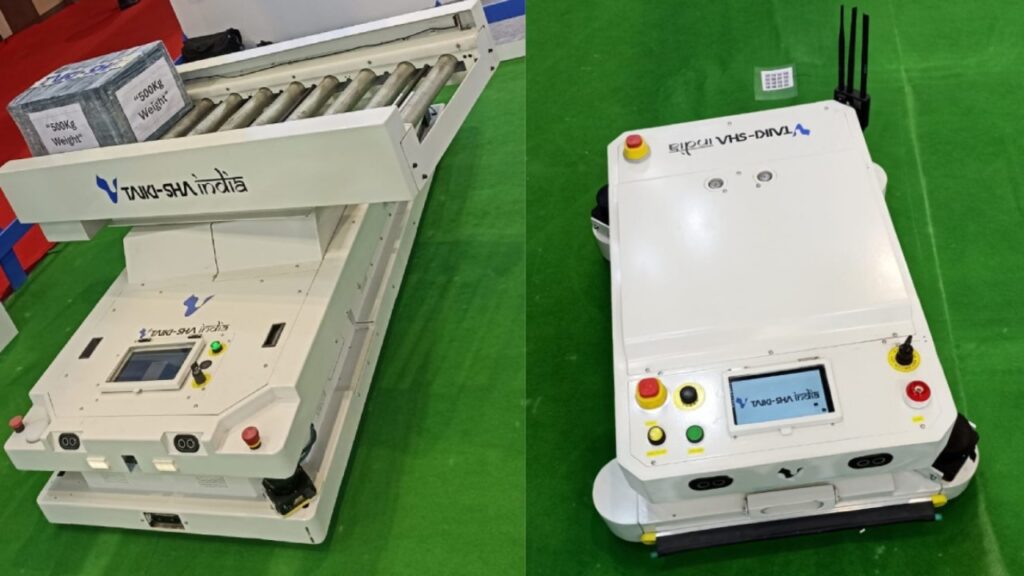
A: We operate as a Japanese joint venture company with five distinct verticals. Among the key solutions on display is our AGV and AMR portfolio. These autonomous mobile robots handle critical material movement tasks, including tugging operations as well as end-of-line and beginning-of-line manufacturing applications. Notably, we develop these automation systems entirely in India, which remains a significant differentiator for us.
In addition, we offer the UGS, or Universal AMR. This platform performs multiple functions within a single system. As a result, it stands apart in the market and holds a patent due to its unique integrated design. Typically, manufacturers deploy separate AMRs for lifting, turning, and material transfer. However, we have consolidated all these capabilities into one unified solution. This integration significantly enhances operational efficiency and flexibility.
In the showcase section, the system includes a roller bed, a turntable, and a lifter. Together, these components enable not only horizontal movement but also seamless feeding into production lines and efficient truck loading operations. Consequently, the solution supports end-to-end material handling across industrial workflows.
We design and develop these automation and robotics products fully in-house. Our dedicated engineering team conducts advanced simulations, develops the software stack, and manages manufacturing internally. Therefore, we deliver a highly integrated and reliable solution tailored for industries that demand advanced robotic automation.
Q: What are the underlying technological frameworks, architectures, and components that power these automation products?
A: The system is built on three core technologies. First, it uses a LiDAR-based camera system. This enables advanced vision capabilities and ensures accurate detection of obstacles in real time.
Second, it relies on a suite of critical mobility and navigation sensors. These sensors continuously monitor movement parameters and maintain precise control during operation.
Third, it runs on a Robot Operating System (ROS). This operating system coordinates all functions and enables intelligent navigation through technologies such as geospatial mapping and environment modelling. Together, these layers create a robust and adaptive automation framework.
Q: How safe are these robotic solutions when deployed across different industries?
A: The system integrates advanced sensors and vision technologies to create multiple layers of safety assurance. As a result, it incorporates comprehensive fail-safe mechanisms at every level of operation.
In practice, these redundancies significantly enhance reliability and control. Moreover, extensive testing has validated performance over prolonged operational cycles, spanning months of continuous evaluation. During this period, no critical safety issues have been observed.
Consequently, the system demonstrates a very high degree of operational safety, supported by rigorous validation and layered protection architecture.
Q: What opportunities do automation products present for the automotive sector in India?
A: We actively deliver a wide range of automation solutions to the automotive sector. In fact, we have already supplied our plants to major manufacturers such as Maruti, Honda, and Toyota. These deployments reflect our strong capability in building solutions tailored for high-volume automotive operations.
In addition, we have recently introduced our systems to Mahindra. We also serve CNH, a leading tractor manufacturing company. As a result, our footprint extends across both passenger vehicle and agricultural equipment segments.
Overall, we continue to support the automotive industry with scalable and industry-ready automation technologies.
Q: What new innovations in robotic automation are you planning to develop over the next five years?
A: Over the next five years, our roadmap focuses on deep integration of hardware and software through IoT. We are strengthening this convergence to build more intelligent and connected systems. This becomes essential as we expand into global competition and scale exports.
To support this direction, we have established a dedicated software team of 18 specialists. This team focuses exclusively on developing IoT-enabled solutions that enhance system intelligence, connectivity, and real-time control. As a result, IoT remains one of our core strategic priorities.
In parallel, we continue to advance our offerings across other segments, with a strong emphasis on the railway sector. We already provide solutions such as robotic painting systems and ASRS. However, we are now moving toward more complex automation challenges. For instance, we are developing a proof of concept for automated sanding and putty applications. These processes remain highly manual and labour-intensive in current railway operations. Therefore, they represent a critical area for next-generation automation, and we have positioned them as a key target for innovation.
Q: Are you leveraging AI to deliver operational insights to end customers?
A: As mentioned earlier, we maintain a dedicated in-house team focused on IoT and AI. This team actively works on artificial intelligence and machine learning applications.
We have already developed several solutions in this domain. However, development does not remain static. Instead, it follows a continuous improvement cycle.
As a result, we are steadily refining and maturing our AI capabilities to enhance performance, reliability, and real-world applicability.