


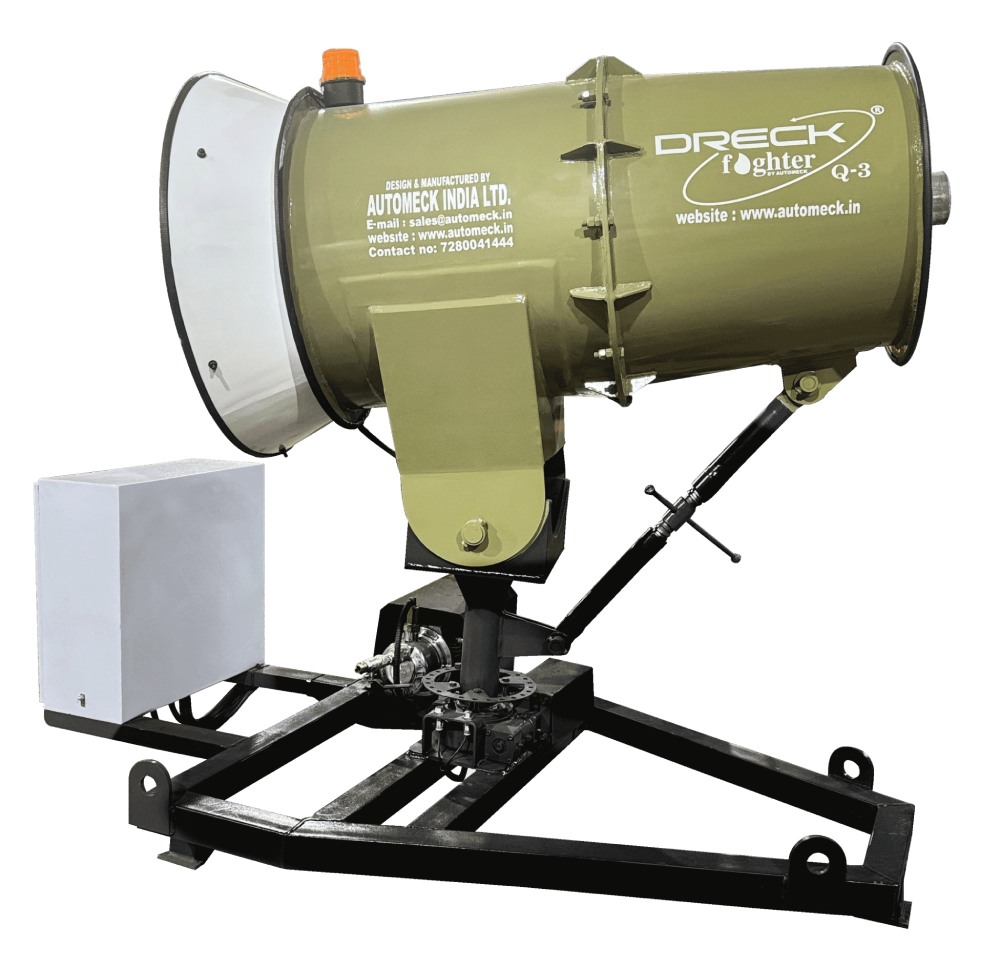
Automeck India Limited, headquartered in Jamshedpur, Jharkhand, has advanced sustainable pollution-control engineering since 2013. The company designs and manufactures high-performance industrial machinery that mitigates dust, emissions, and environmental risk across heavy industry, mining, and construction. It anchors its portfolio in proprietary technologies and holds multiple patents, reinforcing its innovation-led positioning. Most notably, its latest battery-operated mounted dust catcher exemplifies applied engineering excellence. The system suppresses ultra-fine particulate matter below 10 microns without relying on conventional spray nozzles or complex fixed infrastructure.
This dust catcher achieves high-efficiency airborne particle capture while minimizing water and power consumption. Moreover, its compact, mobile architecture enables rapid deployment across dynamic worksites. Consequently, the solution strengthens air-quality compliance, improves worker safety, and advances operational sustainability in demanding industrial environments.
In an exclusive interaction with The Interview World at Municipalika 2026, Dr. Rajesh Jha, Chief Marketing Officer, Automeck India Limited, articulates the strategic and technical dimensions of dust catcher. He explains its core features and differentiators, and evaluates its operational efficiency and battery endurance under real-world conditions. Furthermore, he assesses its commercialization trajectory and market reception. In addition, he outlines the company’s five-year innovation roadmap and forthcoming product launches. Finally, he details Automeck’s export strategy with a focus on high-growth emerging markets.
The following are the principal insights from that discussion.
Q: Could you provide detailed insights into the battery-operated mounted dust catcher, particularly its key features and unique differentiators in the market?
A: When we refer to a dust catcher, we are describing a technologically advanced evolution of the conventional anti-smog gun. Across Delhi NCR and other regions of the country, authorities deploy anti-smog guns to improve the Air Quality Index (AQI). However, despite widespread use, AQI levels often show limited improvement. The fundamental limitation lies in the technology itself.
Conventional anti-smog guns cannot effectively capture PM2.5 and PM10 particulate matter, the primary contributors to AQI deterioration. This constraint arises from droplet physics. Specifically, traditional smoke guns generate water droplets larger than 30–40 microns. Such droplet sizes lack the precision required to bind with fine particulates measuring 2.5 or 10 microns. Consequently, the system fails to neutralize the most hazardous airborne particles.
In contrast, our dust catcher represents a substantive technological advancement. First and foremost, it operates on a nozzle-free architecture. By eliminating the nozzle, the system achieves ultra-fine atomization. It can reduce water droplet size to approximately 1 micron. As a result, the droplets effectively interact with PM2.5 and PM10 particles. The system captures these fine particulates, increases their mass, and accelerates their gravitational settling. Therefore, it delivers measurable improvements in air quality rather than marginal impact.
Furthermore, we offer the dust catcher in multiple configurations to address diverse operational requirements. The portfolio includes electric-driven models, battery-operated units for enhanced mobility, and vehicle-mounted systems powered by onboard engines. Collectively, these variants ensure scalable deployment across urban infrastructure projects, industrial sites, and high-dust environments.
Q: Given that the dust catcher is battery-operated, could you provide details on its operational efficiency and battery durability under typical working conditions?
A: We supply fully battery-operated machines engineered for sustained field performance. A single battery delivers approximately eight to ten hours of continuous operation under standard working conditions. Moreover, we provide a dual-battery configuration. This allows one battery to power the system while the second charges simultaneously. As a result, operators can maintain uninterrupted deployment with minimal downtime.
In addition, the system operates with exceptional water efficiency. It consumes only 2 to 6 liters per minute, depending on the selected mode and application intensity. Consequently, even a compact water tank can support extended operating cycles. Together, optimized energy management and low water consumption ensure high operational endurance with reduced resource dependency.
Q: What is the current commercialization status of the product, and what traction has it achieved in the market so far?
A: We launched the dust catcher commercially two years ago. Since then, the market has responded decisively and positively. Demand has grown steadily across both municipal and industrial segments.
Most notably, we recently fulfilled a major order from the Municipal Corporation of Greater Mumbai, supplying 29 vehicle-mounted units. This deployment underscores institutional confidence in the system’s performance and reliability.
In parallel, we continue to expand our footprint across core industries. Sectors handling coal, limestone, and iron ore have integrated our equipment into their dust-suppression protocols. These environments generate high particulate loads; therefore, they require precision-controlled mitigation systems. Our technology addresses that requirement directly, which in turn drives repeat business and sustained industry adoption.
Q: What new innovations or product lines are you planning to develop or launch over the next five years?
A: Over the next five years, we will expand both the performance envelope and the functional versatility of our dust catcher portfolio. At present, we manufacture systems with 15-meter and 30-meter throw distances. However, we are finalizing the launch of a 50-meter throw variant within the next two to three months. This upgrade will significantly extend coverage for large industrial and infrastructure sites.
Subsequently, we aim to engineer and commercialize a 100-meter throw configuration. Achieving this milestone will position the dust catcher as a high-reach, large-area particulate mitigation solution capable of serving expansive mining zones and bulk material handling corridors.
In parallel, we are strengthening our multi-utility vehicle platform. Specifically, we are integrating a broader range of modular attachments. This approach will enable a single capital investment to deliver multiple operational capabilities. As a result, clients can optimize asset utilization, reduce equipment redundancy, and improve return on investment. Collectively, these initiatives define the next phase of our product development roadmap.
Q: Do you have an export strategy targeting emerging markets?
A: We have already established an international footprint. To date, we have exported our systems to multiple markets, including countries across Africa, Thailand, and Bahrain. In total, we currently serve four to five overseas destinations, reflecting growing global acceptance of our technology.
Building on this momentum, we plan to expand our export operations further. By the end of this year, we expect to reopen and strengthen additional international channels, thereby accelerating our global market penetration strategy.







1 Comment
Just wanna remark on few general things, The website style and design is perfect, the subject material is very great : D.
Comments are closed.