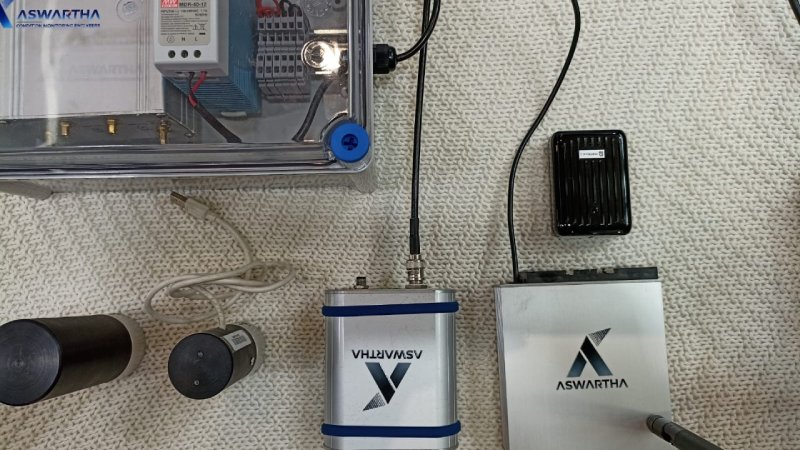

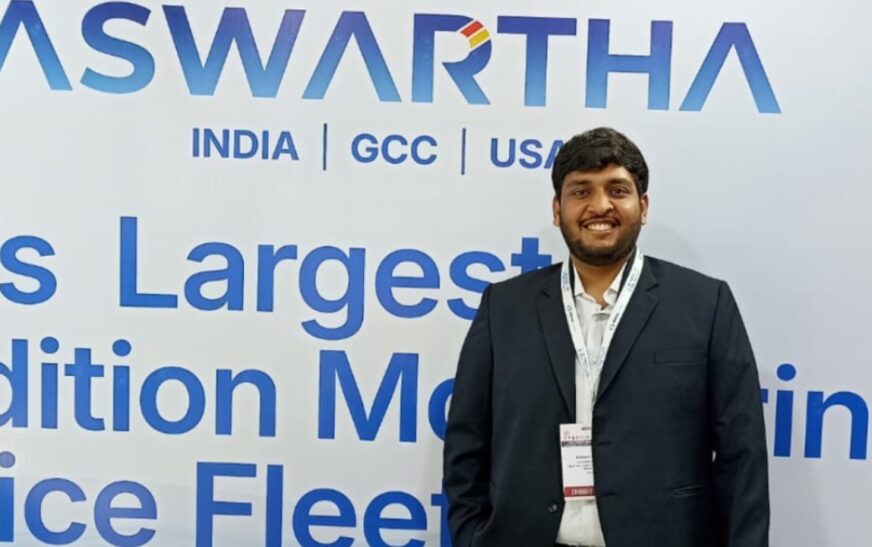
Aswartha Condition Monitoring Engineers (ACME) operates as a true force in predictive maintenance, an engineering ally for industries that simply cannot afford failure. Headquartered in Hyderabad, ACME rewrites the reliability playbook by delivering India’s first 24×7 contract-based condition-monitoring service, shifting plants from reactive repairs to proactive, precision-led upkeep.
With a team of more than 200 diagnostic engineers, ACME safeguards the performance of mission-critical rotating machinery, ranging from colossal 700 MW steam turbines to high-efficiency gas turbines. Its footprint spans power, petrochemicals, steel, cement, sugar, and other sectors where uptime defines competitiveness.
To deliver this edge, ACME deploys a comprehensive suite of capabilities: vibration analysis, dynamic in-situ balancing, laser alignment, NDT, thermography, oil diagnostics, turbo-machinery expertise, and advanced FEA/CFD simulation. The mission is ambitious yet clear: engineer a future where breakdowns cease to exist.
Consequently, ACME doesn’t merely keep plants running, it ensures they run smarter, longer, and more profitably.
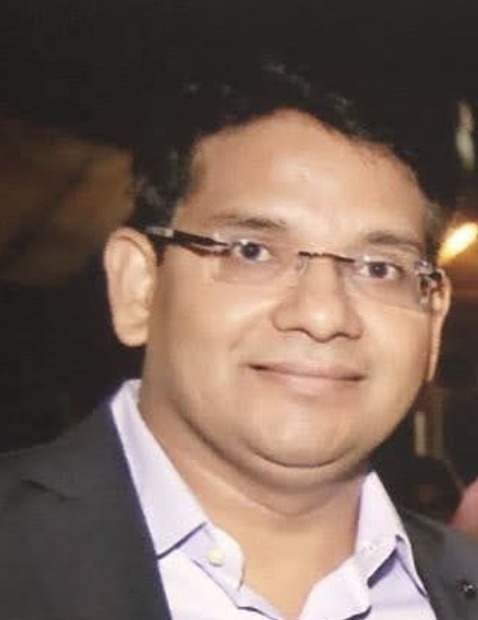
During an exclusive conversation with The Interview World at Paperex 2025, Rakshit Raju, Managing Partner at ACME, detailed the company’s specialized support for the paper industry. He also unpacked the technologies powering its predictive-maintenance ecosystem, offered perspectives on global demand beyond India, clarified the balance between domestic and export markets, outlined plans for expanding into new international regions, and revealed the next wave of innovations he intends to build over the next five to ten years.
The following insights capture the essence of his compelling discussion.
Q: Could you outline the services ACME offers to the paper industry and explain how your value proposition differs from that of other providers?
A: To begin with, we specialize in condition monitoring. In simple terms, if doctors safeguard human health, we safeguard the health of industrial machines. In paper plants, for example, we monitor every critical rotating component: reelers, dryer felt rolls, dryer cylinders, the press section, the wire section, and even motors, pumps, fans, and turbines.
Across all this equipment, we diagnose the precise condition of each machine. With that insight, we can clearly understand what’s happening inside the equipment and then give customers accurate, actionable recommendations on its health.
Importantly, we are the only company that has operated in this space for the past 25 years. Over this period, we have saved our clients nearly $350 billion, a number that reflects the precision of our work. Our results are consistently accurate, we pinpoint defects with exceptional clarity, and we tell customers exactly what’s going wrong and where.
Q: What core technologies power your predictive maintenance capabilities, and how do they function in practice?
A: Earlier, condition monitoring relied on a field technician who manually collected data and submitted it as a static report. That approach worked, but it was slow, limited, and reactive.
Today, the process looks entirely different. We deploy IoT sensors that continuously capture data from machines and transmit it to the cloud. There, real-time dashboards, accessible to our customers, display exactly what their equipment is doing. This shift enables true 24×7 monitoring. As a result, even the slightest deviation is detected instantly and communicated without delay.
The logic mirrors human health. When we develop a fever, our body signals it through aches and rising temperature. Machines behave the same way; they exhibit early symptoms long before a failure occurs.
Our core strength lies in capturing these defects at the earliest possible stage, often at just 0.5% severity. We track the anomaly, analyse its progression, and work to mitigate it before it grows. That early detection is the real advantage, one that transforms maintenance from reactive firefighting into proactive protection.
Q: Given your multi-geographic operations, how do you assess the demand for your solutions outside India?
A: India itself is an enormous market, and we already serve a substantial customer base here. Yet the global opportunity is even larger. As a company founded in Hyderabad, we take pride in advancing the Prime Minister’s Make in India vision that has gained strong recognition. Our goal is to carry that capability confidently to the world.
In many international markets, condition monitoring is still unfamiliar. Industries often wait for machines to fail before taking action. This gap creates far greater scope for our solutions abroad than even in India.
That is why our presence in the Middle East has grown rapidly, we now serve nearly 750 clients in the region. In the United States, we currently support about 40 clients, and we are actively expanding that footprint.
Q: How do you view the contribution of domestic sales and exports to your overall revenue?
A: Today, domestic sales account for nearly 80% of our business, while exports contribute the remaining 20%. We began expanding internationally in 2019, and since then, we’ve invested heavily in market research to enter new regions and build a solid client base.
However, acquiring customers abroad is more challenging. Regional dynamics, entrenched local players, and regulatory nuances create real barriers. Even so, we are steadily pushing through those obstacles, and we remain committed to breaking into these markets with persistence and precision.
Q: Do you have plans to broaden your portfolio into new international geographies in the near future?
A: Our immediate focus remains India, the Middle East, and the United States. Once we strengthen our presence in these regions, we will expand into additional global markets.
Our approach is simple yet strategic: we identify geographies where advanced technology is lacking, study the specific pain points industries face, and then design solutions that directly address those challenges. By understanding the problem at its root, we position ourselves to deliver real, measurable impact.
Take the paper industry as an example. If a paper machine stops even for a single minute, the loss runs into crores of rupees. That kind of downtime is unacceptable, and entirely avoidable. When ACME is involved, such stoppages don’t occur.
Our mission is clear and unwavering: a zero-breakdown world. And everything we do pushes industries closer to that goal.
Q: How do you plan to develop the next layers of innovation on top of your existing solutions over the next 5 to 10 years?
A: In today’s world, technology drives everything, and staying ahead demands constant adaptation. Until now, AI has barely touched our field. We intend to change that. Backed by a strong R&D team, we consistently experiment, innovate, and push the boundaries of what’s possible.
We pursue every new advancement that can elevate our solutions and strengthen our predictive capabilities. Ultimately, customer needs, and customer satisfaction, fuel our momentum. To deliver on that promise, we do whatever it takes, without compromise.