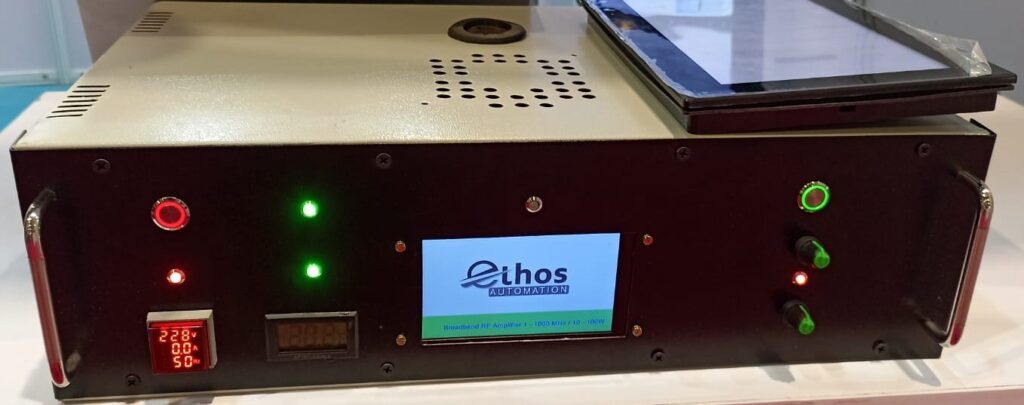


Ethos Automation Pvt. Ltd. is a technology company that engineers advanced electronics and software solutions. It delivers end-to-end capabilities, spanning product ideation, design, development, deployment, and lifecycle maintenance. Moreover, it serves critical sectors such as industrial automation, automotive systems, and defence applications. Within this domain, the company develops RF-based counter-drone systems and next-generation electronic warfare solutions. Its RF power amplifiers and jamming platforms actively disrupt unmanned aerial systems by targeting communication, navigation, and control links. Consequently, they reduce drone operational effectiveness across contested environments.
At the 33rd Convergence India Expo, Ashwani Mathur, Founder & Director of Ethos Automation Pvt. Ltd., spoke exclusively with The Interview World. He explained the operational dynamics of RF jammer technology, emphasizing key parameters such as frequency range, transmit power, environmental conditions, terrain variability, and line-of-sight constraints that collectively determine range and reliability. In addition, he highlighted AI-enabled detection systems that identify and classify drone signatures with greater speed and precision, even in complex operational scenarios. Finally, he outlined the company’s expansion roadmap and its focus on next-generation innovation, offering clear insight into its evolving technological trajectory.
Q: Could you provide an overview of the RF jammer technology developed by Ethos Automation, including its key capabilities and applications in defence and other strategic sectors?
A: We develop advanced technologies in weapon systems, industrial automation, and RF engineering. Our core product is a high-performance RF power amplifier designed for anti-drone jammer applications.
Modern warfare is rapidly evolving. Conventional assets such as guns and tanks are no longer sufficient against the growing threat of unmanned aerial systems. Therefore, effective counter-drone capability has become essential for protecting operational security and national sovereignty.
Our system functions as an RF jammer that emits precisely tuned frequencies to disrupt hostile drone communications. When a target drone operates on a specific frequency band, the system transmits a counter-signal on the same band, creating deliberate interference. As a result, the drone loses access to critical inputs such as GPS navigation and command-control links. Once disconnected, it becomes inoperable and unable to execute its mission.
After neutralization, operators can apply kinetic measures if required to physically disable or recover the drone.
In addition, the system supports anti-spoofing operations, strengthening resilience against deceptive navigation and signal manipulation tactics. It can also assist in controlled neutralization and safe descent of hostile drones.
These capabilities are intended exclusively for defence, paramilitary forces, and law enforcement agencies. Civilian use is not permitted, and deployment is subject to strict licensing and regulatory controls.
The platform is fully developed, commercially available, and validated through testing for operational reliability and field performance.
Q: What is the effective operational range of an RF jammer, and what technical and environmental factors influence its performance and coverage distance?
A: Range is not a single fixed parameter; it depends on multiple operational factors. First, frequency capability and transmitted power define the system’s baseline performance. The platform can generate and operate across a wide frequency spectrum, extending up to 1000 GHz, with configurable tuning across bands. In addition, development is underway for systems reaching 6000 GHz to address emerging operational requirements.
Equally important is power output, which directly determines the strength of interference. Together, frequency range and power level define the effective jamming envelope.
At peak output levels of around 100 watts, the system can achieve an effective operational range of approximately 500 meters to 1 kilometer under optimal conditions. However, real-world performance varies. Atmospheric conditions, line of sight, terrain profile, and target exposure all play a critical role. For instance, if a drone operates behind buildings, vegetation, or other obstructions, the effective range reduces significantly.
Ultimately, performance is context-dependent. Frequency selection and power control jointly determine the level and reliability of interference achievable in a given operational environment.
Q: Are these products currently being marketed and sold within the domestic market, or are they also being exported to international customers?
A: At present, we supply our products exclusively to the Government of India for domestic deployment. However, we are prepared to expand into international markets as opportunities emerge and regulatory pathways permit.
Q: What future innovations or enhancements are planned to build upon the current technology platform?
A: We design and develop the entire system in-house, including both electronics and software. As global technology shifts toward artificial intelligence, we are integrating AI directly into our platform to enhance its capabilities.
The system will automatically identify the RF signature of incoming rogue drones. It analyses signal patterns in real time and distinguishes them from thousands of known signatures. Once identified, it classifies the drone type and determines the operating frequency band with precision.
We are building this capability as an AI-driven detection and classification layer. It significantly improves situational awareness and enables faster, more accurate response in complex operational environments.
Q: Can the system detect and counter multiple drones operating simultaneously within a coordinated or swarm-based environment?
A: Operational effectiveness within a given range depends significantly on antenna configuration. In particular, antenna design plays a critical role in determining coverage and signal distribution.
An omnidirectional antenna, especially when implemented with circular polarization, provides uniform signal dispersion across all directions. This allows the system to maintain consistent coverage within its operational footprint.
In practical terms, such a configuration can neutralize hostile drones within an approximate 500-meter radius, subject to environmental and terrain conditions.