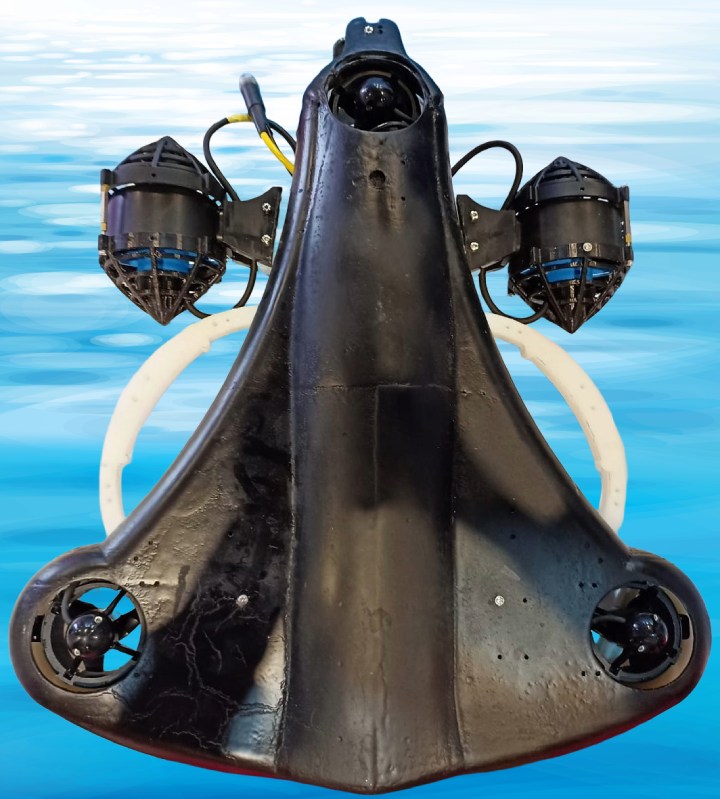


Heuronics operates at the frontier of deep-tech robotics, engineering advanced underwater drones purpose-built for demanding maritime environments. The company designs and develops modular Remotely Operated Vehicles (ROVs) and Autonomous Underwater Vehicles (AUVs) that deliver extended endurance, high-precision navigation, and robust autonomous functionality. Moreover, by integrating sophisticated sensor fusion and adaptable payload architectures, Heuronics addresses complex underwater challenges across offshore energy, scientific research, aquaculture, infrastructure inspection, and defence.
At its core, Heuronics prioritizes indigenous innovation. Consequently, it delivers cost-efficient, high-performance robotic systems tailored to harsh ocean conditions. In doing so, the company enhances operational efficiency while simultaneously reducing dependence on costly foreign technologies.
In an exclusive interaction with The Interview World at the 33rd Convergence India Expo, Dhruv Upreti, Founder and CTO of Heuronics, provides a comprehensive overview of the company’s underwater drone capabilities. He also outlines the commercialization roadmap and details the next wave of innovations planned over the coming five years. Furthermore, he underscores the significant market opportunities emerging for underwater robotics in both Indian and global markets. The following are the key insights from this in-depth conversation.
Q: Could you elaborate on the key features and real-world applications of Heuronics’ underwater drones?
A: We are developing two distinct categories of underwater drones, each engineered for a specific operational purpose. First, we design systems for inspection. Second, we build platforms capable of executing heavy-duty underwater operations with substantial payload requirements.
Accordingly, our portfolio includes two Remotely Operated Vehicles (ROVs): the UROV-S1 and the UROV-MH1. The UROV-S1 is compact and highly portable. It weighs approximately 7 kilograms and fits within a standard suitcase. As a result, a single operator can easily deploy it to perform visual and sonar-based inspections across diverse environments, whether in dams, vessels, shipyards, or other underwater settings.
In contrast, the UROV-MH1 addresses more demanding operational needs. It supports the integration of heavy manipulators, including underwater robotic arms and grippers. Therefore, operators can configure it for complex intervention tasks that require strength, precision, and adaptability in challenging subsea conditions.
Q: What is the maximum payload capacity of the heavier drone?
A: The heavier vehicle carries an underwater payload of up to 10 kilograms. In contrast, the smaller UROV-S1 supports an underwater payload capacity of up to 1 kilogram. Thus, each platform aligns precisely with its intended operational scale and task complexity.
Q: Have these drones been deployed in real-world operations?
A: At present, we are executing a project in a river system in collaboration with Delhi Technological University, which serves as our first client. Consequently, this engagement marks an important milestone in validating our technology in real-world conditions.
Q: What is your commercialization strategy?
A: We aim to commercialize the smaller vehicle by supplying it to organizations that currently rely on manual inspection of dams, bridges, and ports. By adopting our platform, these operators can replace labour-intensive methods with efficient, technology-driven inspections.
In addition, we will provide comprehensive backend support services. For instance, when clients conduct visual inspections and require advanced analytics, they can seamlessly engage with us. We will then deliver precise, data-driven insights to enhance decision-making and operational outcomes.
Q: What key innovations or next-generation capabilities are you planning to develop over the next five years?
A: We will deliver a comprehensive, end-to-end software stack for all underwater operations. Specifically, we will extend our proprietary dashboard with modular add-ons tailored to each client’s requirements. Consequently, clients can access precisely the functionality they need without complexity.
Moreover, we will manage the entire integration layer. As a result, clients can deploy and use these capabilities seamlessly, without requiring specialized technical expertise on their end.
Q: Are these underwater drones integrated with AI, and if so, what functions does AI enable?
A: We have developed proprietary vision algorithms that significantly enhance image clarity and upscale video quality. In addition, we have trained multiple machine learning models to detect structural anomalies such as cracks. Furthermore, these models enable predictive analysis, allowing us to forecast how such defects are likely to evolve over time.
Q: What market opportunities do you see for underwater drones across India and global markets?
A: India commands an extensive coastline of approximately 11,000 kilometers. Consequently, this vast maritime boundary creates a strong foundation for market expansion. In addition, the country’s dense network of rivers and lakes further amplifies the opportunity. Taken together, this expansive water geography positions the market for significant growth and sustained demand.