
Founded in 1917, The Indian Institute of Architects (IIA) serves as India’s premier national professional body for architects. It drives the advancement of architectural practice and education with clarity of purpose and institutional authority. The Institute unites practising architects across the country to elevate the aesthetic, scientific, and functional standards of the profession. Through its expansive membership base and an extensive network of chapters and centres, IIA convenes conferences, publishes scholarly and professional resources, and leads strategic outreach initiatives that strengthen professional excellence and deepen public engagement. Moreover, it represents Indian architecture on national and global platforms through its affiliations with organisations such as the International Union of Architects (UIA) and the Architects Regional Council Asia (ARCASIA).
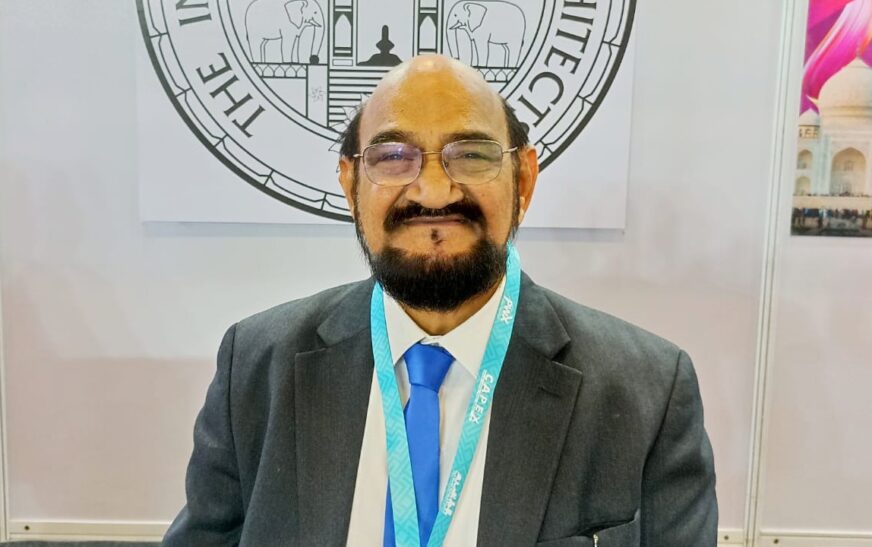
In an exclusive interaction with The Interview World at Municipalika 2026, Ar. Vilas Avachat, President of IIA, articulates a forward-looking vision for the profession. He explains how the Institute equips its members to integrate emerging technologies, including artificial intelligence, into contemporary architectural practice. He details the strategic initiatives recently launched under IIA’s leadership. He calls for urgent curriculum reforms in architecture schools to align academic frameworks with evolving industry and technological imperatives. Finally, he offers pragmatic counsel to aspiring architects, urging them to build resilient, future-ready, and purpose-driven careers. The following are the key insights from this substantive and thought-provoking conversation.
Q: How does the Indian Institute of Architects empower members to integrate emerging technologies, particularly AI, into contemporary architectural practice?
A: Technological progress is not optional; it is inevitable. Every transformative innovation initially triggers uncertainty, and artificial intelligence is no exception. When AI first entered mainstream discourse, many questioned its implications for architecture. However, such apprehensions accompany every paradigm shift. Therefore, instead of resisting change, we must recognise that AI-driven transformation is already underway and will continue to reshape the profession. We should approach it with strategic intent, adopt a constructive mindset, and evaluate how it can enhance architectural practice. That perspective is essential.
Undoubtedly, AI will define the competitive landscape of tomorrow. In fact, it already shapes our present. It operates in our smartphones, digital platforms, design tools, and analytical systems. Consequently, architects must leverage these technologies rather than remain passive observers. AI has the capacity to amplify design intelligence, accelerate workflows, and expand creative exploration.
Traditionally, architects developed concepts through sketches and presented a limited number of design options to clients. Now, AI enables us to generate, visualise, and refine hundreds of design iterations in a fraction of the time. We can tailor solutions precisely to client expectations while maintaining technical rigor and aesthetic coherence. This capability exemplifies the power of contemporary technology.
We live in an era defined by rapid, continuous evolution. Therefore, architects must think adaptively, act decisively, and integrate emerging tools into their professional framework. Embracing AI is not merely a technological choice; it is a strategic imperative for remaining relevant, competitive, and innovative in modern architectural practice.
Q: As a leading architectural institution, what recent skill development programs and new initiatives has the Indian Institute of Architects launched?
A: IIA actively drives professional advancement through structured and sustained initiatives. It curates specialised programmes, expert lectures, and high-impact presentations delivered by leading practitioners and thought leaders from across the world. By bringing global expertise directly to its members, and, more broadly, to the architectural fraternity, it ensures continuous exposure to emerging knowledge, best practices, and technological advancements. As a result, members consistently strengthen their competencies and expand their professional horizons.
Moreover, the Institute’s scale reinforces its impact. IIA represents a robust community of over 30,000 members across India. It operates through 24 state-level chapters, 65 centres, and 58 sub-centres, creating a deeply embedded and well-distributed professional network. This structured framework enables the Institute to decentralise learning, foster regional engagement, and deliver capacity-building initiatives at scale. Consequently, IIA sustains a dynamic ecosystem that advances skill development and professional excellence nationwide.
Q: What curriculum reforms should architecture colleges and universities introduce to align architectural education with evolving industry and technological demands?
A: Architecture institutions must systematically integrate emerging technological competencies into their curricula. They must not treat artificial intelligence as a passing trend; rather, they must position it as a core professional skill. AI is not merely a tool; it is a capability. Its value depends entirely on how architects develop, interpret, and apply it within practice. Therefore, institutions must train students to use AI strategically, ethically, and creatively within the architectural domain.
Accordingly, we actively encourage students to deepen their technological fluency. Today’s learners operate in a fundamentally different environment from previous generations. Digital access is ubiquitous. Information is instantly retrievable. Analytical tools are widely available. As a result, every student now functions with a high degree of technical literacy. Unlike earlier eras, when manual drafting dominated workflows, the contemporary student works seamlessly with AI platforms, CAD systems, and computational design environments. This generational shift reflects both talent and adaptability.
In parallel, the Institute has taken concrete steps to democratise access to professional tools. We introduced IIA CAD to reduce dependence on high-cost proprietary platforms such as AutoCAD. By doing so, we disrupted cost barriers and expanded accessibility within the fraternity. IIA CAD offers a significantly more affordable solution and operates on a perpetual licensing model rather than recurring financial commitments. Consequently, we empower architects to adopt professional-grade digital tools without undue economic burden. Through these measures, we strengthen both technological independence and long-term professional sustainability within the architectural community.
Q: What guidance would you offer aspiring architects in India to build resilient, future-ready, and impactful professional careers?
A: The architectural fraternity, particularly the younger generation, must not fear technology. Instead, it must engage with it decisively and intelligently. Technology defines the trajectory of tomorrow’s practice. Therefore, every architect, regardless of experience level, must cultivate technological competence as a core professional capability.
The future of architecture is inseparable from the future of technology. As digital systems, automation, data analytics, and artificial intelligence reshape industries worldwide, architecture cannot remain peripheral to this transformation. On the contrary, it must integrate these tools to enhance precision, efficiency, sustainability, and creative expression.
Accordingly, young architects must invest in developing advanced technical skills and embed them into their design methodologies. They should approach technology not as a disruption but as an enabler. By leveraging it strategically, they can expand their creative bandwidth, improve project delivery, and remain globally competitive. Confidence, adaptability, and continuous learning will define professional relevance in the years ahead.