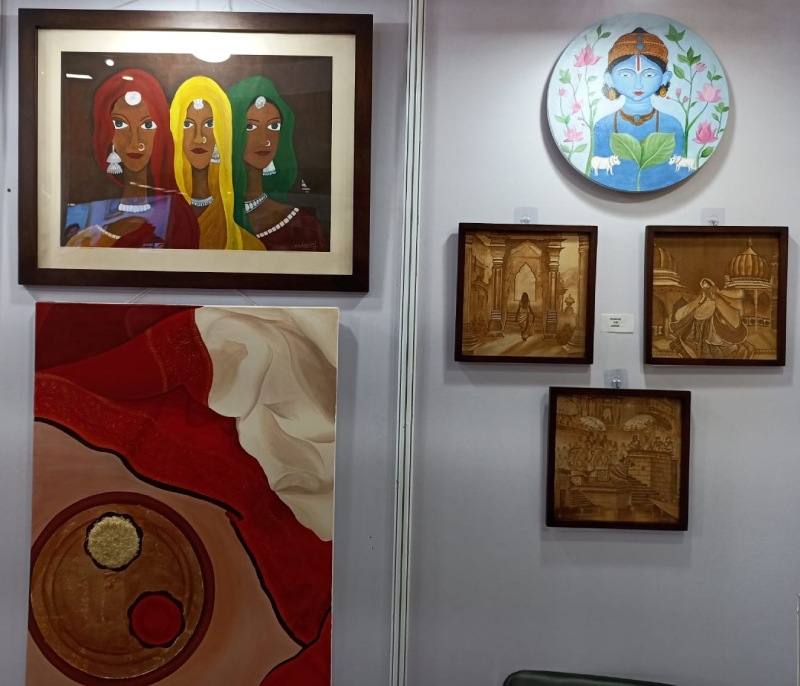

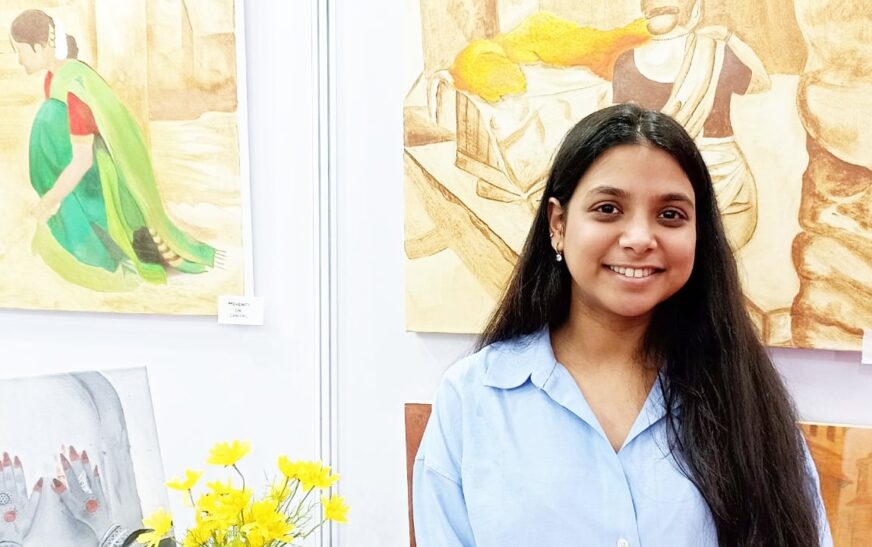
Medhavini Bansal emerges as a compelling voice in contemporary Indian art, commanding attention through visually arresting and conceptually layered work. She fuses aesthetic precision with lifestyle-inflected visual narratives; consequently, her practice aligns with, and actively advances, current trajectories in visual storytelling. Rooted in Indian heritage, she interweaves tradition, emotion, and narrative into a cohesive pictorial language. At the same time, she foregrounds the lived realities of Indian women, placing them decisively at the center of her artistic inquiry.
Moreover, she deploys a distinctive material vocabulary, most notably henna and acrylic, to articulate the quotidian struggles embedded in daily routines of women. Through this synthesis of medium and message, she transforms the canvas into a site of both cultural memory and social reflection.
In an exclusive interaction with The Interview World at The Haat of Art, Bansal delineates the formal frameworks and thematic concerns underpinning her showcase. She further assesses the reception of her work among art patrons and collectors, offering critical insight into audience engagement. In addition, she addresses emerging artists with a considered message on practice and perseverance. Finally, she articulates her forward trajectory, outlining a clear and ambitious vision for the evolution of her artistic practice.
Q: Could you elaborate on the art forms and thematic focus of your showcase?
A: I studied in London; consequently, living in a different cultural context compelled me to foreground my Indian heritage with greater intentionality. In that environment, I found myself increasingly drawn to the lived realities of Indian women, particularly their constant negotiation between professional responsibilities and domestic expectations. This tension, both complex and nuanced, became the conceptual foundation of my work.
Accordingly, my practice explores the intersection of tradition and modernity. I articulate this dialogue through compositions that juxtapose inherited cultural forms with contemporary lived experience. These works, therefore, operate within that thematic framework.
In addition, a portion of the collection comprises academic studies, sketches and exploratory exercises developed during my college years, which reflect my technical grounding and process.
Ultimately, my primary source of inspiration remains Indian women. Through my work, I aim to project the depth, resilience, and cultural richness of Indian identity onto a global stage.
Q: How long have you been working in art?
A: I have painted since childhood; however, I deepened my engagement with the practice during the lockdown. During that period, I imposed a disciplined routine and committed to completing one painting each day. Consequently, this sustained, daily immersion significantly sharpened both my technique and conceptual focus.
Q: What kind of reception have you received from art lovers and collectors at the exhibition?
A: This is my first exhibition; notably, audiences have responded far more strongly to my recent thematic explorations than to my earlier work. As a result, I intend to consolidate and further develop this direction.
At the same time, I will continue to employ henna as a primary medium. Its material distinctiveness not only differentiates my practice but also resonates meaningfully with viewers. Consequently, I aim to refine and expand this approach as a defining element of my work.
Q: Based on your experience, what insights would you like to share with other artists?
A: I would emphasise one principle above all: follow your passion. From childhood, I knew with clarity that I wanted to paint; consequently, I pursued that conviction with focus and intent. Today, I derive deep fulfilment from that choice. Therefore, I believe others, too, can experience a comparable sense of purpose and satisfaction, provided they commit to what they genuinely care about.
Q: What are your upcoming plans, and where do you see yourself evolving in the field of art?
A: I intend to participate in many more exhibitions; however, I increasingly seek long-duration platforms rather than short-term showcases. Such contexts will allow my work to engage audiences over time and generate more sustained, meaningful responses. Through this extended exposure, I aim to understand audience interests with greater precision.
At the same time, I want viewers to engage closely with my practice and grasp the messages I articulate through my work. Ultimately, I seek to create conditions in which my artistic intent can be experienced, interpreted, and critically received over an extended horizon.