


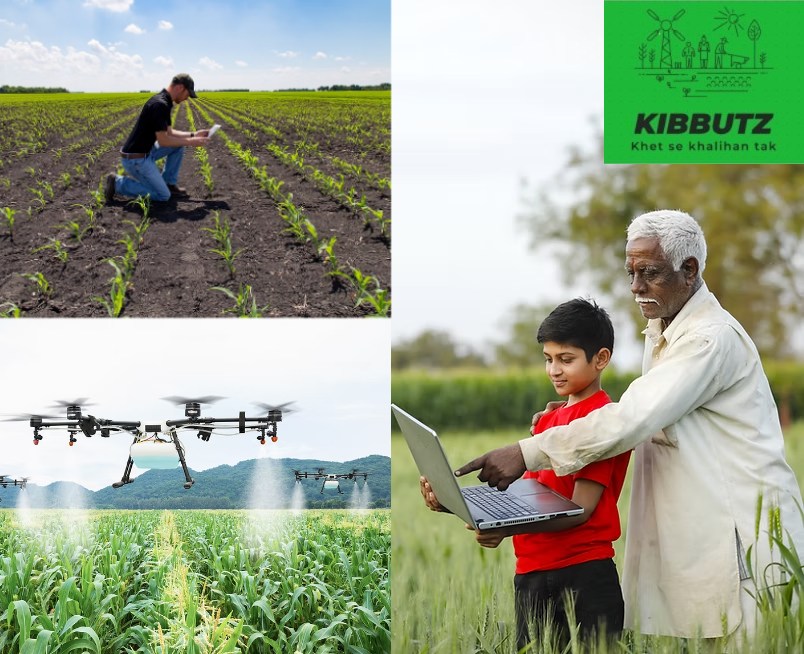
Kibbutz represents a groundbreaking agricultural innovation that harnesses satellite technology to transform the way farming is done. By delivering real-time data and actionable insights, Kibbutz empowers farmers to make smarter decisions, optimize resource use, and enhance productivity with sustainability at its core. Through advanced analytics and precision farming tools, it enables higher crop yields, minimizes environmental impact, and propels agriculture into a more efficient, data-driven future.
In an exclusive interaction with The Interview World, Manish Sharma, Founder and CEO of Bluwage & Kibbutz, reveals the inspiration behind his venture to tackle farming challenges through the integration of satellite imagery, drone technology, artificial intelligence, and the Internet of Things (IoT). He explains how he balances technological sophistication with affordability for India’s small and marginal farmers, outlines key metrics for assessing environmental impact, differentiates his company’s approach from competitors, and shares his strategic roadmap for growth.
Below are the most compelling insights from this thought-provoking conversation.
Q: What inspired you to start Kibbutz, particularly combining satellite imagery, UAV/drone tech, AI, IoT and soil testing? What big problem in agriculture are you most passionate about solving with this combination?
A: The inspiration for Kibbutz arose from observing the deep information gap that small and mid-sized farmers face when managing soil health, crop stress, and resource efficiency. Existing solutions often deliver fragmented or incomplete insights, leaving farmers without a clear path forward. Kibbutz bridges this divide by unifying satellite imagery, UAVs, AI, IoT-based soil sensors, and advanced analytics into a single, integrated decision-support platform. This seamless system empowers farmers to make timely, data-driven, and sustainable decisions. At its core, Kibbutz embodies a powerful vision—to democratize precision farming and bring the combined strength of space technology and digital intelligence to the very roots of Indian agriculture.
Q: Kibbutz offers a range of services (soil health monitoring, satellite imagery, UAV services, automated irrigation, etc.). How do you decide which products to build in-house vs partnerships vs off-the-shelf?
A: We operate on a hybrid innovation model that balances in-house expertise with strategic collaboration. At the core, we develop our proprietary soil sensor probes, AI-driven agronomic algorithms, and cloud-based analytics internally, safeguarding intellectual property while maintaining uncompromising quality. At the same time, we partner with trusted technology providers to design and integrate non-core modules such as drone fleet management systems and hardware components. This blended approach accelerates scalability, enhances interoperability, and enables rapid deployment, all while preserving the depth, precision, and originality of our innovation.
Q: How do you balance cutting-edge technology with affordability for smaller farmers in India? Are there financing, subsidies, or pay-as-you-use models?
A: Affordability lies at the core of Kibbutz’s design philosophy. We operate on a “Precision-as-a-Service” (PaaS) model that allows farmers and Farmer Producer Organizations (FPOs) to access real-time insights through flexible subscription or pay-per-acre plans. For capital-intensive implementations, we partner with financial institutions, agri-credit initiatives, and CSR-backed sustainability funds to offer subsidized or deferred payment options. Through this inclusive approach, even marginal farmers can harness advanced precision technologies without the weight of heavy upfront costs, ensuring innovation reaches every acre, not just the privileged few.
Q: Since your mission seems to also touch sustainability (soil health, precision farming, etc.), how do you measure environmental impact (e.g. reductions in water usage, chemical inputs, soil degradation)? Any concrete metrics or case studies?
A: We evaluate our impact using clear, data-backed sustainability metrics. Optimized irrigation has delivered up to a 30% reduction in water usage, while AI-driven nutrient mapping has cut fertilizer consumption by 25–35%. In parallel, we have observed measurable improvements in soil organic carbon levels and microbial balance, strengthening long-term soil health.
Our pilot project in Maharashtra demonstrated the tangible power of this approach, achieving a 28% increase in crop yield alongside significant reductions in input costs and water consumption. These results affirm that sustainable farming can drive both environmental resilience and economic growth in equal measure.
Q: The agritech space is growing rapidly. What sets Kibbutz apart from other companies offering precision agriculture, satellite/GIS services, or drone-based crop/soil monitoring?
A: Unlike most agritech players that focus on a single technology layer, such as drones or GIS, Kibbutz stands apart by seamlessly integrating multi-modal data from satellites, UAVs, IoT sensors, and AI analytics into a single, unified intelligence platform. Our indigenously designed IoT soil probes are tailored to regional soil profiles and synchronize effortlessly with live satellite feeds, delivering unparalleled accuracy and data granularity. Moreover, our interoperable ecosystem, combined with sustainability-linked credit support, reinforces Kibbutz’s unique position, bridging innovation, accessibility, and environmental responsibility in one cohesive solution.
Q: What is your growth plan geographically & product-wise? Do you aim to expand beyond India, or into different types of crops/agricultural regions?
A: In the near term, Kibbutz aims to scale its footprint across Maharashtra, Punjab, Karnataka, and North-East India by partnering with FPOs, Krishi Vigyan Kendras, and leading agri-enterprises. These collaborations will strengthen regional adoption and deepen farmer engagement.
Looking ahead, our medium-term vision is to expand into South-East Asia and Sub-Saharan Africa, regions that face similar smallholder farming challenges and stand to gain immensely from precision agriculture.
On the product front, we plan to advance our AI-driven agronomy stack, enhance UAV imaging capabilities, and develop robust cloud-based agrifintech tools, creating an integrated ecosystem that supports diverse crop systems and drives the next wave of global agricultural transformation.







1 Comment
This gave me a whole new perspective on something I thought I already understood. Great explanation and flow!
Comments are closed.