
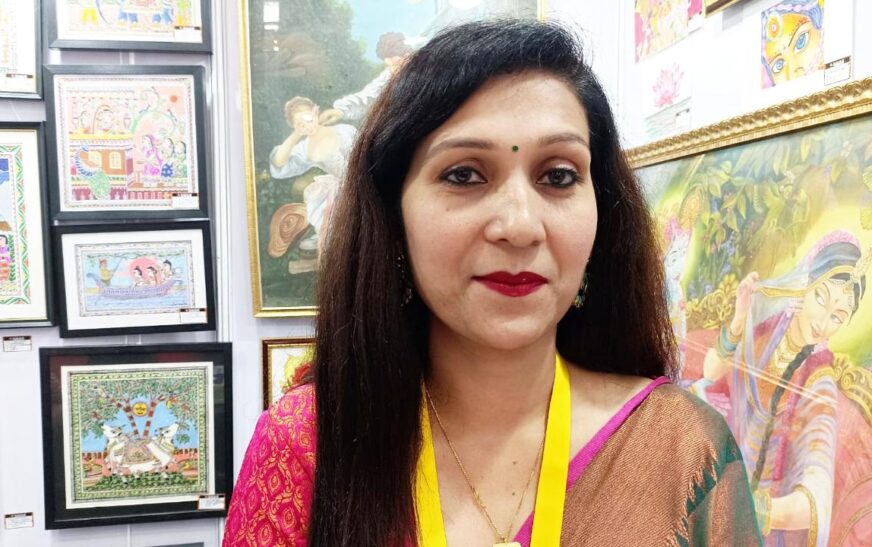
Bhumika Singh Rathour constructs a disciplined and deeply introspective framework for representing women. She shifts the discourse away from overt narratives of empowerment and instead foregrounds the nuanced, often obscured textures of lived experience. Her practice operates simultaneously as inquiry and translation; it renders internalized emotion, negotiation, and resilience into a precise and intentional visual language. By invoking philosophical constructs such as Ardhanarishvara and ideas of relational completeness, she repositions feminine energy as structurally central rather than marginal. Moreover, she critiques passive modes of art consumption and, in doing so, advances a pedagogy that treats art as a disciplined, meditative practice—one that extends beyond aesthetics into cognition, perception, and the rhythms of everyday life.
In an exclusive conversation with The Interview World at The Haat of Art Expo, Rathour articulates her artistic forms and thematic concerns with clarity and conviction. She reflects on the responses her work elicits, particularly from women viewers; examines how buyers and collectors engage with her practice; and reinforces her role as an art educator. Crucially, she positions art as a meditative discipline that sharpens focus, alleviates stress, and deepens learning, especially for children. What follows are the key insights distilled from this compelling exchange.
Q: Could you elaborate on the art forms you practice and the thematic focus of your work?
A: I articulate the interior life of women, grounding my practice in the poetics of empowerment. My work foregrounds emotion, yet not as abstraction, but as lived experience of women, mapping a visual language of freedom, restraint, and the search for inner stillness.
However, I deliberately shift the gaze away from the archetype of the “superwoman” or the visibly empowered professional. Instead, I center the ordinary woman, whose agency is often obscured by the relentless negotiations of daily life. While autonomy may appear attainable in public or professional spheres, it remains structurally constrained within the intimate domains of family, caregiving, and social expectation. Consequently, women are compelled to compromise continuously, and across all dimensions of their existence.
As a result, a quiet isolation emerges. She internalizes her struggles, often unable to fully articulate them in language. Therefore, I translate these unspoken states into visual form. Through my paintings, I render her emotional landscape, allowing her to see herself, and to be seen, on her own terms.
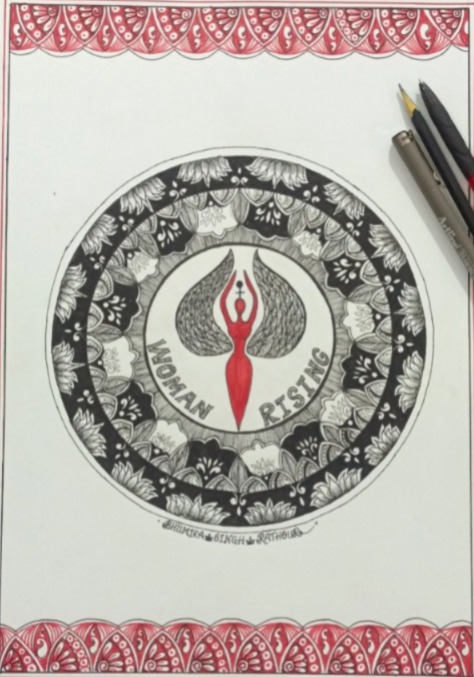
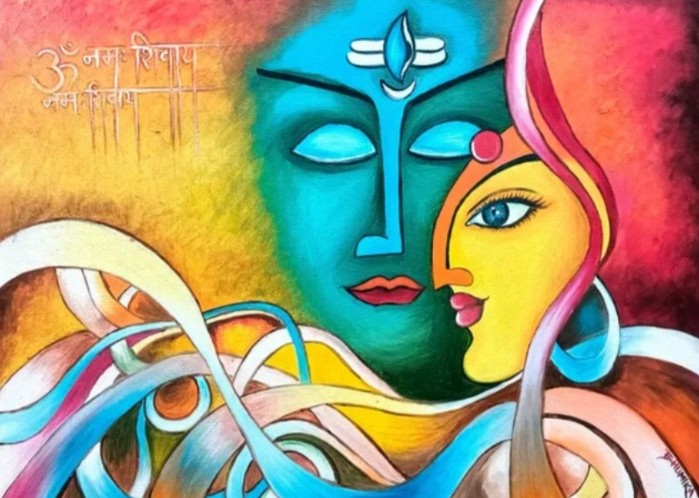
In this work, for instance, I evoke a state of mental stillness. Yet this peace is not passive; rather, it is an active, hard-won equilibrium. Indeed, I position peace of mind as a radical force, a form of resilience that consolidates her strength. Ultimately, within this quietude, she does not diminish; instead, she becomes more powerful.
Q: What kind of responses have you received from women viewers, considering your emphasis on empowerment themes?
A: A woman recognizes herself in my work. She confronts what she feels within the social fabric, and, in turn, she reimagines herself through the visual field I construct. Thus, each painting becomes a site of identification: open, interpretive, and deeply personal.
For instance, this work engages directly with the theme of women’s empowerment through the lens of Ardhanarishvara, the indivisible synthesis of masculine and feminine energies. Here, Shiva remains incomplete without Shakti. This is not merely symbolic; rather, it articulates a fundamental ontological truth: creation and continuity depend upon their union. Indeed, even Mahadev derives wholeness through Shakti.
Therefore, I position feminine energy not as auxiliary, but as central, the generative force that sustains the world. Even in states of calm, she does not fragment or falter. Instead, she operates with quiet coherence, sustaining life with composure and intent. Her stillness is not absence; it is disciplined strength.
This principle extends across my practice. In the iconography of Radha and Krishna, too, completeness emerges only through relational presence. The same holds true beyond divinity, within the everyday human condition. Wherever women are absent, meaning collapses; continuity dissolves.
Q: How do buyers and collectors engage with your work, and what patterns have you observed in their response?
A: Most buyers remain reticent; they observe, they show interest, yet they rarely articulate a critical response. More importantly, they often fail to apprehend value. Instead, they perceive art as a surface object, detached from the intellectual and emotional labour that produces it.
However, this perception obscures the artist’s true investment. I embed concept, theme, and affect into every work; I construct each piece through sustained inquiry and disciplined execution. Consequently, the material realities, pigment, surface, framing, also accrue cost through process and precision. Yet these are only the visible strata.
Beyond them lies the intangible: the density of thought, the duration of engagement, and the emotional intensity that the work carries. This dimension constitutes the real value. Nevertheless, it resists immediate comprehension for the uninitiated viewer. As a result, many defer judgment, assuming that only a trained or sensitized eye can decode its worth.
Therefore, the collector base remains selective rather than expansive. Still, those who engage seriously with art, who recognize process, intention, and conceptual depth, do perceive its value with clarity and conviction.
Q: In what ways, your role as an art educator position art as a meditative discipline that enhances focus, reduces stress, and deepens learning, particularly for children?
A: I practice as an art educator, and I treat this role as an extension of my artistic responsibility. I disseminate what I have cultivated, what I have been entrusted with, so that art does not remain confined to the studio, but instead permeates everyday life.
Accordingly, I position art not as a peripheral hobby, but as a disciplined form of meditation. It regulates the mind; it cultivates focus; it stabilizes emotional states. Through sustained engagement, it sharpens self-awareness and, in turn, builds confidence.
This function becomes especially critical within education. Children, in particular, navigate constant distraction, escalating academic pressure, and psychological stress. Therefore, I integrate art as a stabilizing practice. It anchors attention, diffuses anxiety, and restores cognitive balance.
As a result, learning itself becomes more effective. When the mind settles, comprehension deepens. Students do not merely memorize; they internalize. They absorb knowledge with clarity, and they begin to process it from within.