


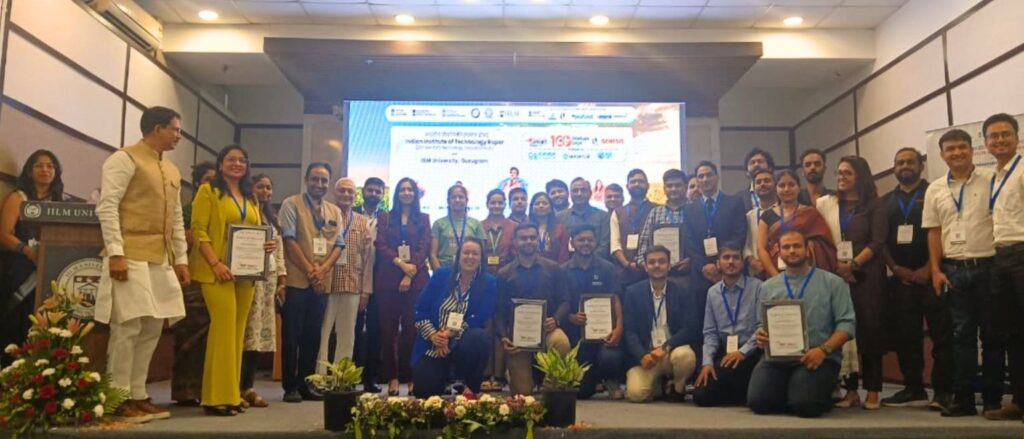
The SPRINT North Edition 2025, under IIT Ropar and iHub–AWaDH’s flagship initiative 100 Startups 100 Days, marked a decisive milestone in India’s startup journey. Hosted at IILM University, Gurugram, on 12 September 2025, the inauguration ignited a fresh wave of deeptech entrepreneurship.
The gathering brought together industry leaders, government officials, investors, entrepreneurs, and academia united by a shared mission: to accelerate and strengthen India’s startup ecosystem. The atmosphere crackled with energy as conversations seamlessly bridged policy, capital, and innovation.
Momentum surged through a series of key announcements. A high-powered panel dissected the challenges and opportunities shaping the sector. Organizers released the AWaDH Progress Report, launched DTC Accelerate – ClimateTech in collaboration with NASSCOM, and unveiled an update on Bharat Innovate 2026. This Ministry of Education-led initiative spans 13 IITs and will showcase India’s top 100 innovations on the global stage, with France hosting the marquee event in June 2026.
The celebration’s defining moment came during the cheques and certification ceremony. Thirteen trailblazing startups and three visionary innovators from the GENESIS EIR program earned recognition for their groundbreaking ideas and indomitable entrepreneurial spirit.
Together, these initiatives carried a message far beyond ceremony. They embodied India’s resolve to convert deeptech potential into global leadership.
Against this backdrop, The Interview World engaged with Dr. Radhika Trikha, CEO of the Technology and Innovation Foundation (iHub–AWaDH), IIT Ropar. Dr. Trikha spotlighted flagship programs such as SPRINT and 100 Startups 100 Days, emphasizing the push to increase their frequency. She outlined how iHub–AWaDH actively nurtures startups, helping them scale their ventures and bring products successfully to market. She also shared her strategy to drive innovation and growth while ensuring technology remains adaptable, affordable, and accessible for end-users.
What follows are the key insights from her compelling conversation.
Q: The SPRINT and 100 Startups 100 Days initiatives by iHub–AWaDH at IIT Ropar are truly commendable. Given their impact, do you plan to increase the frequency or scale of such programs to enable more startups to benefit from this platform?
A: SPRINT is not confined to IIT Ropar; we are taking it across the nation. This edition marks our 13th milestone. The earlier 12 editions spanned diverse regions, Jammu and Kashmir, Punjab, the Southern states, and the North East, steadily expanding our footprint across India. Now, for the first time, we have brought SPRINT to Haryana. Next, we will extend to the West, East, and Central regions as well. Alongside this expansion, we are preparing to launch several new programs that will soon come into play.
Q: How does your startup incubation ecosystem support entrepreneurs in scaling their ventures and successfully taking them to market?
A: Our portfolio encompasses over 160 startups, and what makes it truly exciting is its diversity. We have startups at the very beginning of their journey, those refining an idea, experimenting, and testing whether their concept can succeed. Alongside them are ventures already active in the market, growing steadily, and accelerating their impact.
These established startups play a crucial role in mentoring and integrating with newer entrepreneurs, offering the first level of real-world scaling. At the same time, they gain exposure to the broader ecosystem we are carefully building. This ecosystem goes beyond academia; it connects startups with venture partners, angel investors, and key enablers who drive innovation. By engaging with this network, startups absorb valuable lessons that shape their own growth journeys.
Moreover, our incubators and accelerator programs amplify this support. We do not operate in isolation; we actively collaborate with leading organizations to bring world-class knowledge, best practices, and strategic guidance. The goal is clear: to equip our entrepreneurs to scale efficiently, launch successfully, and thrive in the market. Through this multi-layered approach, we are creating a vibrant, self-sustaining ecosystem where startups at every stage can grow, learn, and contribute to India’s innovation landscape.
Q: As the CEO of iHub–AWaDH, what is your strategy for driving innovation and growth while nurturing startups to develop smart solutions for agriculture?
A: As the CEO, my vision is simple yet ambitious: whatever we develop must reach the ground. It cannot remain confined to papers or limited to events. Our goal is for the agricultural community to directly benefit from our work.
We aim for true democratization of technology. At IIT Ropar, we view startups as powerful channels to deliver our innovations to the field. We are open and proactive in sharing these technologies, bringing them to the market where they can create tangible business value.
Our vision extends beyond innovation. It is about transforming agriculture. We want smart, digital farming to become a practical reality for every farmer, whether rural or urban, smallholder or large-scale. By leveraging technology, we can demonstrate how even a simple device, like a phone, can revolutionize agricultural practices and outcomes.
In essence, our mission is to ensure that advanced agricultural technologies are not just developed, but widely adopted, empowering farmers, enhancing productivity, and shaping the future of farming in India.
Q: How are the startups in your ecosystem ensuring that technology remains adaptable, affordable, and accessible for end-users?
A: When we develop technology, our core vision is clear: it must be accessible to everyone. Accessibility, however, comes with two critical requirements: it must be practical and affordable.
We focus specifically on cost-effectiveness. Technologies should not burden the farming community. Farmers are not looking for technical jargon; they want solutions that are simple, useful, and within reach. Our team works relentlessly to simplify innovations, reduce costs, and ensure independence from imports. Affordability is therefore not an afterthought, it is central to our mission.
Startups play a vital role in this journey. They bring hunger, drive, and a desire to create meaningful change. For them, real impact comes from delivering technologies that are not only functional but also economically viable. By lowering costs, we ensure these solutions are adopted on a large scale, enabling farmers to fully benefit from advancements in smart agriculture.
In essence, our approach combines innovation with pragmatism: we build technologies that are simple, affordable, and scalable, turning ideas into real-world solutions that empower the farming community and strengthen the agricultural ecosystem.




3 Comments
Excellent read! The insights into nurturing startups and driving innovation in agriculture are incredibly inspiring and offer valuable lessons for aspiring entrepreneurs everywhere.
This article provides a great insight into how iHub–AWaDH is fostering innovation and supporting startups, especially in agriculture. The focus on practical, affordable solutions for farmers is commendable and highlights a meaningful approach to tech development.
Your writing is not only informative but also incredibly inspiring. You have a knack for sparking curiosity and encouraging critical thinking. Thank you for being such a positive influence!
Comments are closed.