


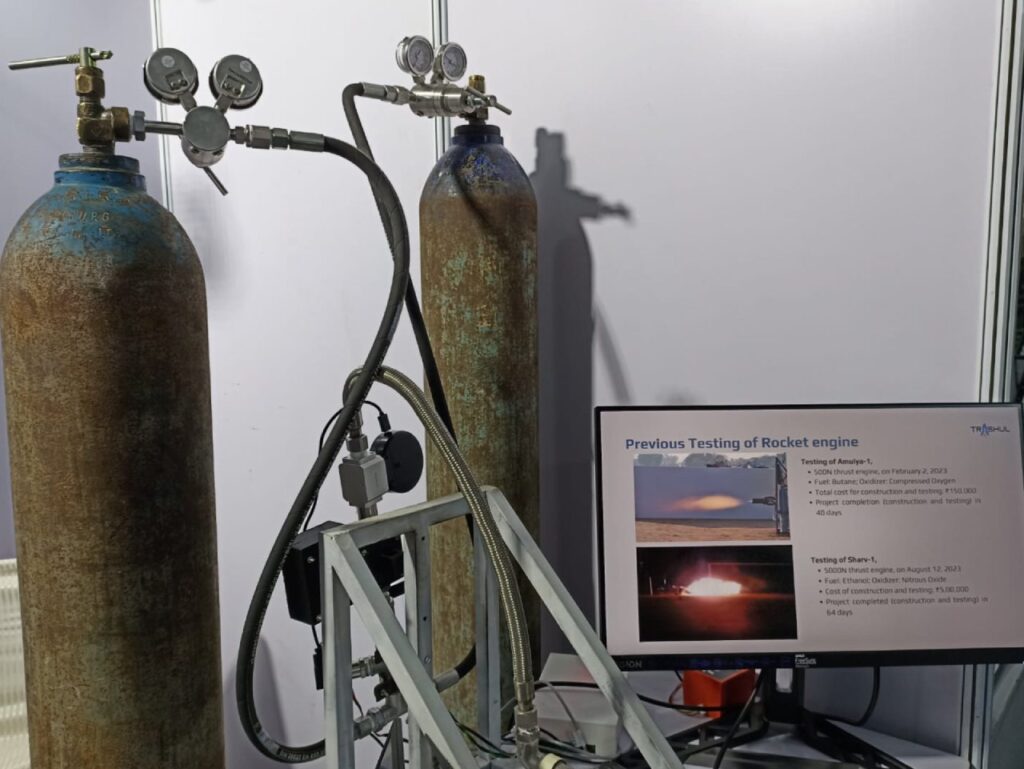
Trishul Space is reshaping India’s space narrative from the ground up. Founded in 2024 in Prayagraj, this young startup confronts one of aerospace’s most formidable challenges: rocket propulsion. Traditionally, every launch vehicle manufacturer spends years, and enormous budgets, developing engines from scratch. Trishul Space disrupts that cycle with a smarter, faster, and more efficient alternative.
At the heart of its mission lies the Harpy-1 engine, a breakthrough in propulsion technology. Delivering 25 kN of thrust, it combines the sophistication of a staged combustion cycle with the intelligence of AI-powered failure detection. The result is a propulsion system designed to cut costs, accelerate launch timelines, and minimize risk. For a market hungry for dependable, ready-to-deploy engines, Harpy-1 is not merely hardware, it is a catalyst for unlocking new frontiers.
Although still in prototype, Trishul Space has already positioned itself as the partner of choice for both emerging space startups and established industry leaders. Its vision is bold yet clear: transform propulsion from a bottleneck into an enabler, and in doing so, democratize access to space.
In an exclusive conversation with The Interview World at FITT Forward 2025, hosted by FITT and IIT Delhi, Aditya Singh, CEO and Co-founder of Trishul Space, shared his perspective on the company’s pioneering propulsion solutions. He explained the efficiencies of their engine design, detailed the thrust performance, discussed the rigor of their testing process, and illuminated the vast market opportunities within space technology. Most importantly, he articulated a strategic vision that underscores Trishul Space’s ambition to become a defining force in the future of space exploration.
Q: Could you elaborate on the rocket propulsion solutions your startup is developing for the space technology sector, and explain how these innovations are redefining or disrupting conventional propulsion systems?
A: We are developing a cryogenic liquid rocket propulsion engine in response to India’s Space Policy 2020, which has opened the sector to private participation. The policy has unleashed a wave of ambitious players: Skyroot Aerospace, Agnikul, Ethereal Space, Exo-Space, Abyom SpaceTech, among others, each racing to build their own launch vehicles. Yet, all of them face the same fundamental challenge: propulsion. Without a powerful, reliable rocket engine, no vehicle can achieve the thrust required to break free into space.
At present, every company is attempting to design and manufacture engines in-house. This path demands enormous investment: millions of dollars, years of development, and relentless human effort. On average, it takes five to seven years to produce a single propulsion system before a vehicle can even approach the launchpad. That long, costly process slows innovation and drains resources.
This is where we step in. Trishul Space is building a ready-to-use propulsion engine designed for seamless integration into launch vehicles. Instead of every player reinventing the wheel, we provide the core technology that powers liftoff. In doing so, we remove one of the industry’s toughest barriers and accelerate the journey from idea to orbit.
Q: How does the efficiency of your propulsion engines compare with existing solutions in the market, and what key differentiators set them apart?
A: In rocket propulsion, the choice of cycle defines performance. For our Harpy-1 engine, we adopted the staged combustion cycle, the most efficient configuration for the 25-kilonewton-class engine we are developing. This decision ensures maximum performance within a compact design.
We are targeting a specific impulse (ISP) of around 345 seconds. ISP, the benchmark of propulsion efficiency, measures how effectively an engine converts fuel into thrust. A higher ISP translates into longer burn times and better payload capacity, both critical for competitive launch systems.
Another crucial parameter we focus on is the thrust-to-weight ratio. This ratio, the thrust produced relative to the engine’s own weight, directly impacts a rocket’s viability. In aerospace, every kilogram matters. Reducing engine weight while maximizing thrust enhances efficiency, lowers launch costs, and broadens mission potential.
Our goal is clear: engineer a propulsion system that delivers superior efficiency, lighter mass, and higher thrust, making Harpy-1 a performance multiplier for the next generation of launch vehicles.
Q: Could you elaborate on the thrust capabilities of your rockets and how they align with the requirements of different space missions?
A: This marks our first decisive step. We are beginning with a 25-kilonewton engine, purpose-built for small-scale launch vehicles. It provides the ideal foundation to validate our technology and prove its reliability in real-world missions.
Looking ahead, we have set our sights on larger engines. The next phase will focus on developing a 100-kilonewton class engine, followed by an even more powerful 150-kilonewton system. Each advancement will expand our capability, enabling us to serve progressively larger and more demanding launch platforms.
Q: Have your propulsion engines undergone comprehensive testing, and have they received certifications or validations from recognized organizations such as ISRO or other regulatory bodies?
A: We have already completed engine testing. Certification, however, remains the next critical milestone. Our roadmap includes rigorous evaluation and validation within the coming year. In about 12 to 14 months, we will approach ISRO to conduct official testing and secure certification, ensuring the engine meets the highest industry standards.
Q: Have you filed or planned to file patents for your propulsion engine technology?
A: We have several developments in the pipeline. One of the most critical is a new injector design. Within the next one to two months, we plan to complete and test this innovation, marking another step forward in refining engine performance.
Q: What market opportunities do you foresee for your propulsion engines within the space technology sector?
A: With India recently opening its space sector to private players, the domestic market is expanding rapidly. However, it will take at least a decade to fully mature. In contrast, the international market already presents a prime opportunity for startups. Demand for reliable rocket engines is high, and the cost of engines abroad remains prohibitively expensive.
Here lies our advantage. By producing high-quality engines at a lower cost, we can compete globally and capture a significant share of this lucrative market. Trishul Space aims to make advanced propulsion both accessible and affordable, positioning itself as a key player on the international stage.
Q: Do you have a strategic plan for scaling your business and capturing a significant share of the space technology market?
A: Yes, we have a clear roadmap. First, we will conduct pilot testing over the next two and a half years. Following successful validation, we plan to advance to full-scale commercial testing, paving the way for market-ready deployment.






1 Comment
Thank you for sharing such a well-structured and easy-to-digest post. It’s not always easy to find content that strikes the right balance between informative and engaging, but this piece really delivered. I appreciated how each section built on the last without overwhelming the reader. Even though I’ve come across similar topics before, the way you presented the information here made it more approachable. I’ll definitely be returning to this as a reference point. It’s the kind of post that’s genuinely helpful no matter your level of experience with the subject. Looking forward to reading more of your work—keep it up!
Comments are closed.