

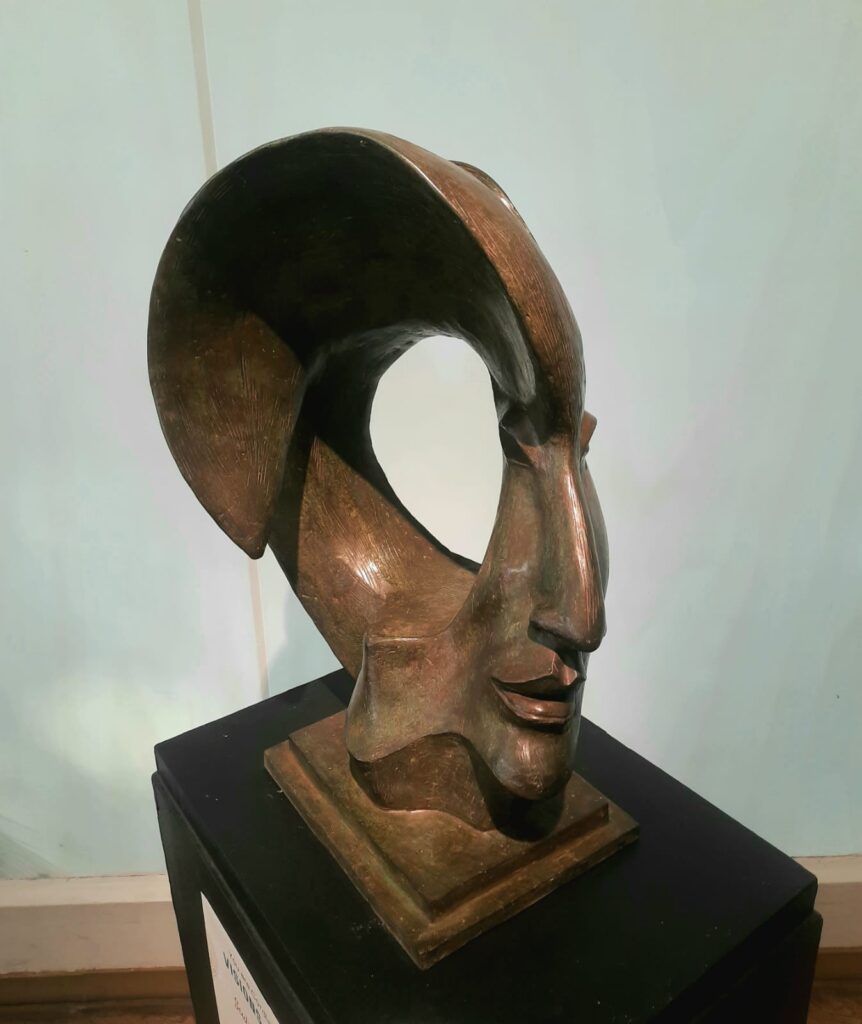
Suresh Kumar stands among India’s most accomplished contemporary sculptors, recognized for a practice that fuses formal rigor with a penetrating exploration of human emotion and identity. Trained at the College of Art, Delhi University, where he completed both his B.F.A. and M.F.A. in Sculpture, he has since built a substantial national and international exhibition record. His sculptural language, most often articulated through bronze and mixed media, moves between introspection and the broader human condition, uniting conceptual intensity with exacting craftsmanship. At the same time, Kumar’s impact extends well beyond the studio: as an influential educator and institutional leader, he plays a decisive role in shaping the direction of India’s contemporary art discourse.
In an exclusive dialogue with The Interview World, Kumar traces the evolution of his artistic journey and reflects on Lifeline, his recent solo exhibition. He also details the sculptural techniques that anchor his practice, while clarifying the critical differences between contemporary and traditional approaches to facial expression and figuration. Moreover, he explains how abstraction amplifies both the emotional charge and the conceptual reach of sculpture. As the conversation unfolds, Kumar addresses the thematic arc of his current body of work and, finally, considers the distinct sensibilities that shape how collectors engage with sculpture as opposed to painting. What follows are the central insights from this incisive exchange.
Q: What has your journey as a sculptor been like?
A: Born in the village of Rewari in Haryana, I began my artistic journey at Narayana Village School in Delhi. I earned my Bachelor of Fine Arts in 1990 from the Delhi College of Art, followed by a Master of Fine Arts from Delhi University in 1992. From that point forward, I committed myself fully to professional practice, exhibiting regularly in Delhi, Mumbai, and Bengaluru. I maintain a studio at the Lalit Kala Akademi and have lived and worked in Delhi for many years. Alongside my studio practice, I serve as a lecturer in a Delhi Government School, contributing to the education of the next generation of artists.
My sculptural work spans multiple materials and techniques. I have worked extensively in wood and stone, and I continue to explore bronze as a primary medium. Throughout this practice, the human face has remained my central subject. I study people closely, observe their expressions, and translate those observations into sculpture. Over time, this focus led to an extensive body of work devoted to the face as a carrier of emotion, identity, and social meaning.
From this exploration emerged a deeper inquiry into womanhood and inner strength. While working on a female figure, I introduced the image of a flower, already rooted and blooming, to symbolize growth, resilience, and continuity. Gradually, this evolved into a more powerful visual language. To express the strength of a woman, I incorporated the face of a horse, a universal symbol of power and endurance. I then unified the woman, the horse, and the flowers into a single sculptural form. Still, the idea felt incomplete, so I added another essential element: education. I introduced the book, sometimes one, sometimes two, to represent knowledge as the foundation of empowerment.
I firmly believe that when a woman is educated, she gains not only independence but also the capacity to support her family and strengthen her society. The sculptures you see in this series therefore stand as visual statements on the power of women.
Beyond this body of work, I regularly address social and environmental issues through sculpture. I have produced a major series on bulls and have created many works of Ganpati, although none appear in the current series. During the height of the global warming crisis, I created eight to ten sculptures responding to the rising temperatures and the growing threat to life on Earth. Because art communicates directly and powerfully with the public, I chose this urgent theme to provoke awareness and reflection.
Several of these works have been collected internationally, including by buyers in Washington, D.C. I continue to develop this ongoing series, expanding both its formal language and its social reach through new sculptural explorations.
Q: Could you discuss the conceptual framework and artistic intent behind your solo exhibition, Lifeline?
A: Lifeline is a documentary film directed by Vajranabh Natraaj Maharshi, an accomplished filmmaker whose work captures both artistic depth and human truth. The film traces my journey from a village upbringing to a life shaped by education and artistic practice.
Through a careful and observant lens, he documents my techniques and working process. He records how I shape each sculpture, how I carve wood and stone, and how I bring form to raw material. He also captures the precision of my metalwork, including the delicate process of applying patina to bronze.
At every stage, the camera follows not only my hands but also my creative intent. The film reveals how I live with my sculptures and how they emerge through disciplined labour and sustained reflection. His visual language is so refined that each frame carries the strength and clarity of a powerful photographic poster.

Q: Which technique do you prefer most in your sculptural work?
A: Stone carving remains my preferred technique because it offers absolute clarity and directness. For a long time, I viewed stone and wood carving as fundamentally different disciplines, and through experience I came to understand why. In stone carving, every action produces an immediate and visible result. When I remove material, the outcome appears instantly before me and does not change afterward.
By contrast, metal sculpture depends on casting, which introduces uncertainty. After pouring the metal, the final form remains hidden until the mould is broken. Damage, distortion, or flaws may appear, and the interior of the casting remains unpredictable.
Stone, however, allows no such ambiguity. What I see as I carve is precisely what exists. The form reveals itself in real time, and the truth of the sculpture stands directly before the artist.
Q: How do you perceive the key differences in facial expression and treatment between contemporary sculpture and traditional sculptural practices?
A: The difference is unmistakable. Creating a portrait and creating a contemporary work require fundamentally different approaches. In a portrait, the artist aims for direct likeness. The subject must look exactly as they appear in reality, with every feature rendered faithfully.
By contrast, contemporary and expressive work moves beyond physical resemblance. Instead, it captures the inner life of the subject. The artist focuses on emotion, on the expression in the eyes, on the tension or softness in the lips, and on whether the person feels joyful, troubled, or contemplative.
When we work from direct observation, we reproduce the entire face as it exists. We record structure, proportion, and outward identity. However, in contemporary or abstract practice, we deliberately let go of literal appearance. We do not ask who the person is in the world. We ask what the person is feeling within.
Q: How does working in abstraction expand the expressive and conceptual possibilities of your sculptural practice?
A: Abstract art operates within a vast and open spectrum because it does not belong to a single maker alone. Instead, it extends into the perception of every viewer. When people encounter an abstract work, each person interprets it differently. One may sense contemplation, another may read tension, and yet another may imagine a gesture or an unspoken thought.
Because every observer brings a unique perspective, the meaning of the work continues to expand. In this way, abstraction does not narrow interpretation; it multiplies it. As more minds engage with the artwork, the expressive spectrum of art grows wider and richer.
Q: What themes or subjects are currently shaping your ongoing body of work?
A: Currently, I am moving toward a more abstract approach in my work. In my latest sculpture, I have embraced complete abstraction. Rather than depicting the entire figure, I focus only on specific elements: legs, hands, and clothing.
This exploration forms the foundation of my new series. So far, I have completed two sculptures and have only just begun developing this body of work.
Q: How do collectors and buyers typically perceive sculptures compared to paintings, and what differences do you observe in their evaluative criteria?
A: I have observed a clear distinction between the audiences for sculpture and painting. Sculpture buyers, collectors, and enthusiasts focus almost exclusively on three-dimensional works. Often, they do not even notice paintings.
Conversely, lovers of painting concentrate on two-dimensional art and frequently overlook sculptures. This difference highlights how the spectrum of appreciation for sculpture and painting is entirely separate.
Sculpture occupies the three-dimensional realm, while painting exists in two dimensions. Consequently, the interests and perspectives of their audiences naturally diverge. I have noticed this distinction firsthand, as I work in both mediums, painting occasionally, while primarily creating sculpture.



1 Comment
Interesting work.. lovely article’s
Comments are closed.