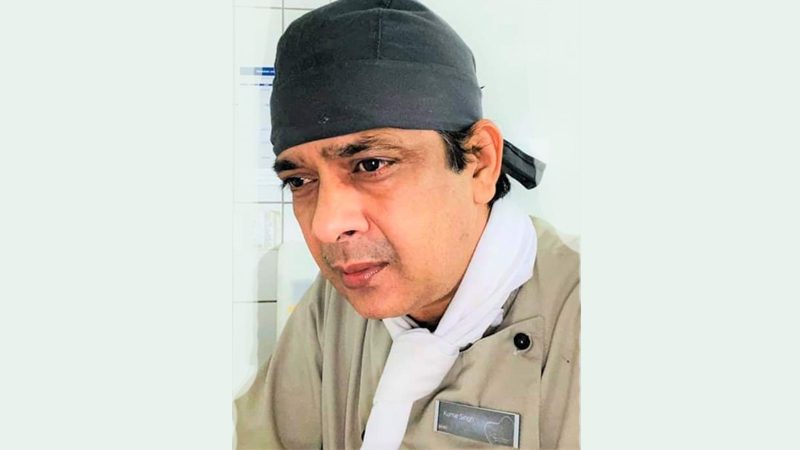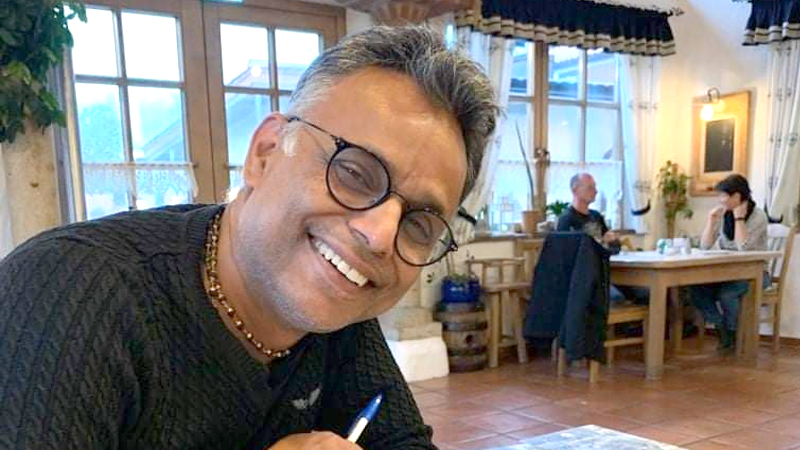


Devi Dass Khattri is an Indian visual artist and sculptor whose practice seamlessly unites material intelligence with spiritual inquiry. Born in Bishnah, Jammu & Kashmir, he underwent rigorous training at Visva-Bharati, Santiniketan, and later at the Delhi College of Art, an education that anchored him in classical discipline while sharpening his engagement with contemporary form and thought. Working fluently between sculpture and painting, and across materials with clay at the core, Khattri distills lived experience into forms that are meditative, tactile, and alert to presence. As a result, his work has travelled widely through solo and group exhibitions in India and abroad, earning recognition at state, national, and international levels. Collected across borders, his art speaks with restraint yet conviction, asserting a quiet authority that endures.
In an exclusive conversation with The Interview World, Khattri reflects on how clay absorbs and translates lived human experience. He articulates what continually draws him to the medium, clarifies clay’s distinctive contribution to the language of contemporary art, and addresses the emerging generation with clarity and purpose. What follows are the key insights from a conversation marked by depth, precision, and resolve.
Q: How can clay art be used to express the lived experiences of people?
A: Here, we are shaping a tribal family in clay. As the form comes into being, its identity will declare itself. You will recognize the people immediately. Nothing needs to be searched for, decoded, or explained. No text must accompany the sculpture. The work carries its own meaning. It speaks directly, and it speaks for itself.
Q: What excites you about working with clay at this point in your practice?
A: The tradition of working with clay is steadily eroding. Therefore, we work to preserve it. At the same time, we teach the new generation how to sustain this knowledge with care and responsibility. This is their work now. I contribute by guiding them through the process of making, by revealing its discipline, its patience, and its purpose. From there, they will carry the tradition forward.
Q: How does clay contribute uniquely to the language of contemporary art?
A: From life to death, clay remains inseparable from human existence. The question, then, is how we preserve this continuity. We hold both ends of the spectrum together: memory and possibility. As children, we shaped clay into small houses with our hands. Today, we work with the same material in a more advanced, self-aware society. As a developing nation, we continue to engage with clay, not as nostalgia but as intent. Through it, we demonstrate how traditional art can be sustained, renewed, and carried forward. We do this, deliberately and responsibly, through clay.
Q: What message would you like to share with the new generation about this art form?
A: To the new generation, I say this with conviction: we will endure. We will endure through our art, our culture, and our heritage. These art forms have travelled across millennia, shaped by time yet never diminished. Now, they move forward again, carried by younger hands, sustained by new vision, and extended into the future.
Q: In what ways does clay hold meaning beyond its material form?
A: Without clay, there is nothing. It is the ground from which form, utility, and meaning arise. Consider something as ordinary as a pair of shoes. Before it exists, an artist must first imagine and design it. In the same way, everything we shape in clay, whether modest or monumental, earns value beyond economics. We cherish it regardless of scale or status. If it is large, it is still clay. If it is small, it remains clay.
Therefore, I seek to show how clay moves across scale, from the intimate to the expansive. More importantly, I want to demonstrate how clay travels from daily life toward development. Clay anchors our existence. Its role is fundamental. The message, then, is unequivocal: clay is not merely a material; it is a language we must continue to share.