

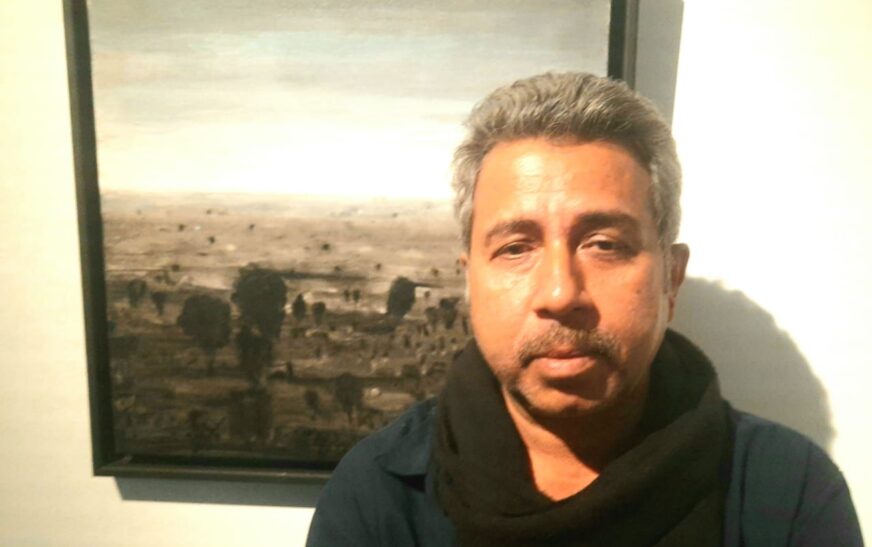
Pankaj Jha is an Indian actor, writer, and painter who commands attention through a restrained yet potent presence across film, television, and digital media. Born in Saharsa and trained at the National School of Drama, he began in theatre; from there, he transitioned to cinema with disciplined intent. He delivered finely calibrated performances in Monsoon Wedding, Gulaal, and Black Friday; subsequently, he garnered wide recognition for his role as an MLA in the series Panchayat. At the same time, Jha sustains a rigorous visual art practice. He has mounted multiple solo exhibitions; moreover, he treats paintings, often informed by nature and spirituality, as central to his creative identity. His canvases privilege introspection; consequently, they reject flamboyant palettes in favour of disciplined tonalities, especially monochromatic fields of black, white, and grey, to articulate philosophical and affective states. In effect, his art complements his screen work; both arise from close observation, interior inquiry, and a sustained search for meaning beyond surface realism.
In an exclusive conversation with The Interview World at Triveni Kala Sangam, Jha delineates the conceptual core of his paintings; further, he clarifies their settings and registers the impact of his artistic practice. He also argues that overt messaging can complicate life rather than simplify it; accordingly, he reframes audience reception, asserting that people do not move away from such ideas so much as resist accepting them. The following are the key takeaways from this incisive exchange.
Q: Could you describe your artistic practice and the central idea you aim to convey through your recent paintings?
A: I paint for myself for the sheer act of making. Therefore, I resist the impulse to exhibit my work for approval. When one paints for an audience, the work often turns superficial; consequently, it drifts toward mediocrity. By contrast, when creation rises from within, it eludes articulation; it exceeds language and resists tidy explanation. I cannot account for its origin or method. Even so, it emerges unexpectedly from my imagination, often as landscape.
Meanwhile, the city presses in. We do not merely meet others; we collide with them. It is not a wall but a swarm. As a result, people retreat inward; they seal themselves within their own thoughts and private images. Against this density, I return to the canvas. In fact, I do not simply make these paintings; I live through them.
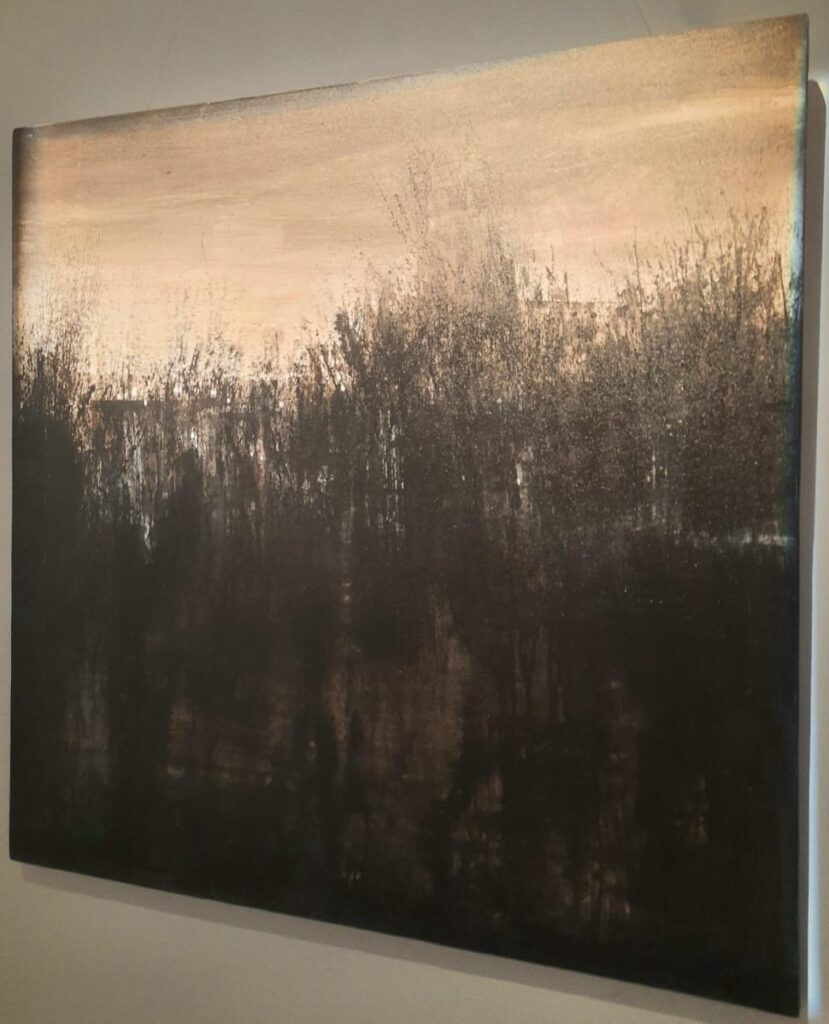
Q: The background features soft white tones that evoke a dusk-like atmosphere. What does this setting represent in your paintings?
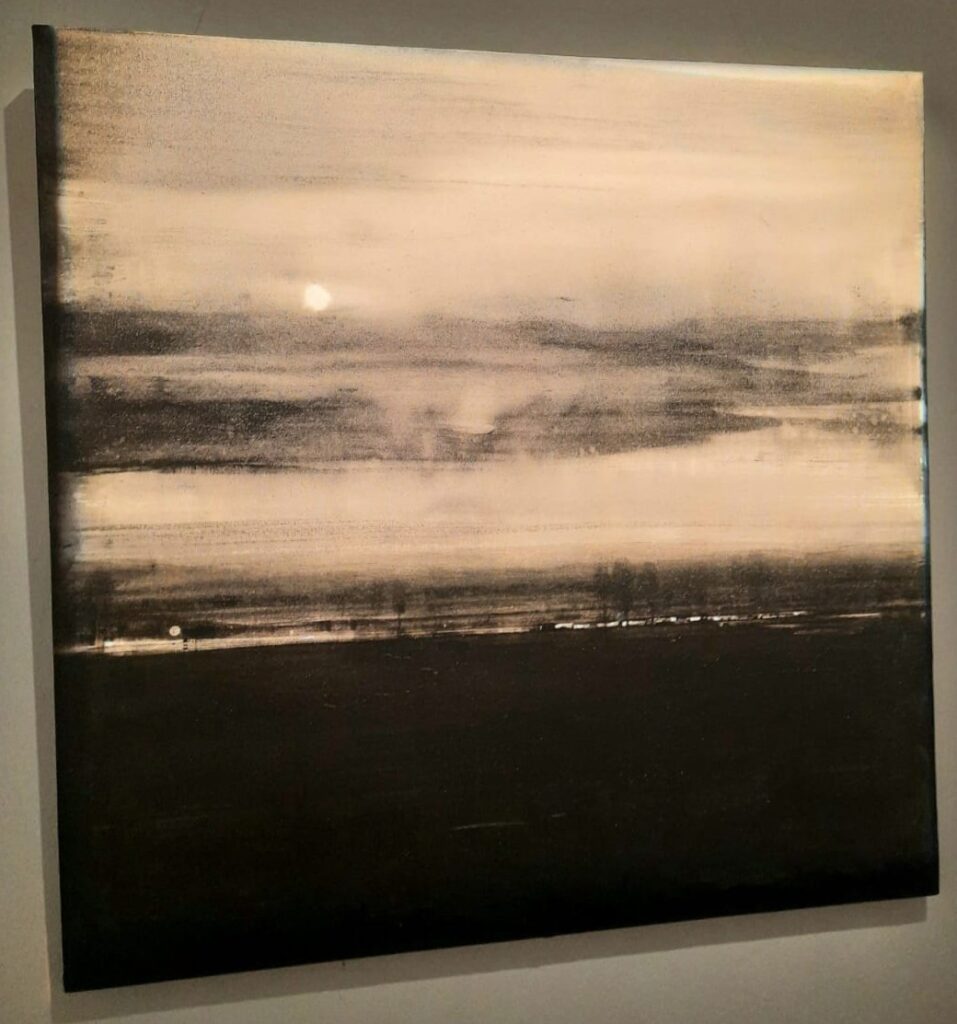
A: Many people ask why I chose black and white. In truth, black and white chose me. When I try to translate that pull into language, I falter; words feel inadequate. Still, I hold a conviction: in creative practice, the primal colour is white. When all colours converge, they resolve into white; therefore, white signals origin as much as culmination.
At the same time, black and white exert a magnetic force. They grip me and draw me in. I gravitate toward black in particular, because I prefer the night. Daylight unsettles me; it teems with restless pursuits and declared ambitions. Night, by contrast, conceals and withholds; consequently, it generates mystery. That sense of the hidden attracts me.
Moreover, I often think of the womb. For nine months, we inhabit darkness without anxiety or identity. From that state, our search for comfort begins. Perhaps that primordial memory explains my affinity for black and white. Even so, I cannot fully account for it; the impulse remains intuitive rather than reasoned.
Q: How has your formal training influenced your artistic practice?
A: I completed a Bachelor of Fine Arts at Patna Art College; however, the program did not shape my practice in any decisive way. At that time, I remained deeply uncertain, unsure what to paint and what to withhold. Then Osho entered my life. Without fully grasping his philosophy, I began to meditate. Gradually, I immersed myself in contemplations on human evolution and engaged with his therapeutic approaches; consequently, my creative direction clarified and expanded.
Out of that phase, a distinct body of work emerged. In parallel, I wrote Agyat Se Gyat Ki Aor. Viewers often read my paintings through the same lens; accordingly, they discern in them a movement toward the unknown, a quiet, persistent orientation from the known to the unseen.
Q: What message do you aim to convey through your paintings?
A: I find the urge to deliver messages aesthetically and intellectually suspect. Why impose a message at all? Life already furnishes us with sight, hearing, and a full range of sensibilities; therefore, it invites experience, not instruction. When we package experience as “messages,” we often indulge a quiet vanity: the claim that we possess something exceptional for others to decode. Consequently, communication turns didactic, and experience thins out.
Moreover, this culture of messaging burdens the young. Parents prescribe lessons; teachers multiply directives; as a result, children inherit confusion rather than clarity. Hence, I reject the compulsion to instruct. Life, in itself, remains simple and sufficient; it is we who complicate it through assertion, interpretation, and the constant urge to explain.
Q: What would you say to people who are moving away from a simple life in pursuit of a more material or fast-paced world?
A: No one truly moves toward anything; rather, most people move away from themselves. They refuse self-acceptance. Moreover, a large proportion of children grow up feeling unwanted, born into circumstances that lack emotional readiness or care. Consequently, they encounter rejection at home, at school, and across society. In response, they strive to prove their worth; they perform, achieve, and display in order to secure acceptance. Beneath that effort, however, lies a persistent void, the belief that they possess nothing of value within.



1 Comment
Great article, i really enjoy reading it, i hope you post more, keep up the good wok , is gona come follow you for more , nice reading it.
Comments are closed.