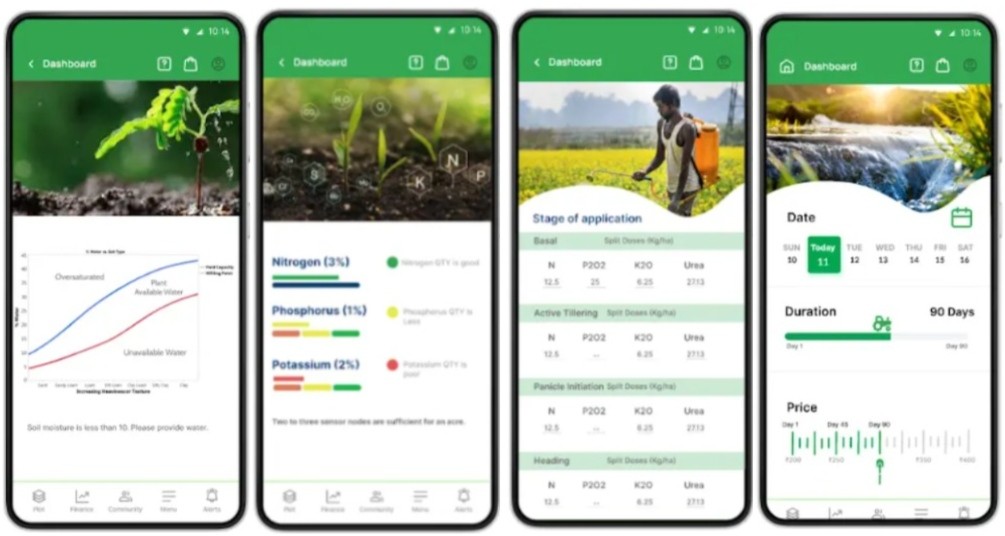

Farmoid is an agritech enterprise that advances precision agriculture through a farmer-centric Farming-as-a-Service (FaaS) platform. It integrates IoT, artificial intelligence, and satellite intelligence to generate high-resolution, data-driven insights. Consequently, it delivers precise, actionable agronomic guidance tailored to each farm’s distinct agro-climatic and soil conditions. The platform unifies irrigation and fertigation scheduling, pest and disease surveillance, crop stage–specific advisories, and forward-looking market price intelligence within a single decision-support architecture. As a result, farmers gain real-time visibility into field performance and receive context-aware recommendations that enhance operational accuracy. This integrated intelligence optimizes resource allocation, increases productivity, reduces input costs, and strengthens long-term sustainability. Above all, Farmoid replaces uncertainty with evidence-based agronomy, enabling farmers to produce more with fewer resources and greater confidence.
In an exclusive interaction with The Interview World at the India AI Impact Expo 2026, Ananthraj Ksheerasagar, Founder and CEO of Farmoid Robotech Pvt. Ltd., articulates the strategic architecture of the company’s agritech solutions. He explains the scope of services the startup delivers and quantifies their measurable impact on farmers. Furthermore, he outlines the scale of farmer onboarding, details the engagement channels the company deploys to connect and collaborate with its user base, and identifies the primary crop segments Farmoid prioritizes. The following are the principal insights from this in-depth discussion.
Q: Can you detail the specific agritech solutions Farmoid provides to farmers?
A: At Farmoid, we deliver two integrated solutions: hardware and software. First, we deploy an in-house, sensor-based device that captures critical soil and atmospheric parameters with high precision. Specifically, the device measures soil moisture, pH levels, electrical conductivity (EC), and essential macronutrients such as nitrogen, phosphorus, and potassium. In parallel, it records atmospheric variables, including wind speed and wind direction.
Once the system captures this field-level data, it transmits it securely to our cloud infrastructure. There, we apply proprietary AI and machine learning models engineered specifically for horticultural crops, particularly fruits and vegetables. These algorithms analyse crop-stage dynamics, soil health, and environmental conditions to generate precise, context-aware recommendations.
We primarily serve farmers who manage landholdings exceeding two acres, as this segment derives the greatest operational and economic value from precision interventions. After processing the data, we deliver insights directly to end users through our proprietary mobile application. Notably, the application supports multiple vernacular languages and enables voice-based interaction. As a result, farmers can engage with the platform intuitively, access recommendations seamlessly, and make informed decisions without technological barriers.
Q: What specific services do you provide to farmers, and what measurable benefits have they realized?
A: Our service architecture spans the entire crop lifecycle. To begin with, we enable precision irrigation management. We determine when farmers should irrigate, how much water they should apply, and how to optimize usage based on real-time soil and climatic data. In parallel, we deliver fertilization and crop protection advisories. We specify the optimal timing for pesticide application and define the precise dosage required. As a result, farmers avoid overuse, reduce waste, and protect crop health.
As crops progress through successive growth stages, we intensify predictive monitoring. We identify vulnerability windows during which plants face heightened exposure to pests and diseases. More importantly, we issue early-warning alerts up to 14 days in advance. Consequently, farmers can implement preventive measures proactively rather than reactively, thereby minimizing yield losses and safeguarding crop quality.
At the harvest stage, we extend decision support to market intelligence. Through our market price forecasting engine, farmers gain localized insights within a 5–10 kilometer radius. They can identify active mandi markets, assess prevailing prices for specific crops on a given day, and analyse price trends for up to one month. Therefore, they can time their sales strategically, select the most profitable market, and optimize revenue realization.
The measurable impact is significant. Farmers who adopt our technology reduce input costs by up to 35 percent. Simultaneously, they increase per-acre productivity by nearly 30 percent. In addition, they receive advance alerts for disease outbreaks and price fluctuations, which strengthens both agronomic and commercial decision-making. By leveraging our mobile application, they access real-time intelligence and translate data into precise, outcome-driven actions. Ultimately, they cultivate crops more efficiently, deploy resources more judiciously, and maximize profitability with disciplined, evidence-based execution.
Q: How many farmers are currently onboarded on your platform, and what channels do you use to connect and interact with them?
A: We are currently in the early stage of expansion. Nevertheless, we have already established a strong institutional network of 278 Farmer Producer Organizations (FPOs), collectively representing nearly 300,000 farmers across Karnataka, Tamil Nadu, and Andhra Pradesh. This foundation provides both scale and structured engagement.
At the same time, we are systematically expanding into Maharashtra and Punjab to strengthen our geographic footprint. To validate market readiness and agronomic adaptability, we are executing pilot projects with three farmers. In southern Karnataka, particularly in the Kolar region, we work with farms averaging seven acres in landholding. Similarly, in Maharashtra, we operate in the Akola and Pune regions. Additionally, in the Northeast, we have initiated deployment in Bahati. Through these pilots, we refine our models, calibrate regional parameters, and optimize service delivery.
Farmer onboarding primarily occurs through FPO partnerships, which enable organized aggregation and structured outreach. However, we also maintain direct digital engagement channels. Many farmers actively use social media, especially Facebook; therefore, we leverage our Facebook presence to drive awareness and interaction. In addition, farmers can visit our official website, farmoid.in, where they can initiate contact, request consultations, or schedule onboarding. Once they connect with us, our team engages directly, assesses their requirements, and deploys our services accordingly.
Q: Which crops does Farmoid primarily focus on?
A: We remain in the nascent phase of operations. Accordingly, we have narrowed our focus to four crops: banana, potato, grapes, and tomato. This deliberate concentration enables us to refine our agronomic models, validate performance metrics, and ensure precision at the crop level before scaling further.
However, we intend to expand our crop portfolio progressively. As we enter new geographies, we will incorporate region-specific crops, including orange, guava, and a broader spectrum of fruits and vegetables. In doing so, we will align our algorithms and advisory systems with localized agronomic conditions and market dynamics.
At present, we are not yet fully commercialized. Instead, we are executing structured pilot projects with three farmers, two in the Kolar region of Karnataka and one in Akola, Maharashtra (Pune region). Through these pilots, we are rigorously testing system performance, data accuracy, and measurable farm-level impact. Once we complete validation and optimize delivery, we will transition to full-scale commercialization, which we anticipate commencing next year.