

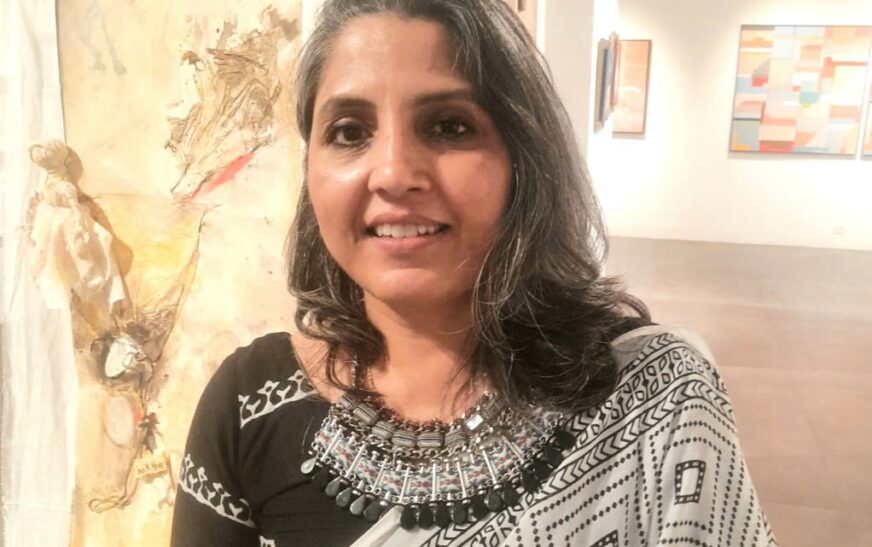
Shikha Gupta is an acclaimed artist, art therapist, educator, and cultural advocate whose practice is anchored in the transformative capacity of art to foster healing, self-discovery, and personal growth. Trained at the Nationale École des Beaux-Arts in Paris and armed with a Master’s degree in Art Therapy and Psychology, she has spent more than two decades advancing arts and culture through meaningful engagement and social impact.
Driven by a deep commitment to community empowerment, Gupta founded the NGO Udaan Ek Meetha Sapna and serves as Director of the Kalagram Society. Through these platforms, she has spearheaded a wide range of art therapy initiatives that have benefited students, educators, corporate professionals, specially abled children, and diverse community groups. In recognition of her outstanding contributions, she received the APJ Kalam Award in 2023.
In an exclusive conversation with The Interview World during Parallels of Perception, an exhibition organized by The Quartz Collective at the Shridharani Art Gallery, Triveni Kala Sangam, Shikha Gupta delves into the central themes and concerns that shape her artistic practice. She reflects on the realities and lived experiences of the tribal communities that feature prominently in her work and explains the conceptual foundation of Parallels of Perception. Furthermore, she discusses the role of art in confronting societal trauma, dismantling entrenched taboos, and fostering collective healing. She also highlights how contemporary artists are using their creative practice to engage with issues affecting tribal communities and women. Presented below are the key insights from this thought-provoking conversation.
Q: Could you describe the nature of your exhibited works and the key themes, mediums, and inspirations that define your artistic practice?
A: These scrolls embody layers of emotion, conditioning, memory, and the subconscious. Much of my work emerges intuitively. It draws from the memories we carry throughout our lives and the experiences that shape our identities. Those accumulated experiences ultimately define who we become. Through my art, I seek to translate these invisible psychological landscapes into a visible form on canvas.
At times, my work also serves as a response to the world around me. It reflects how I perceive social realities and how I emotionally engage with them. For instance, one of these scrolls emerged from my experience of working with adolescents from the denotified Pardhi tribe in Madhya Pradesh. The British colonial administration had branded these communities as “criminal tribes.” Although that law was repealed long ago, the trauma of that historical injustice continues to endure across generations.
While working with them, I sensed that they had built invisible walls around themselves, protective boundaries born of inherited pain and mistrust. For decades, society silenced them. Over time, that silence became deeply internalized. Today, many members of the community struggle to articulate their emotions, even when encouraged to do so. However, positive change is gradually emerging. Increasingly, NGOs and social organizations are listening to their stories and creating spaces for dialogue and healing.
That realization inspired this artwork. Through it, I wanted to convey a simple but powerful message: “I hear you.” You will notice feathers emerging from concrete structures. They symbolize vulnerability slowly breaking through hardened defences. For years, people concealed their fragility behind seemingly impenetrable walls. Now, however, those hidden emotions are beginning to surface. That is why I introduced light into the composition. The scroll itself functions as a visual timeline, tracing a journey from historical trauma toward self-expression and hope.
The second scroll addresses another deeply entrenched social issue, the conditioning imposed upon women. Across society, conversations around gender inequality, dowry-related violence, and women’s rights have become increasingly urgent. For generations, women have inherited rigid social expectations. Society has prescribed specific roles for them and passed those expectations from one generation to the next. As a result, many women have grown up believing that their value lies solely in fulfilling these predetermined responsibilities.
Yet that narrative is beginning to change. Women are questioning inherited norms and challenging structures that deny them the dignity, recognition, and autonomy they deserve. As they step into public life, pursue careers, and claim their agency, they are disrupting long-standing cycles of conditioning.
In the artwork, the circular forms represent those repetitive and self-perpetuating social structures. As questioning begins, the circles start to crack and leak. Once these cycles break, friction inevitably follows. Conflicts emerge with society, with families, and sometimes even within oneself. Yet such clashes often become the catalyst for awareness. Through disruption comes reflection, and through reflection comes transformation.
Today, we find ourselves at a transitional moment. We are beginning to recognize these patterns and understand their consequences. The old circles are collapsing. The challenge now is to move toward a society where individuals can breathe freely, move without constraints, and define their own paths. We must also ensure that we do not pass these limitations on to future generations. Every individual possesses a unique identity and deserves the freedom to choose how they wish to live, whether at home, outside it, or somewhere in between.
Importantly, these pressures are not limited to women. They are universal. Men, too, bear the weight of societal expectations. For example, a man who chooses to stay at home or deviates from conventional notions of masculinity often faces intense social scrutiny. Why should caregiving or domestic responsibilities be considered exclusively feminine? Such assumptions reveal how deeply conditioned our thinking remains.
These are only two examples among many. Similar tensions and contradictions exist across countless aspects of society. They affect me profoundly. My art becomes a space where I process these realities, confront these questions, and transform them into visual narratives. Ultimately, everything I witness, experience, and feel finds its way onto the canvas.
Q: In your view, how have the lives of these tribal communities changed since India’s independence? Have conditions improved significantly, or do many of the same challenges persist?
A: Their circumstances have undoubtedly improved since 1952, when the law that stigmatized them was finally repealed. However, legal reform alone cannot erase historical trauma. Trauma does not disappear overnight; it often takes generations to heal. Before healing can begin, communities must first acknowledge the trauma, understand its impact, and find the courage to confront it. Inevitably, a few individuals take the first steps toward change. They challenge long-standing fears and inherited limitations, and others gradually follow their lead.
Encouragingly, that process is already underway. Numerous organizations are now working closely with these communities, listening to their experiences and creating opportunities for empowerment. As a result, access to education, employment, and social inclusion has expanded significantly. In the past, many members of these communities survived primarily through manual labour and led largely nomadic lives. Today, however, younger generations are acquiring new skills, learning computer literacy, pursuing formal education, and exploring a much broader range of career opportunities.
Consequently, meaningful progress is taking place. Yet social transformation is never linear. It unfolds in cycles, requiring constant reflection, adjustment, and balance. Change is part of an ongoing evolutionary process, one that has been unfolding for decades and will continue into the future.
At the same time, there is no final destination where society can claim complete success. Every generation faces new challenges and new responsibilities. Therefore, progress must remain a continuous pursuit rather than a fixed achievement. While much work still lies ahead, there is no doubt that the situation today is far better than it was in the past. The journey continues, but the direction is undoubtedly positive.
Q: Could you elaborate on the idea behind Parallels of Perception and the perspectives or narratives you seek to convey through the exhibition?
A: The idea behind Parallels of Perception stems from the understanding that every artist interprets the world through a unique lens. Each of us occupies a different space, shaped by distinct experiences, beliefs, and observations. Consequently, our perspectives vary, yet each remains equally valid within its own context.
What makes the exhibition compelling is that these viewpoints coexist without competing with one another. They run parallel rather than intersecting in conflict. Every artist presents an individual interpretation of social, cultural, or personal realities, thereby contributing a distinct voice to the larger conversation.
For example, Natasha explores themes such as patriarchy, male dominance, and the structures of power that shape gender relations. Similarly, other artists engage with different concerns and subjects that resonate with their own experiences and artistic inquiries. While their themes may differ, all of these perspectives exist side by side, enriching the discourse rather than contradicting it.
That is precisely why the exhibition is titled Parallels of Perception. It celebrates the coexistence of multiple viewpoints, acknowledging that there is no single way to interpret reality. Instead, it invites viewers to engage with diverse perspectives that unfold simultaneously, each offering its own truth and insight.
Q: Do you believe art can play a significant role in addressing and healing societal traumas and challenging deeply rooted taboos?
A: Art creates a powerful space for dialogue. It encourages people to engage with ideas, ask questions, and explore realities they may never have encountered before. For example, through this artwork, I have brought attention to a tribal community that many people know little or nothing about. Once viewers encounter the work, their curiosity is often sparked. They may choose to learn more, conduct their own research, visit these communities, or even contribute to their well-being in meaningful ways.
This is how change begins. First comes awareness. Awareness then leads to conversation, and meaningful conversations often inspire action. Without that initial engagement, many important issues remain invisible and unaddressed.
Therefore, art plays a vital role in society. It not only reflects reality but also amplifies voices, highlights overlooked narratives, and creates opportunities for collective reflection. By bringing people into conversation with complex social issues, art fosters empathy, understanding, and, ultimately, the possibility of meaningful change. That is why its role in generating awareness and driving social transformation is both profound and indispensable.
Q: Do contemporary Indian artists actively engage with issues affecting tribal communities and women through their work?
A: Artists approach their work in different ways because each brings a unique sensibility, perspective, and purpose to the creative process. Some choose to paint landscapes. Others focus on beauty, tranquillity, or meditative experiences. Still others engage directly with social realities and human struggles. There is no single path in art; each artist responds to the world according to their own vision and temperament.
At the same time, artists tend to be deeply sensitive observers of life. Consequently, the events, emotions, and challenges unfolding around them inevitably leave an impression. How they choose to interpret and express those impressions, however, varies from one individual to another. Some may emphasize beauty even in difficult circumstances, while others may confront uncomfortable truths more directly. Both approaches are equally valid forms of artistic expression.
Ultimately, an artist’s work reflects not only the subject matter but also the artist’s personality and worldview. It reveals how they perceive reality and how they choose to communicate that perception to others.
In my own practice, I often engage with themes of suffering, trauma, and social complexity. Yet I also strive to present these realities through a visual language that retains beauty, balance, and aesthetic harmony. Even when addressing difficult subjects, I want the artwork to invite viewers in rather than push them away.
That balance is essential. An artwork must communicate meaning, but it must also demonstrate artistic discipline and technical sophistication. Composition, texture, colour, form, and visual rhythm all play a crucial role in shaping the viewer’s experience. Therefore, while art can raise important questions and address pressing social issues, it must also succeed as a work of art in its own right. In the end, an artist’s responsibility is not only to convey an idea but also to transform it into a visually compelling and emotionally resonant experience.



1 Comment
I really appreciate the idea of turning trauma into art. It’s interesting how creativity can be a healing process, isn’t it?
Comments are closed.