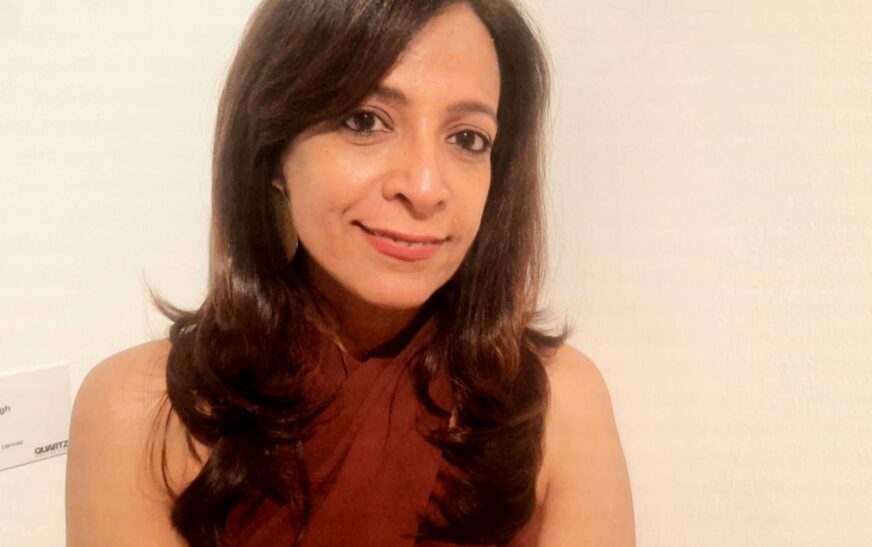
Gitanjali Kashyap is a distinguished Indian visual artist whose multidisciplinary art delves into spirituality, memory, language, and introspection through drawing, painting, and mixed-media expressions. After earning her training in Fashion and Textile Technology from Pearl Academy, New Delhi, she pursued formal artistic mentorship under the celebrated artist Rameshwar Broota at Triveni Kala Sangam. This formative journey helped shape a unique visual language that seamlessly integrates script, layered textures, and meditative mark-making.
Drawing inspiration from sacred texts, landscapes, and cultural narratives, Kashyap creates evocative works that invite reflection and deeper engagement. Her art transcends conventional aesthetics, offering contemplative spaces where visual expression intersects with philosophical inquiry and personal memory. Over the years, she has showcased her work extensively at prominent galleries and institutions across India and abroad. Her artistic excellence has earned her several prestigious accolades, including the Bombay Art Society Award and multiple awards from AIFACS. Today, her works form part of distinguished private collections around the world.
In an exclusive conversation with The Interview World, Gitanjali Kashyap at Parallels of Perception, organized by The Quartz Collective, at the Shridharani Art Gallery, Triveni Kala Sangam offers profound insights into her artistic journey and the ideas that animate her work. She discusses the thematic foundations of her practice, explains the distinctive qualities that set her art apart, reflects on the ways she cultivates meaningful engagement with audiences, and shares her vision for the future evolution of her creative exploration. Presented below are the key highlights from this thought-provoking and inspiring conversation.
Q: Could you describe your artwork in detail and elaborate on the ideas, inspirations, and narratives you seek to express through it?
A: My artistic practice engages deeply with contemporary themes, drawing significant influence from architecture and its inherent sense of structure and linearity. Consequently, lines have become my primary visual language and the principal tool through which I communicate ideas and emotions.
I employ lines in multiple forms; they may appear thin or bold, etched or engraved, delicately drawn or assertively painted. Regardless of their manifestation, they remain central to my creative vocabulary. Working primarily on paper with charcoal and graphite, I use these elemental materials to construct abstract, non-representational compositions that transcend literal depiction.
Rather than portraying recognizable forms, nature, or still-life subjects, my work seeks to evoke an emotional and sensory response. Through the interplay of lines, textures, and spatial rhythms, I aim to create an atmosphere of calm, serenity, and contemplation. The viewer is invited not to identify an object but to experience a feeling.
Furthermore, my reliance on a monochromatic palette reinforces this intention. Rooted in the philosophy of minimalism, my work embraces the principle that less can indeed express more. By eliminating visual excess, I strive to reveal a quiet yet powerful aesthetic that encourages reflection and inner stillness.
Q: What distinguishes your art from the work of other artists globally?
A: I closely observe developments in contemporary non-representational art. However, I often find that many works rely on highly saturated colour palettes or dense visual imagery that leave little room for quiet contemplation. This is purely a personal observation rather than an objective critique. In many instances, colour, form, and imagery dominate the visual field to such an extent that the subtler, almost musical resonances of the artwork struggle to emerge.
Consequently, I have consciously chosen a different path. I keep visual imagery to an absolute minimum and employ a restrained, almost austere colour palette. Instead of relying on colour to create impact, I construct form through the rhythm, movement, and interplay of lines. These lines generate a sense of flow and progression, creating cascading structures and gradual unfoldments that reveal themselves over time rather than all at once.
At a deeper level, my work reflects an inner journey: a movement toward self-discovery and expanded awareness. In this regard, I draw considerable inspiration from Eastern philosophical traditions, particularly Vedanta, which encourages one to turn inward and explore the depths of consciousness. The silence encountered in that inward journey profoundly influences my artistic practice.
Accordingly, space assumes a central role in my compositions. For me, empty space is never empty; it is a field of potential, a silent expanse charged with subtle energy. Much like a still surface awaiting the slightest vibration, this space becomes the source from which form emerges. Every line, mark, and movement arises from that silence and returns to it, creating a visual experience that invites reflection, stillness, and deeper engagement with the self.

Q: How do you connect and engage with your audience through your work? Do you consider your art forms to be more interactive than traditional forms of art?
A: I hope viewers spend time with my work rather than merely glance at it. The intricacy of the compositions and the meticulous attention to detail naturally invite closer engagement. In fact, the density and subtlety of the visual experience often compel passersby to stop, look again, and linger a little longer.
It is in that moment of stillness that the real interaction begins. When a viewer stands before the artwork in silence, a dialogue gradually unfolds between the work and the observer. The artwork does not impose a message; instead, it responds to the viewer’s presence. As the viewer’s inner silence encounters the subtle vibrations embedded within the work, a connection emerges. When those frequencies align, the experience can evoke a sense of harmony, calmness, and emotional resonance—much like perceiving musical overtones through a visual medium.
Therefore, the essence of my work reveals itself only through sustained engagement. These pieces are not designed for fleeting consumption. They demand more than a passing glance; they invite contemplation. The longer one remains with them, the more they disclose their layered rhythms, textures, and emotional nuances.
At the same time, I do not seek to impose a singular interpretation or an elaborate philosophical framework. Each viewer brings a unique sensibility, and consequently, each person may encounter a different meaning or emotional response. Yet beneath those individual experiences lies a common thread: a sense of peace.
I want my work to function as a soothing presence, a visual balm amid the relentless noise of contemporary life. Today, we are surrounded by an overwhelming flood of images, opinions, declarations, and ideological assertions. Art, too, often carries the weight of political, social, and intellectual commentary. While such expressions have their place, my intention is different.
Rather than adding another voice to the noise, I seek to create a space of quiet reflection. I want viewers to pause, however briefly, and experience a moment of stillness. In that pause, they may reconnect with themselves, find a measure of calm, and simply exist without distraction. That, perhaps, is the most meaningful conversation my work can inspire.
Q: Beyond your current artistic practice, what other areas or mediums would you like to explore in the future?
A: Paper remains my primary and most cherished medium. Over the years, I have developed a deep affinity for its versatility, tactile qualities, and expressive potential. I work with a wide range of archival papers, including watercolor paper, textured paper, hot-pressed surfaces, and cold-pressed varieties. Each type offers a distinct character and responds differently to mark-making, allowing me to explore subtle variations in texture, depth, and visual rhythm.
My practice relies predominantly on charcoal and graphite, mediums whose simplicity aligns perfectly with my minimalist aesthetic. Their restrained palette enables me to focus on form, movement, and emotion without the distraction of excessive colour or ornamentation.
At the same time, I remain curious about the possibilities of expanding the visual experience beyond the two-dimensional plane. This curiosity led me to explore ways of introducing a sculptural dimension into my work. Rather than treating the artwork as a flat surface, I began experimenting with forms that extend into space, thereby creating a more immersive and dynamic encounter.
As a result, the interplay of light and shadow became an integral component of the work. The shifting relationship between illumination and form adds another layer of depth and meaning, transforming static compositions into living surfaces that evolve with the viewer’s perspective. Through this exploration, I seek to bridge the gap between two-dimensional drawing and three-dimensional presence, allowing space, light, and materiality to participate actively in the visual narrative.
Q: How do you perceive the future trajectory of this artistic practice?
A: I believe my work resonates particularly strongly with younger generations, especially Gen Z and young professionals who are establishing themselves, building careers, and creating their own living spaces. This audience has largely embraced a contemporary aesthetic and sensibility. Their worldview, visual language, and lifestyle choices are shaped by modernity, and consequently, they often seek art that reflects those values.
In this context, my work seems to speak directly to them. While it is firmly rooted in a contemporary visual vocabulary, it also offers something increasingly rare in today’s fast-paced world: a sense of stillness. Many of my collectors are drawn not only to the modern character of the work but also to its ability to create a quiet, contemplative presence within their homes and workspaces.
As a result, a significant proportion of my collectors belong to a younger demographic. They connect with the minimalist and abstract language of the work, yet they also appreciate the emotional and psychological space it creates. The artworks function almost as sanctuaries of calm, places where one can momentarily withdraw from the constant flow of information, stimulation, and noise.
In many ways, this sensibility aligns with the principles of Zen philosophy. Although my work does not consciously seek to illustrate Zen concepts, it is undoubtedly influenced by a similar appreciation for simplicity, balance, silence, and mindful presence. Ultimately, I strive to create works that not only complement contemporary interiors but also enrich them with a sense of tranquillity and introspection.