

Salam Kisan, the precision agriculture arm of PRYM Group, has unveiled a nationwide Agri-Drone Business Franchise initiative to accelerate the digital transformation of Indian agriculture. The company launched the programme at Franchise India 2026 and plans to establish more than 100 agri-drone hubs across the country during the first phase, with a strategic focus on Tier 2 and Tier 3 markets. Through this initiative, Salam Kisan will empower entrepreneurs to deliver AI-enabled precision farming solutions, including crop surveillance, drone-based spraying, pest and disease detection, and advanced farm mapping services.
Moreover, the company is scaling this expansion on the strength of its proven operational success in Maharashtra, where it has already engaged more than five lakh farmers and serviced over 2.5 lakh acres of farmland. Backed by strategic collaborations with Microsoft and the Government of Maharashtra, Salam Kisan aims to drive sustainable rural employment, improve farm productivity, enhance farmer profitability, and catalyse technology-led economic growth across India’s agricultural ecosystem.
In an exclusive interaction with The Interview World, Dhanashree Mandhani, Founder & CEO, Salam Kisan discusses the company’s agri-drone franchise initiative and its differentiating capabilities. She explains how the franchise-led model can accelerate drone adoption among Indian farmers, shares insights into the scale of drone deployment on the platform, and outlines the underlying business and revenue framework of the initiative. In addition, she highlights the long-term value proposition for investors and examines the substantial growth potential and emerging business opportunities within India’s rapidly evolving agri-drone ecosystem. Here are the key insights from this compelling conversation.
Q: How did Salam Kisan conceptualize and build its drone-franchise initiative for farmers, and what are the distinctive features or innovations that differentiate this model from other agri-drone services in the market?
A: Salam Kisan operates as a fully vertically integrated agri-drone enterprise. The company manages the entire value chain internally, from drone manufacturing and pilot training to on-ground agricultural deployment and farmer services.
Its manufacturing arm, Prime Aerospace, develops DGCA-approved drones tailored for precision agriculture. Simultaneously, its training division, Prime Drone School of Excellence, prepares certified drone operators and entrepreneurs for large-scale field operations. Together, these entities create a tightly integrated ecosystem that enables Salam Kisan to execute end-to-end precision farming services with operational consistency and technological control.
At the core of this ecosystem sits Salam Kisan’s precision agriculture platform, which functions much like a two-sided digital marketplace. On one side are farmers seeking efficient crop-management solutions. On the other are drone entrepreneurs and operators who either purchase drones from the company or work directly as trained field personnel. Salam Kisan strategically deploys these operators across villages and district clusters, enabling them to serve farmers within their local geographies.
Farmers can access services through multiple channels, including phone calls, WhatsApp, the mobile application, or an AI-enabled chatbot. Once a service request is generated, the platform automatically routes the assignment to the nearest available agri-drone operator, who then visits the farm for assessment and execution.
However, Salam Kisan does not operate on a simplistic “spray-on-demand” model. Instead, the company follows a far more sophisticated “detect, prescribe, and spray” framework. Even when a farmer requests a specific chemical application, operators do not execute the instruction mechanically. Rather, trained personnel first analyse field conditions, identify crop stress or pest incidence, and then validate the requirement through the company’s AI-powered precision agriculture platform.
The process begins with digital farm mapping. Salam Kisan creates a plot-level map connected to satellite intelligence systems, enabling farmers to receive continuous satellite-driven advisory services. Subsequently, when a spraying request is initiated, the operator conducts pest and crop diagnostics directly through the company’s application. Based on this assessment, the platform generates a scientifically calibrated prescription. If the recommendation aligns with the farmer’s intended treatment, the spraying operation proceeds immediately. If not, the operator advises corrective measures before deployment begins.
This precision-led methodology generates substantial economic and environmental benefits. Traditionally, farmers tend to overuse agricultural inputs by nearly 30 to 40 percent. Drone-enabled precision spraying, by contrast, reduces fertiliser and pesticide consumption by a comparable margin. Water usage declines even more dramatically. Conventional spraying methods consume nearly 150 to 160 litres of water per acre, whereas drone spraying requires only 15 to 16 litres per acre.
Moreover, drone-assisted application significantly improves absorption efficiency. Leaf-level nutrient absorption rises by nearly 60 to 70 percent, while overall spraying efficacy, including nutrient delivery and pest control effectiveness, reaches up to 90 to 95 percent. Operational efficiency also improves sharply. Drone spraying completes one acre in approximately seven to eight minutes, whereas manual or hand-pump spraying often requires nearly two hours per acre. In addition, agri-drone deployment substantially reduces labour exposure to hazardous agrochemicals, thereby improving occupational safety in rural farming environments.
Beyond operational efficiency, Salam Kisan positions drone agriculture within a much larger geopolitical and economic context. The company argues that excessive fertiliser and pesticide application is no longer merely an agronomic issue; it has become a strategic economic concern. In an increasingly volatile global environment marked by supply-chain disruptions and rising input costs, uncontrolled fertiliser consumption can severely impact both farmer profitability and national economic resilience.
Consequently, Salam Kisan views its distributed network of drone operators not merely as service providers, but as an on-ground agricultural intelligence and awareness force. By combining satellite analytics, AI-driven recommendations, and local operator engagement, the company aims to educate farmers, optimise input usage, and systematically reduce agricultural waste at scale.
Q: Is the Indian agriculture sector ready for large-scale adoption of agri-drone platforms, and how long will it take for farmers to become familiar with and confidently adopt such innovations?
A: Over the past four years, Salam Kisan has reached nearly five lakh farmers and delivered drone-based spraying services across more than 2.5 lakh acres of farmland. This scale of adoption clearly demonstrates one critical reality: once farmers understand the economic value of precision agriculture, resistance to technology declines rapidly and acceptance accelerates naturally.
However, the adoption model itself remains crucial. Indian farmers may not necessarily purchase drones individually, but they are overwhelmingly willing to use drone-based services when those services become affordable, accessible, and economically beneficial. In India, technologies that generate visible financial advantages tend to scale quickly, particularly within farming communities where peer learning and social validation strongly influence behavioural change.
Farmers constantly observe neighbouring fields, compare outcomes, and evaluate productivity improvements in real time. Consequently, once a few early adopters demonstrate measurable gains, surrounding communities begin adopting the same practices at an accelerated pace. This network-driven adoption cycle significantly strengthens technology penetration in rural agriculture.
Therefore, the real challenge is not technological acceptance; it is market structuring. Asking individual farmers to invest directly in drone ownership creates a high-entry barrier and limits scalability. In contrast, enabling farmers to access drone services through a nearby trained operator dramatically improves adoption rates and operational reach.
This is precisely why the entrepreneurship-led franchise and custom-hiring-centre model becomes highly effective. The structure mirrors the long-established rural tractor economy in India. Typically, one entrepreneur purchases a tractor, while multiple farmers within the village utilise the service on a rental basis. Salam Kisan applies the same economic principle to agricultural drones.
Under this model, a local entrepreneur acquires and operates the agri-drone, while farmers across the village access precision spraying services without bearing the burden of capital investment. As a result, the entrepreneur generates recurring rental income and builds a sustainable rural enterprise. Simultaneously, farmers receive advanced precision agriculture services at an affordable cost, significantly improving productivity while reducing operational expenses.
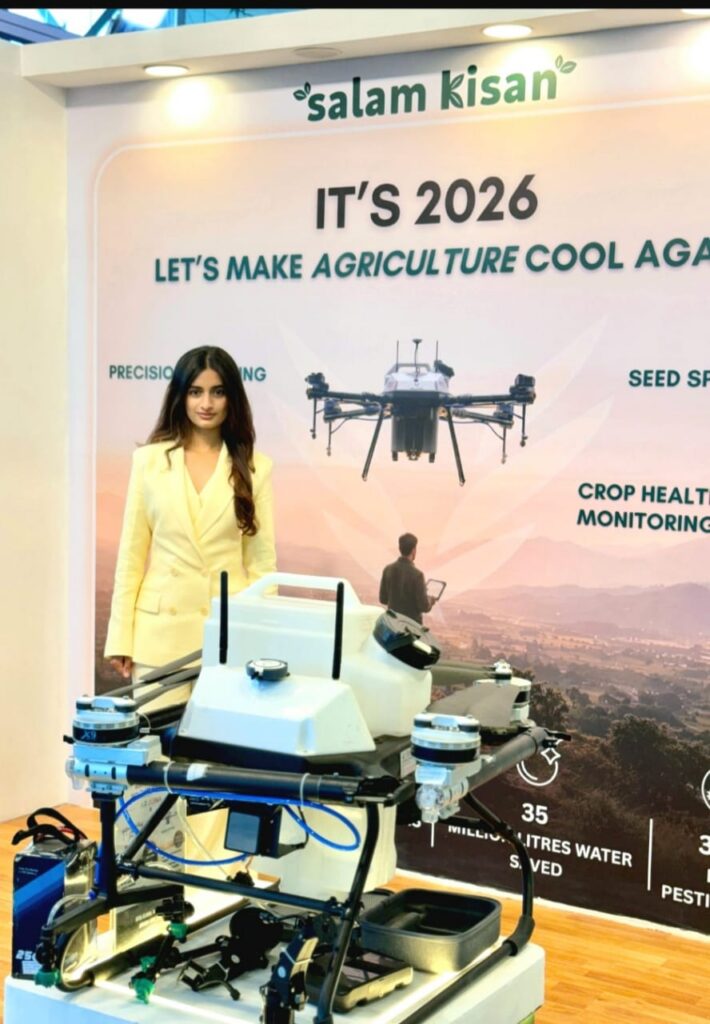
Q: How many drones are currently available on your platform, and do you also provide drone-hiring and allied services for large-scale or corporate farming operations?
A: Salam Kisan currently operates a fleet of 200 drones actively deployed across Maharashtra, where they deliver precision agriculture services at scale. In addition, the company has expanded its corporate farming operations into multiple states, including Assam, Uttar Pradesh, Gujarat, and Punjab, thereby strengthening its national operational footprint.
Building on this proven execution model, Salam Kisan is now launching a large-scale franchise opportunity that will enable entrepreneurs across India to establish and operate Salam Kisan drone-service centres within their respective districts. Through this initiative, franchise partners will not only contribute to agricultural transformation and rural productivity enhancement, but also build commercially viable and scalable businesses.
The company’s confidence in the model stems from operational evidence accumulated over the past four years. Salam Kisan has already demonstrated that drone-enabled precision agriculture can generate strong unit economics, recurring service demand, and sustainable profitability. Consequently, the franchise model combines measurable social impact with long-term entrepreneurial value creation, positioning agricultural drone services as a high-growth rural enterprise opportunity in India.
Q: What is the business and revenue model behind your drone-franchise initiative, and what kind of returns or long-term value can investors expect from participating in it?
A: Salam Kisan has structured its franchise model to create a scalable and economically attractive rural enterprise opportunity. The entry-level investment begins at approximately ₹20 lakh, under which franchise partners receive a fully integrated precision agriculture package designed for end-to-end farm mechanisation.
The package includes two agricultural drones and two custom-built electric mobility vehicles engineered specifically for transporting drones efficiently across rural terrains and farm clusters. In addition, franchisees receive an electric farm bull capable of performing critical agricultural operations such as sowing, weeding, and tilling. Consequently, the model extends beyond aerial spraying and enables broader mechanisation across multiple stages of farm activity.
Beyond hardware deployment, Salam Kisan also provides five-year access to its integrated digital agriculture ecosystem. Farmers connected to the platform gain access to advanced services such as farm plot mapping, pest-detection systems, satellite-driven advisory support, and WhatsApp-enabled agricultural guidance. Simultaneously, franchise operators receive enterprise-grade operational tools, including fleet management systems, booking and scheduling platforms, and revenue management infrastructure. Together, these systems create a technology-enabled operating framework that improves efficiency, scalability, and service coordination at the grassroots level.
Financially, the model offers strong revenue potential. Based on current operational performance, franchise partners can generate annual earnings of nearly ₹15 lakh to ₹18 lakh. Moreover, the estimated payback period for the overall investment remains under two years, making the business model commercially compelling for rural entrepreneurs and agri-service operators.
Operational scalability further strengthens the proposition. A two-drone franchise unit can serve nearly 1,500 to 2,000 farmers annually, enabling entrepreneurs to build a high-volume, recurring-service business with substantial long-term profitability. As a result, Salam Kisan positions its franchise network not merely as a drone-distribution model, but as a technology-driven agricultural infrastructure platform capable of delivering both economic returns and measurable rural impact.
Q: With over 500,000 registered farmers on your platform and growing adoption, what long-term growth potential and business opportunities do you foresee in India’s agriculture sector?
A: Salam Kisan has initiated the first phase of its nationwide franchise expansion with an ambitious target of entering 100 districts across India. The company has already established a strong operational presence in Maharashtra, where it currently operates in 30 out of the state’s 35 districts. Building on this foundation, Salam Kisan now aims to replicate and scale its precision agriculture model at the national level.
Under Phase 1 of the expansion strategy, the company plans to penetrate 100 strategically selected districts, creating deep rural access at the block and taluka levels. This network is expected to generate operational reach across nearly 1,000 block-level and taluka-level agricultural clusters, significantly expanding the company’s grassroots footprint.
Salam Kisan intends to anchor this expansion through its standardised two-unit franchise model, which the company believes is best suited for rapid rural deployment and scalable service delivery. Rather than concentrating operations only in major urban centres, the company is deliberately positioning franchise units within talukas and block-level ecosystems, where precision agriculture services remain largely underserved yet highly needed.
As a result, Salam Kisan envisions building a distributed rural technology infrastructure capable of accelerating drone adoption at scale. Over the next 12 months, the company aims to establish nearly 1,000 franchise units nationwide, thereby creating one of India’s largest decentralised agri-drone service networks.