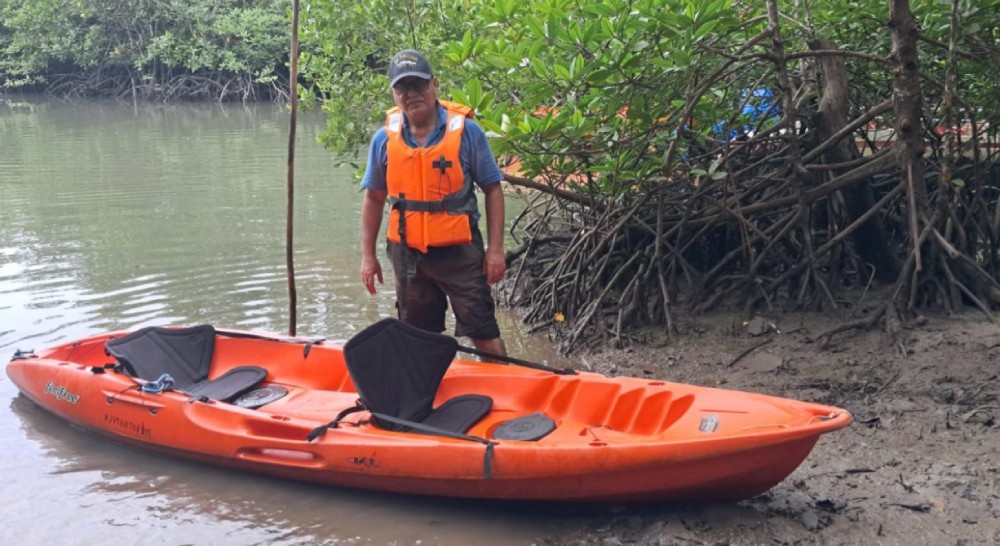

Vipul Dhasmana, Founder of Uttarakhand Marine Works, stands among India’s leading maritime experts, with distinguished experience spanning marine safety, vessel surveying, naval engineering, and regional journalism. A former Indian Navy officer, he served for 15 years as a Shipwright Artificer, where he specialized in ship construction and naval architecture. Building on this strong technical foundation, he has worked as a Marine Surveyor since 1994 and most recently served as the Chief Inland Vessels Surveyor for the Andaman and Nicobar Islands Administration.
Over the years, Dhasmana has emerged as a respected authority on inland water transportation and maritime safety regulations. He regularly delivers legal and technical expert briefings on the implementation of the Inland Vessels Act, 2021, with a particular focus on water transportation systems and adventure water sports safety protocols. Earlier in his career, he served as a Boat Surveyor for the Zila Panchayat in Tehri Garhwal, Uttarakhand, where he successfully tested and certified the Tehri Dam Reservoir Ambulance Boat for critical medical operations.
Dhasmana also specializes in the European Union’s Recreational Craft Directive (RCD). He strongly advocates for the adoption of similar regulatory standards in India to strengthen manufacturing quality, improve operational safety, and ensure that consumers benefit from globally benchmarked marine products and practices.
In an exclusive interaction with The Interview World, Dhasmana examines the long-term strategy and economic significance of maritime transportation in India. He analyses the sector’s structural and operational challenges while outlining the measures companies must adopt to make water sports safer, more reliable, and operationally resilient. In addition, he highlights the critical role of audits in the maritime ecosystem and explains how rigorous compliance frameworks create long-term value for stakeholders. He also shares compelling insights into the immense yet underexplored growth potential of India’s water sports industry. Here are the key insights from the conversation.
Q: With the government prioritizing maritime transportation at an unprecedented scale, how do you assess its long-term strategic and economic implications?
A: The implementation of the Inland Vessels Act, 2021 has significantly accelerated domestic economic growth by transforming India’s inland water transportation ecosystem. Enacted by Parliament, the legislation established a unified and modern regulatory framework for inland navigation, vessel safety, operational standards, and pollution control across the country.
More importantly, the Act has streamlined regulatory processes and improved the ease of doing business in the inland waterways sector. At the same time, it has modernized water transportation infrastructure and operational governance. As a result, transportation costs have declined considerably, enabling businesses to operate more efficiently and pass the economic benefits directly to consumers.
Q: What are the major challenges facing maritime transportation in India, and how can they be addressed to improve efficiency and competitiveness?
A: The implementation of the Coastal Shipping Act, 2025 will mark a major shift in India’s maritime policy framework by modernizing key provisions of the Merchant Shipping Act, 1958. The legislation aims to strengthen coastal cargo movement and increase cargo transportation capacity to 230 million metric tonnes by 2030.
At the same time, the Act seeks to simplify regulatory procedures and improve operational efficiency across the coastal shipping sector. It removes licensing requirements for Indian vessels, thereby reducing procedural bottlenecks and encouraging greater industry participation. Furthermore, the legislation proposes the creation of a National Coastal and Inland Shipping Strategic Plan to drive integrated growth, strengthen multimodal connectivity, and accelerate the expansion of India’s maritime economy.
Q: What measures should companies adopt to make water sports in India safer, more reliable, and operationally robust?
A: India’s adventure water sports sector has yet to achieve growth at par with international standards. The industry continues to face structural limitations primarily due to the absence of long-term vision, technical expertise, and a uniform regulatory policy framework. Consequently, the sector remains fragmented and underregulated despite its immense commercial and tourism potential.
As a Marine Consultant to the National Institute of Water Sports under the Ministry of Tourism, Government of India, and as a domain expert in Special Category Vessels (SCVs), I have consistently advocated for integrating the regulation of adventure water sports within the framework of the Inland Vessels Act, 2021. Importantly, the Act already contains provisions for the identification and regulation of Special Category Vessels, which can serve as the foundation for a robust national regulatory architecture.
However, states and Union Territories have yet to formally identify the SCVs currently operating in the adventure water sports ecosystem and notify them to the Inland Waterways Authority of India (IWAI). Once this classification process is completed, authorities can draft and implement uniform operational, safety, and compliance standards across the country. Such a framework would bring consistency, accountability, and greater institutional oversight to the sector.
At the same time, manufacturers of adventure water sports equipment and vessels must adopt a far more safety-centric approach. They need to strengthen technical capabilities, upgrade infrastructure, and invest in skilled human resources in line with globally accepted standards and best practices. Only then can India build a credible, safe, and internationally competitive adventure water sports industry.
Q: Why are safety audits essential in the maritime sector, and what measurable economic value do they create for stakeholders?
A: In the maritime sector, safety audits remain mandatory for both water transportation systems and adventure water sports operations. These audits play a critical role in ensuring operational safety, regulatory compliance, risk mitigation, and environmental accountability. More importantly, they strengthen institutional credibility and drive sustained growth in the maritime insurance sector by reducing operational uncertainties and enhancing stakeholder confidence.
Globally, nearly 80 percent of trade moves through shipping routes across oceans, seas, rivers, and inland waterways. This underscores the strategic importance of maintaining rigorous safety and compliance standards throughout the maritime ecosystem.
Against this backdrop, Uttarakhand Marine Works was established in 1994 to deliver specialized marine services in India and overseas markets. Over the years, the company has built expertise in the manufacturing of steel, fibre-reinforced plastic (FRP), and high-density polyethylene (HDPE) boats while consistently aligning its operations with evolving maritime safety and engineering standards.
Q: What is the growth potential of India’s water sports market?
A: The Adventure Water Sports Policy of the Andaman and Nicobar Islands remains one of the most progressive and well-structured frameworks in India. Nevertheless, the policy still offers significant scope for refinement and expansion. The Tourism Department can strengthen it further by actively engaging domain experts with global experience across diverse adventure and leisure water sports disciplines. Such collaboration would help align the policy with international safety standards, operational best practices, and emerging global tourism trends.
I have closely known the Andaman and Nicobar Islands since 1986, and I firmly believe the region possesses the natural advantage, marine ecosystem, and strategic potential to emerge as a premier international destination for adventure and leisure water sports. With the right policy support, infrastructure development, and regulatory execution, the Islands can position themselves among the world’s most sought-after marine tourism hubs.