

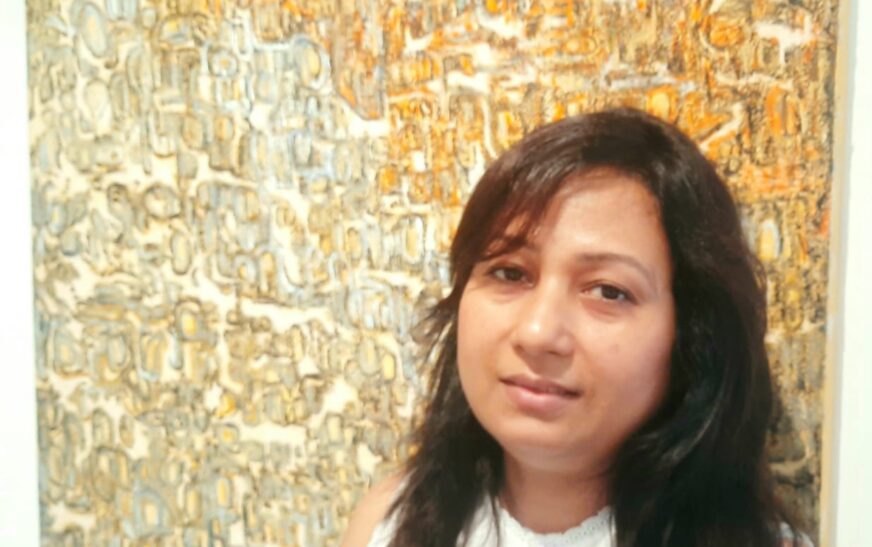
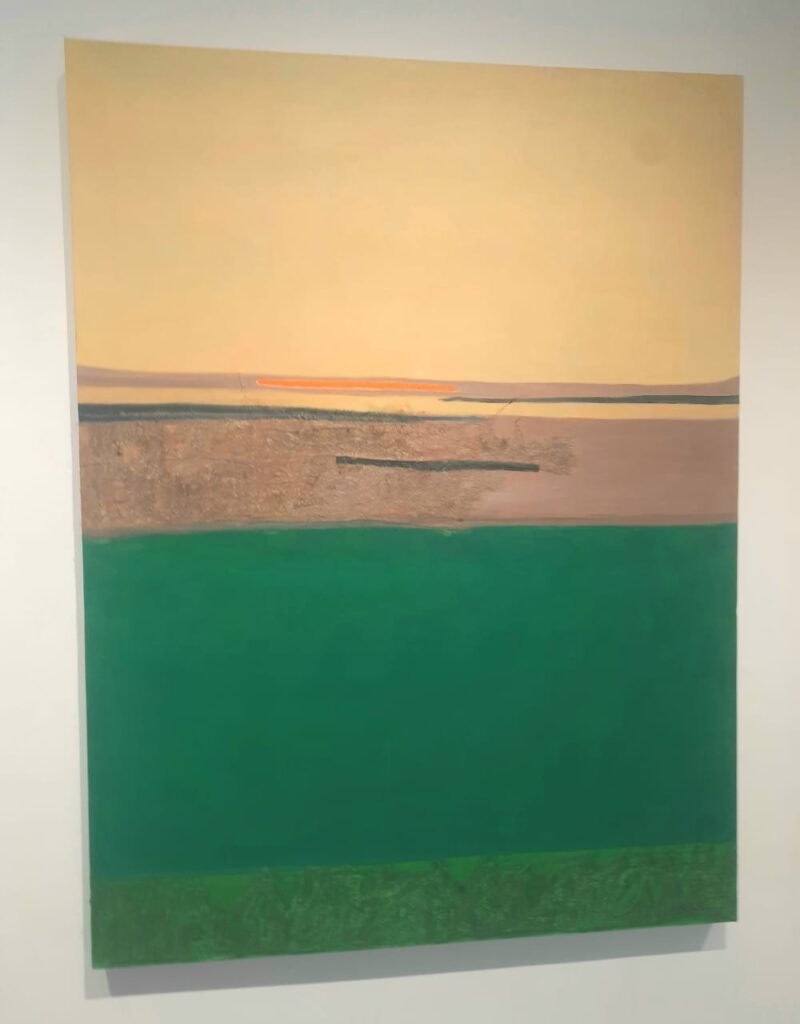
Dipa Patowary’s abstract paintings embody her interior landscape, charged with a sense of void that resists articulation and defies translation. When the inexpressible is rendered into form, and the untranslatable is forced into meaning, something inevitably fractures; nuance erodes, and fragments fall away. Her latest body of work consolidates a decisive turn toward abstraction. As an artist who asserts both her own autonomy and that of her audience, she situates experience within the individual rather than the collective. Consequently, her works do not generalize; they address the singular. She engages viewers directly, extending each piece as a personal offering, an intimate exchange between creator and recipient.
In an exclusive conversation with The Interview World at Triveni Kala Sangam, Patowary reflects on her artistic evolution, articulates her engagement with abstraction, and clarifies the thematic undercurrents of her practice. She also assesses market reception, examines how her work connects with diverse audiences, and explains why her themes resonate across contemporary India. What follows are the key insights from that discussion.
Q: What’s your journey been like as an artist, and how does it connect to the work you’re showing here?
A: Guwahati remains my place of origin; however, for the past decade, I have built my practice in New Delhi. During this period, I have worked consistently, refining both form and intent. I currently hold a studio at Lalit Kala Akademi, and I have earned national selection on three separate occasions.
Here, I present a body of abstract work. I engage deliberately with colour relationships, while simultaneously exploring texture and structural formation. Through this process, I construct visual fields that privilege sensation over representation.
Q: What overarching ideas or themes are you exploring in this exhibition?
A: Primarily, I work within the domain of abstract art; therefore, I do not anchor this exhibition in a fixed theme or narrative. Instead, I foreground affect. I focus on how the mind responds: how it registers colour, processes shifting formations, and generates sensation in real time. As viewers encounter these visual configurations, the brain reacts instinctively; it interprets, associates, and feels before it seeks meaning.
Likewise, when I revisit my own work, it does not remain static. Rather, it continues to provoke new thoughts, often revealing different readings with each viewing. Consequently, the work evolves not only in its making but also in its reception. Looking ahead, this evolution will likely extend to my formal language. My use of colour and the logic of my formations may shift; however, I will continue to work within abstraction, allowing the practice to transform organically over time.
Q: What kind of response has your work been getting?
A: Viewers respond positively to my work; however, many initially lack a clear understanding of abstraction. Consequently, they engage me in conversation, and I articulate my approach while also listening to their interpretations. Through this dialogue, they begin to grasp how abstract art operates beyond literal representation. As a result, their engagement deepens, and the response remains both affirmative and ongoing.
Q: How does your art connect with a broader audience?
A: Viewers often seek recognizable imagery; therefore, they look for forms they can immediately identify. However, when confronted with abstraction, they struggle to decode the formations and search for fixed meaning. In response, I clarify that the work does not require explanation, it operates through feeling. If the intent were to explain or narrate, I would have chosen the language of poetry or writing. Instead, I work visually. I engage directly with sensation, using colour and formation to evoke responses that precede, and often exceed, verbal interpretation.
Q: You mentioned being selected for a national-level recognition three times. Could you elaborate on those selections and the awards or distinctions involved?
A: This is not an award; rather, it is a highly selective national inclusion. Artists from across India, often numbering around 30,000, submit their work, yet only about 300 are chosen overall. Within that limited cohort, multiple disciplines compete, including photography, painting, and sculpture. Consequently, each category accommodates only a small fraction of artists, typically no more than 20 to 30. That is the distinction I wish to underscore.
Q: In what ways does your practice translate regional experiences into themes that resonate more broadly across India?
A: Although I come from Guwahati, I do not deliberately embed overt cultural markers in my work. Instead, I rely on instinctive, unconscious gestures. These strokes emerge without premeditation; therefore, I cannot always determine whether they reflect specific cultural imprints. The mind absorbs countless experiences, and it releases them unpredictably. Consequently, I do not control which memory or influence surfaces at a given moment.
In this sense, the work originates in the subconscious. It is there that disparate impressions converge and take form. As a result, any cultural resonance remains implicit rather than explicit. Nevertheless, this subconscious process establishes a quiet yet powerful connection with viewers, and I am confident that they engage with the work on that deeper, intuitive level.


1 Comment
Your advice is exactly what I needed right now.
Comments are closed.