AI is no longer a peripheral capability layered onto enterprise systems; it is rapidly becoming the structural core of modern business architecture. As organizations confront compressed innovation cycles, rising data complexity, and intensifying competitive pressure, the imperative has shifted from experimentation to operationalization. Enterprises now seek AI systems that are secure, domain-aware, scalable, and economically viable, solutions that move beyond pilots to measurable business impact.
It is within this context that Nextdot, a Gurgaon-based digital creative and AI-driven marketing firm, is positioning itself as a strategic architect of intelligent enterprise ecosystems. By embedding AI directly into production workflows through its Content Process Outsourcing (CPO) model, the company integrates automation, analytics, and creative execution into a unified delivery engine. Simultaneously, it designs bespoke AI agents across operations, healthcare, and marketing, each engineered to address tightly defined business challenges with precision.
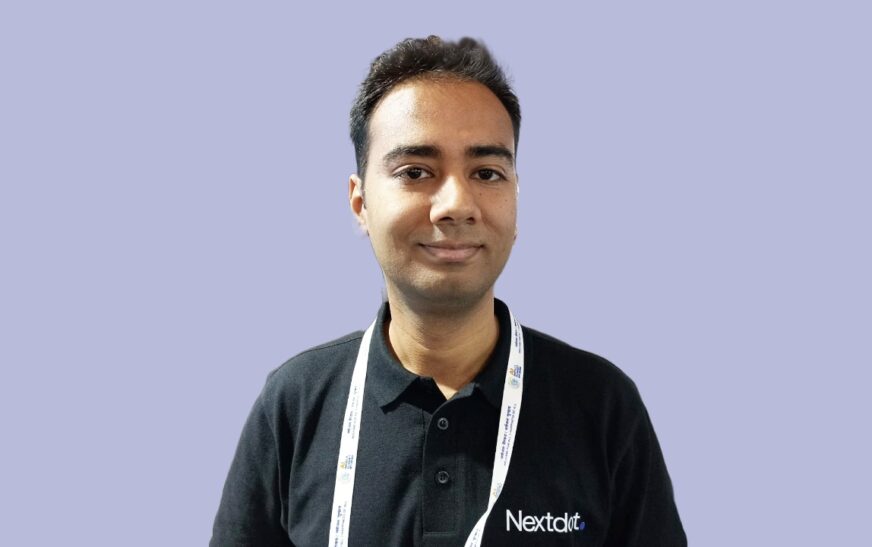
In an exclusive conversation with The Interview World at the India AI Impact Expo 2026, Ayush Prashar, Founder of Nextdot, outlines the company’s three-vertical AI strategy, secure LLM deployment framework, pricing philosophy, talent model, and long-term ambition to replace monolithic enterprise software with modular, interoperable AI agent ecosystems. Here are the key takeaways from his insightful discussion.
Q: What are Nextdot’s primary AI capabilities, and how does its platform help enterprises accelerate the operationalization of AI agents?
A: We operate across three distinct verticals.
First, we focus on AI engineering. This practice remains industry-agnostic. We partner with organizations across sectors, identify granular operational pain points, and design bespoke AI agents to address them. We deploy these solutions primarily in B2B environments. Consequently, we drive operational excellence, process optimization, and measurable efficiency gains.
Second, we lead a specialized AI vertical for healthcare. We have worked in this domain for nearly a decade. Over time, we have identified high-impact niche challenges across healthcare, pharmaceuticals, and insurance. Accordingly, we build AI solutions that strengthen regulatory compliance, deepen understanding of medical technologies, and enable compliant content marketing within tightly governed frameworks. This vertical reflects both domain depth and regulatory fluency.
Third, we develop AI applications for the creative and media industries. Here, we design AI systems specifically for marketing leadership, particularly Chief Marketing Officers (CMOs). Our platforms enable marketing teams, across every level, from the CMO to frontline associates, to interact directly with their data. As a result, teams extract role-specific insights in real time and make faster, evidence-based decisions.
In essence, we combine domain specialization with intelligent system design. We solve micro-level business problems. We empower decision-makers with contextual data. And ultimately, we accelerate execution across operations, healthcare, and marketing ecosystems.
Q: Do you offer data center or managed infrastructure services for hosting client applications and securely storing customer data?
A: At present, we operate on shared infrastructure. We provision GPUs, CPUs, and a range of data services as required. However, we are not yet operating at hyperscale or managing massive big data environments. Instead, we work closely with enterprises that prioritize stringent data security and governance standards.
Accordingly, we design and deploy localized large language model (LLM) environments tailored to each client’s proprietary datasets. We do not rely solely on generic models. Rather, we adapt and fine-tune systems within secure, controlled ecosystems. This approach ensures contextual accuracy while preserving data integrity.
Moreover, we emphasize robust data observability. We continuously monitor model behaviour, track performance metrics, and evaluate how each LLM responds within enterprise-specific use cases. We scrutinize outputs, reinforce guardrails, and refine models to align with compliance and operational requirements.
Looking ahead, scalable infrastructure will become indispensable. As adoption accelerates and data volumes expand, the demand for dedicated data centers and high-performance computing environments will intensify. We recognize this trajectory. Consequently, we are preparing to scale our infrastructure capabilities to meet the next phase of AI-driven enterprise transformation.
Q: Could you share insights into your client landscape, including the industries you serve and the typical profile of your customers?
A: At present, our client portfolio reflects a focused geographic strategy. Approximately 70 percent of our clients operate in India, while the remaining 30 percent are based in the United States and the GCC region. We have deliberately concentrated on these two international corridors. Although we intend to expand into additional markets, we currently maintain disciplined geographic focus.
In total, we serve 57 clients. Each engagement involves a large enterprise within its respective industry. We do not target small or mid-sized businesses. Instead, we work with organizations that require scale, governance, and enterprise-grade AI deployment.
Client value, however, varies significantly. It depends on the complexity and scope of the problem we solve. Some mandates involve narrowly defined AI agents. For example, we recently built a specialized voice agent for a healthcare organization. The system interacts with patients on behalf of doctors outside consultation hours. It enables appointment scheduling at any time while delivering contextually accurate, responsive communication. Such solutions are tightly scoped yet highly impactful.
Conversely, other engagements demand broader AI architecture, multi-layer integrations, and long-term optimization. As a result, ticket sizes vary considerably. Our pricing reflects the depth of problem-solving, the scale of deployment, and the strategic value delivered.
Q: Can you explain your pricing model across verticals and the value differentiation that supports its competitive positioning?
A: We offer rigorously competitive pricing. At the same time, we deliver enterprise-grade capability. In terms of brand visibility and strategic positioning, we operate with the same conviction and clarity that global consulting leaders such as Accenture demonstrate on their platforms. We articulate our value proposition confidently and execute at comparable strategic depth.
Moreover, we collaborate with leading AI technology providers. For instance, we partner with ElevenLabs to integrate advanced voice capabilities into our solutions. These alliances strengthen our architecture and expand the sophistication of our agent ecosystems.
Within the services landscape—particularly among AI agent–building firms—we position ourselves in the mid-market enterprise band. We are neither a boutique experimental shop nor a large, legacy integrator. Instead, we combine agility with enterprise discipline. Looking ahead, we aim to scale upward. However, we remain clear on one principle: pricing must never become a barrier to adoption. Our immediate priority is to build and deploy more high-impact agents while maintaining accessibility.
One of our distinct differentiators lies in talent strategy. We believe Gen Z professionals are building the most adaptive and innovative AI agents. They learn rapidly, iterate quickly, and embrace emerging AI frameworks with minimal friction. Consequently, we have intentionally invested in young, high-velocity talent.
In parallel, we identified a structural opportunity beyond India’s conventional corporate corridors. Rather than concentrate exclusively in the glass towers of Gurgaon and Noida, we chose to expand into Tier-2 ecosystems. Accordingly, we established our AI Capability Center in Jamshedpur, in the state of Jharkhand. While our headquarters remain in Gurgaon and we maintain branch offices in Mumbai and Bangalore, we see long-term strategic value in decentralizing AI capability. We are also working closely with local authorities in Jamshedpur to scale the center to any required size.
Ultimately, we prioritize client outcomes above all else. We engineer solutions that deliver measurable impact. And we ensure that every client extracts maximum value from our AI systems, without compromising on cost efficiency.
Q: What are the next layers of innovation you are planning to pursue over the next five to ten years?
A: A five- to ten-year horizon is too distant in the current AI cycle. The landscape is recalibrating every two years. Therefore, a three-year outlook offers a more realistic planning window.
Over the next three years, we intend to penetrate the enterprise supply chain layer. Historically, platforms such as SAP and Oracle have anchored mission-critical workflows for large organizations. We aim to reimagine that paradigm. Instead of monolithic software suites, we will architect interconnected micro-service AI agents. Each agent will execute a specific operational function. Collectively, they will form an intelligent, modular ecosystem.
Moreover, these agents will not operate in isolation. We will link them through shared data layers and orchestrated workflows. As a result, enterprises can replace rigid legacy systems with adaptive, continuously learning AI infrastructures. This shift will reduce dependency on heavyweight platforms and introduce flexibility at scale.
Ultimately, our strategy centers on democratization. We want businesses of every size, not just large enterprises, to access modular, enterprise-grade AI agents. By lowering structural and cost barriers, we will make intelligent automation ubiquitous rather than exclusive.