
Aap Ka Awas is an innovative construction technology company focused on delivering cost-effective, sustainable, and environmentally responsible housing solutions across India. It advances its Integrated Hybrid Solution-One (IHS-One), a partially precast construction system that enables faster execution, higher durability, and improved environmental performance compared to conventional construction methods.
The company leverages a suite of engineered components, including Interlocking Nutan Bricks, Prabal Joists, and RCC Planks, to reimagine affordable housing and large-scale construction. In addition, it offers end-to-end services spanning design, construction, supervision, and training. Through these offerings, Aap Ka Awas equips homeowners, contractors, and construction workers with modern building technologies that improve efficiency, quality, and environmental outcomes.
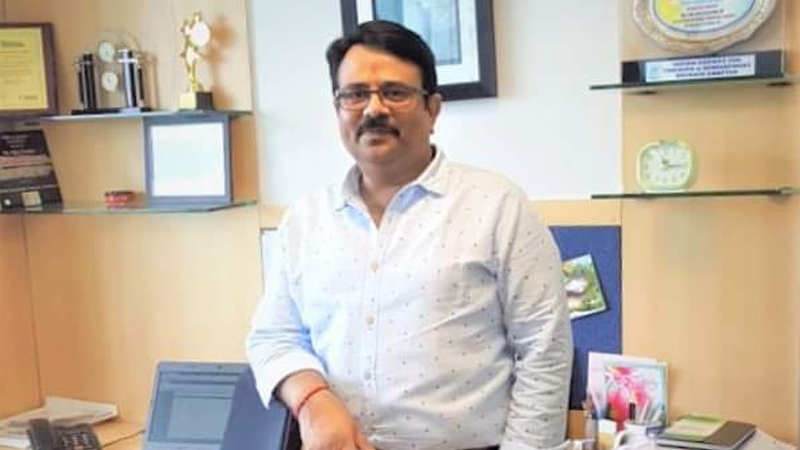
In an exclusive conversation with The Interview World at the NAREDCO Real Estate Conclave 2026, Saket Mehra, Founder & CEO of Aap Ka Awas, outlines the company’s core solutions for affordable housing in India. He highlights the structural safety, durability, and long-term resilience of its housing systems and explains the key components that define their construction approach. He also discusses alternative technologies available in the market and positions his solution within that broader ecosystem.
Further, he emphasizes the ability of these structures to withstand seismic forces, shares his perspective on the current state of affordable housing in India, and outlines how the sector is likely to evolve over the next five years. He also provides insight into the average cost of constructing a 600-square-foot home and discusses market response to such housing technologies. Overall, he underscores the strong demand potential in the Indian market for scalable and affordable housing solutions.
Q: What are the core solutions offered by Aap Ka Awas, and how are they helping make affordable housing more accessible, scalable, and sustainable in India?
A: Aap Ka Awas is redefining affordable housing by delivering ultra-low-cost construction without compromising structural integrity. It provides RCC structures at highly competitive prices while maintaining quality and durability.
The system organizes construction into three core components: walling and roofing. The roofing system itself consists of two integrated elements. These components come together through a precise interlocking mechanism that ensures structural cohesion and stability.
The approach functions like a Lego-style assembly system, where standardized elements fit together seamlessly to form a complete structure. As a result, construction becomes simpler, more systematic, and significantly faster.
This innovation directly addresses a long-standing challenge in civil construction, especially for individuals building homes for personal use. Consequently, Aap Ka Awas has streamlined the process and enabled construction speeds that are up to 200% faster, while also making it far more cost-efficient.
Q: How do Aap Ka Awas buildings perform in terms of structural safety, durability, and long-term resilience?
A: This housing system represents one of the most standardized approaches to modern construction. It delivers significantly higher reliability and consistency compared to conventional methods. In fact, its durability is up to twice that of traditional construction.
Unlike conventional practices, which often depend heavily on contractor skill and on-site discretion, this system removes that variability. Instead, it operates on a plug-and-play architecture where each component follows a predefined, engineered sequence.
As a result, it eliminates scope for arbitrary execution. Neither contractors nor on-site workers can compromise quality, since every element must fit within a structured and controlled assembly process. This disciplined framework defines the core technological foundation of the system.
Q: What are the three primary structural components used in this building system, and what role does each component play?
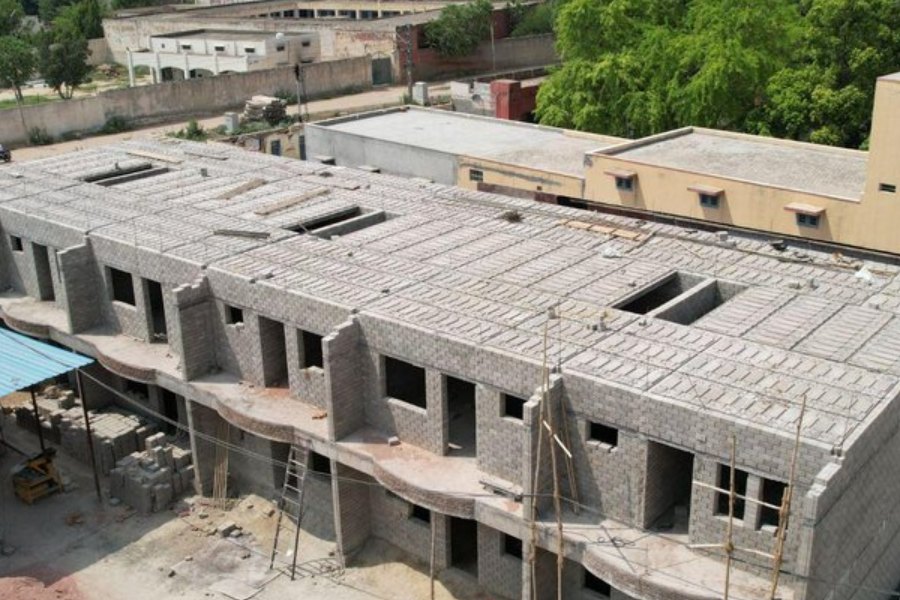
A: The system begins with interlocking bricks that do not require mortar. These M15-grade bricks provide high compressive strength and form the load-bearing walls of the structure.
Next, the roofing system uses a joist and plank configuration designed for structural efficiency and durability. These engineered components work together to ensure stability and uniform load distribution.
Finally, all three elements, interlocking bricks, joists, and planks, integrate seamlessly into a unified construction system. Together, they form a complete and cohesive structural framework.
Q: What alternative construction methodologies or technologies are your competitors currently introducing in the market?
A: Several construction technologies exist in the market, with around seven to eight distinct methodologies currently in use. Each offers a different approach to building systems and execution models.
Aap Ka Awas operates within this broader ecosystem as one of the available solutions. However, it positions itself as one of the most cost-efficient options in the country.
Q: Are these housing structures designed to withstand seismic activity, and how do they perform in earthquake-prone regions?
A: These housing structures are engineered to comply with the highest seismic safety standards and are designed to withstand conditions prevalent in Seismic Zone V, the most earthquake-prone category. Their resilience has been demonstrated through projects executed in the aftermath of the Bhuj earthquake, where the need for safe, durable, and rapidly deployable housing solutions became critical.
Following the disaster, Aap Ka Awas successfully delivered construction projects in Vapi, Anjar, and Ahmedabad. The structure being showcased here is part of the Ahmedabad project, reflecting the system’s proven performance, structural robustness, and suitability for deployment in high-seismic-risk regions.
Q: What is your perspective on the current state of affordable housing in the country, and how do you see it evolving over the next five years?
A: The construction sector primarily serves builders and contractors. However, a far larger opportunity exists within the Beneficiary-Led Construction (BLC) segment, where individuals build homes for themselves. In fact, the BLC segment accounts for nearly 65–70 percent of the country’s total housing demand, making it the largest housing market in India.
Aap Ka Awas focuses specifically on this segment. The objective is simple yet transformative: enable individuals to construct their homes faster, more efficiently, and at a significantly lower cost. By simplifying the construction process, the company empowers beneficiaries to build quality housing without the complexities typically associated with conventional construction.
Moreover, the technology is equally relevant for both urban and rural housing. Its small-panel construction system allows components to be assembled manually, eliminating the need for specialized tools, heavy machinery, or cranes. As a result, construction becomes more accessible, particularly in locations where infrastructure and equipment availability remain limited.
Most importantly, the system enables the construction of structures up to Ground Plus Three (G+3) floors with minimal dependence on specialized equipment. This combination of affordability, scalability, and ease of deployment positions the technology as a practical solution for addressing India’s large and growing housing demand.
Q: What is the approximate cost of building a full-fledged house?
A: To put the economics into perspective, the government classifies a 600-square-foot dwelling as a Low-Income Group (LIG) house. Using our construction technology, such a house can be completed at an approximate cost of ₹6.5 lakh.
In other words, a construction budget of nearly ₹1,000 per square foot is sufficient to deliver a structurally sound and complete home. This cost efficiency significantly lowers the financial burden on homeowners while making quality housing more accessible to a larger segment of the population.
Q: What kind of market response have you received for these products?
A: We have received an overwhelmingly positive response from the market. Customers, developers, and other stakeholders have shown significant interest in the technology and its potential to transform affordable housing. However, the primary challenge we currently face is technology adoption, a challenge we are actively addressing in collaboration with government agencies and industry stakeholders.
The hesitation is understandable. For most families, building a home represents a lifetime investment funded by years of hard-earned savings. Consequently, people naturally seek assurance regarding structural quality, durability, and long-term reliability before embracing a new construction methodology.
To address these concerns, we adhere to established quality and regulatory standards. Our technology operates under a dedicated Indian Standards (IS) code that was introduced in 1994. Since then, we have consistently followed the prescribed standards and specifications with strict discipline. This commitment ensures uniformity, reliability, and quality across every project.
Moreover, we maintain complete control over the manufacturing process. We do not outsource or subcontract the production of our core building components. By retaining manufacturing in-house, we ensure rigorous quality control at every stage, eliminate variability, and deliver a product that consistently meets our performance and safety benchmarks.
Q: Do you have plans to expand this technology for affordable housing into international markets or other countries?
A: India alone presents an enormous opportunity. The scale of the country’s housing demand is so vast that it could take decades to fully address it. Consequently, our immediate focus remains firmly on the domestic market rather than overseas expansion.
The reality is that India continues to face a substantial need for affordable, high-quality, and rapidly deployable housing solutions. As a result, the market offers immense growth potential and sufficient room for innovation and scale. For now, our priority is to contribute meaningfully to meeting this demand and to strengthen our presence across the country before exploring opportunities beyond India’s borders.