
Bandhan Konnagar is a not-for-profit organisation established in 2001 with a clear mission: to empower women and alleviate poverty. Over the past 25 years, it has pursued sustainable social and economic transformation by expanding access to livelihoods, financial inclusion, education, healthcare, skills development and social protection.
The organisation delivers a diverse portfolio of programmes spanning education, financial literacy, healthcare, sustainable livelihoods, climate action and targeted interventions for the most vulnerable communities. Working across multiple states in India, Bandhan Konnagar places women at the heart of development. At the same time, it addresses the structural causes of poverty through holistic, community-led interventions designed to create lasting change. It also contributes to development research and knowledge-building on critical issues related to nation-building and inclusive growth.
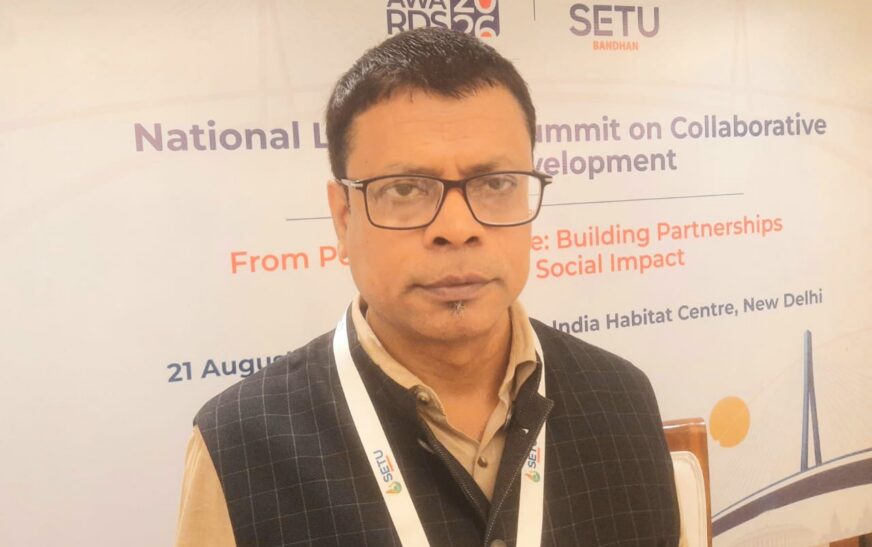
In an exclusive conversation with The Interview World at SETU 2026, organised by Bandhan Konnagar, Sanjib Kumar Das, CEO, Bandhan, reflects on the organisation’s 25-year journey of transforming rural communities. He highlights the impact Bandhan has created on the ground and offers insights into the role of key stakeholders in advancing inclusive development. He also outlines his vision for Bandhan Konnagar over the next decade, with a focus on deepening impact and building more resilient and empowered communities.
Here are the key takeaways from his compelling conversation.
Q: Bandhan has completed 25 remarkable years. Looking back, what have been the defining moments and milestones that shaped Bandhan’s journey?
A: The journey of Bandhan Konnagar over the past 25 years has been both remarkable and deeply rooted in community transformation. We began our work in 2001, and since then, we have worked closely with vulnerable communities, particularly those living at the last mile of rural India.
These communities continue to face persistent challenges. Many families have limited access to sustainable livelihoods and stable incomes. They also struggle to access quality education, healthcare and essential social protection. As a result, poverty often becomes intergenerational and limits their ability to build secure and dignified lives.
The government, meanwhile, has launched several transformative initiatives and social-security programmes to address these challenges. However, the real challenge lies in ensuring that these benefits reach the people who need them most. This is where Bandhan Konnagar plays a critical last-mile role.
We work with vulnerable families and connect them with the government’s welfare and social-security ecosystem. We help beneficiaries understand, access and enrol in relevant government schemes and platforms. In doing so, we bridge the gap between policy and the people it is intended to serve.
Finally, our objective is not merely to facilitate access to benefits. It is to empower families to access opportunities, strengthen their livelihoods and build more secure futures. By connecting communities with the resources and institutions available to them, Bandhan Konnagar is helping turn government programmes into meaningful outcomes on the ground.
Q: What has been the most significant impact Bandhan has created over its 25-year journey?
A: If I reflect on the impact of Bandhan Konnagar, the story is both compelling and deeply encouraging. Over the past 25 years, we have transformed the lives of 46 lakh families by creating pathways to livelihoods, financial security, education, healthcare and social protection.
For us, transformation means enabling families to move from subsistence to sustainable incomes. For instance, a woman from a rural village who once earned ₹2,000–₹3,000 a month can now earn ₹12,000–₹15,000 through livelihoods, enterprise development and access to government schemes, including Direct Benefit Transfer (DBT). Many of these women are now emerging as “Lakhpati Didis,” women whose annual household income has crossed ₹1 lakh. More importantly, they are building multiple enterprises and income streams, fundamentally changing the economic trajectory of their families.
This transformation extends beyond income. As household incomes become more stable, children are staying in school and gaining better access to education. Families are also accessing primary healthcare and insurance, which provides greater protection against financial shocks. At the same time, senior members of these households are gaining access to pensions and other social-security benefits, giving them greater financial dignity and security.
Therefore, our impact goes far beyond individual interventions. We follow a multi-pronged approach that addresses the interconnected challenges faced by vulnerable rural communities. We help families who have historically remained excluded access livelihoods, education, healthcare, insurance, pensions and government welfare programmes. As a result, they are gradually moving from the margins into the mainstream of economic and social development.
Ultimately, our endeavour is to ensure that no family is left behind. We want vulnerable communities to become empowered, self-reliant and active participants in India’s development journey, and, in doing so, become meaningful contributors to the vision of Viksit Bharat.
Q: Which stakeholders play a key role in making this scheme successful?
A: Our most important stakeholders are the Government of India and various state governments, with whom we work closely to advance inclusive development and ensure that public programmes reach the communities that need them most.
At the same time, we work with a wide range of corporate organisations that are committed to creating meaningful social impact. These partnerships bring together resources, expertise and innovation to address pressing development challenges. We also collaborate closely with civil society organisations and CSR institutions, creating a broader network of partners working towards shared social goals.
We firmly believe that sustainable transformation cannot happen in isolation. No single institution can address the complex and interconnected challenges facing communities on its own. Meaningful change requires collaboration, coordination and a shared commitment to outcomes.
That is why collaboration remains central to Bandhan’s approach. We are working to build a larger and more integrated ecosystem in which governments, corporates, civil society organisations, CSR institutions and communities can work together. By bringing these stakeholders onto a common platform, we can combine their strengths, extend our reach and accelerate transformation at scale.
Eventually, our goal is to create an ecosystem where every stakeholder contributes to a shared vision, and where collective action translates into lasting impact for communities.
Q: Looking ahead, what do you envision for Bandhan over the next decade?
A: Over the next 10 years, our ambition is clear: to work with the Government of India and other stakeholders to help eradicate poverty in India. This is one of our most important goals. We do not want to see any family remain trapped in poverty or excluded from the country’s development journey. We have therefore committed ourselves to making a meaningful contribution towards ending poverty over the next decade.
We know that such a transformative goal cannot be achieved alone. We will work closely with the Government of India, state governments and the broader corporate ecosystem to strengthen livelihoods, expand opportunities and ensure that vulnerable communities can participate fully in economic growth.
At the same time, we will place a strong emphasis on strengthening foundational and school education in rural India. Our objective is not simply to ensure that every child enters school. We want every child to stay in school and complete their education. Although school enrolment has improved significantly, many children continue to drop out before completing their secondary and higher-secondary education. We want to change that.
Therefore, over the next decade, we will work to ensure that every child completes secondary education and progresses through higher secondary education. More importantly, we want young people to transition successfully from education to skills, employment and sustainable livelihoods.
Our vision is to create a pathway that takes a child from school to skills, from skills to employment, and from employment to economic independence. If we can achieve this at scale, we can break the cycle of intergenerational poverty and help build a more inclusive and prosperous India.