


Established in 2011 as the social development arm of Indian Metals and Ferro Alloys Limited (IMFA), the Bansidhar & Ila Panda Foundation (BIPF) has remained steadfast in its mission to uplift Odisha’s most marginalized communities. Inspired by the vision of IMFA’s founders—Late Dr. Bansidhar Panda and Late Mrs. Ila Panda—the foundation brings to life its guiding philosophy: “Touching Lives beyond Business.”
BIPF operates at the grassroots level across five underserved districts—Keonjhar, Jajpur, Rayagada, Angul, and Cuttack. Here, it drives large-scale, transformative impact through focused interventions in healthcare, education, livelihoods, water and sanitation, and community advocacy. The foundation doesn’t work in isolation—it forges strategic alliances with government bodies and both local and international organizations. Together, they empower nearly 200 villages by instilling a sense of community ownership, championing gender equity, and catalyzing behavior change.
Long before Corporate Social Responsibility (CSR) became a statutory obligation, BIPF had already pioneered scalable and impactful development models. With a sharp emphasis on women and youth, the foundation continues to translate its legacy of compassion and social responsibility into measurable change. From disaster-prone hamlets to remote tribal pockets, BIPF transforms fragile ecosystems into resilient, self-sustaining communities.
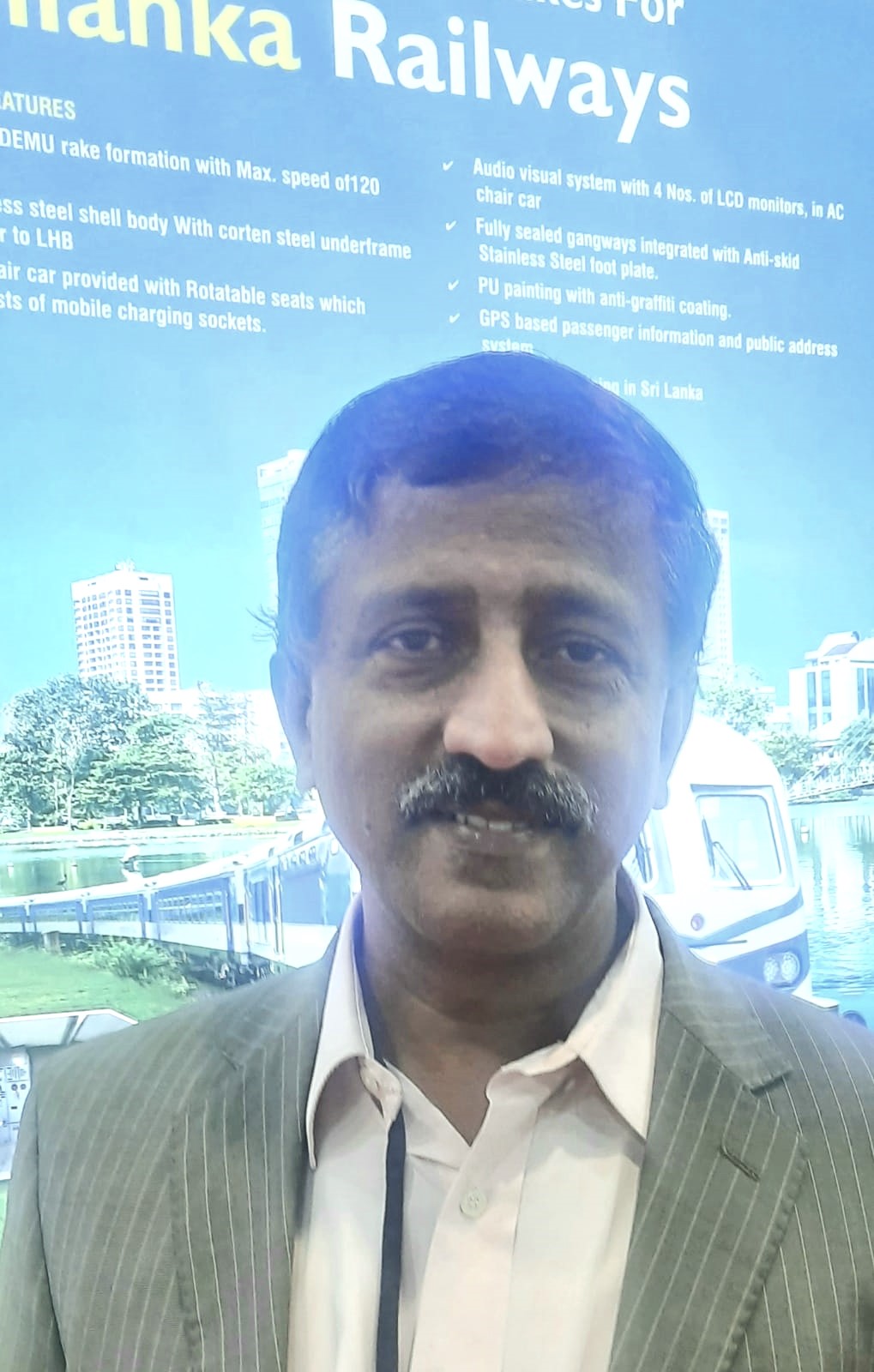
At the FICCI CSR Summit and Awards, The Interview World sat down with Dharmesh Gohel, Vice President of BIPF, for an exclusive conversation. He shed light on the foundation’s deeply rooted work with underserved populations—particularly women—and shared insights into its expansive outreach in education and empowerment. He outlined BIPF’s future growth plans, underscored the sustainability of its empowerment models, and emphasized the pivotal role CSR plays in building an inclusive and developed nation.
What follows are key takeaways from this powerful and insightful exchange.
Q: How is the Bansidhar & Ila Panda Foundation driving meaningful change at the grassroots level, particularly in the areas of women’s empowerment and rural upliftment?
A: Our entire CSR framework is rooted in one core mission: empowering women. At the heart of this effort lies our flagship Self-Help Group (SHG) program—Unnati. But empowerment cannot be sustained if the next generation of women isn’t ready to carry the torch forward. That’s why we introduced the Kanya Express, an initiative dedicated to adolescent girls. It tackles critical issues like malnutrition, anaemia, hygiene, and menstrual health. The goal is to equip these young girls with the knowledge and tools to lead healthier, more informed lives.
Importantly, this creates a generational bridge. While mothers and grandmothers participate in Unnati, their daughters—already groomed through Kanya Express—join in later, amplifying the impact across family lines. This intergenerational continuum ensures continuity, resilience, and long-term change.
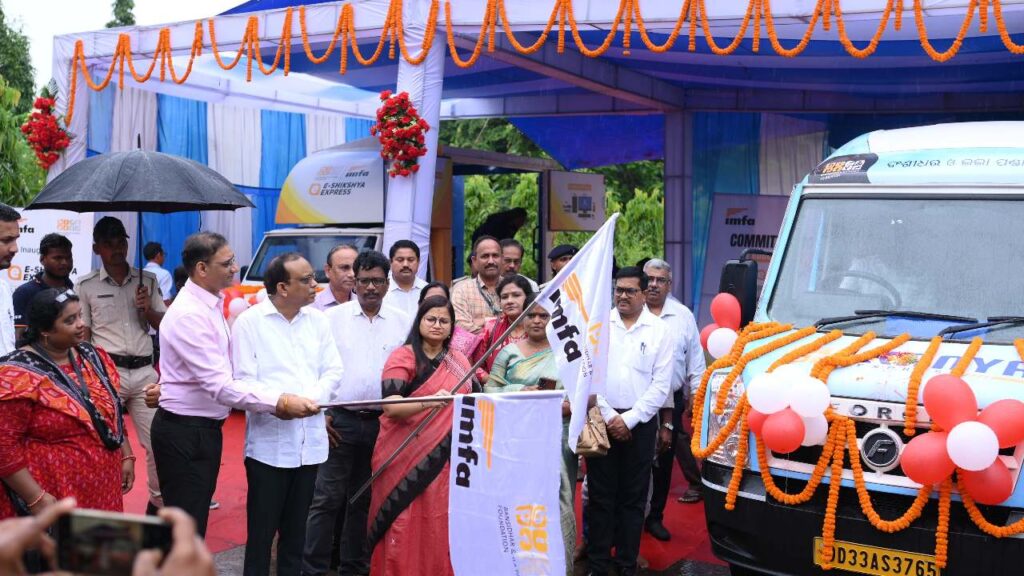
Yet, we knew empowerment needed more than just awareness and health. Education—especially digital education—became the next frontier. Enter our mobile learning unit, E-Kanya, E-Siksha Express, which travels across communities to promote both basic literacy and digital literacy. In today’s world, digital skills are non-negotiable—even operating a smartphone effectively requires knowledge many still lack.
We train women in essential IT tools—Word, Excel, and foundational computer skills. These skills, once considered optional, are now essential even for simple organizational tasks like generating AI-based reports or taking printouts. Furthermore, we’ve integrated cybercrime awareness into our curriculum, recognizing its growing importance in the digital age.
The results speak volumes. Many of these women, equipped with just three months of focused training, now secure jobs paying ₹8,000 to ₹10,000 per month. This proves that you don’t always need a long list of degrees—practical, targeted training can transform lives.
Lastly, we also foster entrepreneurship. Through sewing machine programs, micro-enterprise training, and access to credit via SHGs, women are not just finding employment—they’re creating it. This is how our SHG model evolves from a support system into a springboard for economic independence and leadership.
Q: How effectively has your organization been able to empower marginalized communities, and which target groups have you focused on through your outreach and education initiatives?
A: To date, we have formed nearly 350 Self-Help Groups (SHGs), each comprising around 10 to 11 women. That brings our total outreach to approximately 4,000 women across various regions of Odisha. Our focus remains concentrated within the state because our operations, factories, and infrastructure are rooted here.
IMFA, established in the 1960s, stands as one of Odisha’s first private sector enterprises. Over the decades, it has become more than just an industrial entity—it has evolved into an aspiration. Generations of students have pursued engineering with a singular dream: to one day walk through the doors of IMFA. This legacy speaks volumes about the company’s enduring influence on the community.
When we work towards uplifting these communities through BIPF, we are not just delivering programs—we are advancing a vision that has always aimed to develop Odisha and empower its people. The Panda family, founders of IMFA, represent Odisha’s first homegrown industrial legacy, and today, IMFA is counted among the top 1,000 companies listed on the BSE. That scale of impact carries weight.
This is why the name Bansidhar & Ila Panda Foundation (BIPF) already commands deep respect. It draws strength from the legacy of its founding patriarchs, and every initiative we undertake builds on this solid foundation of trust and commitment.
Moreover, we firmly believe that business and CSR go hand in hand. One cannot thrive without the other. At IMFA and BIPF, this synergy isn’t an afterthought—it is a principle. Our business was built on values, and our CSR continues to uphold and expand those values through meaningful action.
Q: As you look ahead, are there plans to scale your impact beyond Odisha? What does the roadmap for expansion and growth look like for the foundation?
A: At present, we have no plans to expand beyond Odisha. Our business operations remain firmly rooted within the state, and from a strategic standpoint, it wouldn’t make sense to venture outside this geography—at least not yet.
Instead, our focus is on deepening and scaling the impact of what we already do well. Take our Self-Help Groups (SHGs), for example. Rather than replicating the model elsewhere, we aim to elevate it—by integrating technology, exploring AI-based connectors, or leveraging app-based platforms. As we’ve seen from national networks showcased at recent forums, there are agencies successfully linking grassroots efforts across India. If we can connect our SHG-produced goods to those national platforms, we’d be more than willing to expand our footprint across India—not by physical presence, but through digital integration.
We are already in discussions with several agencies to take our initiatives to the next level. But while we scale, we remain deeply committed to preserving the integrity and identity of our core programmes. For instance, Kanya Express and Unnati are not just initiatives—they are our signature interventions, born out of local need and nurtured through experience. These aren’t generic models; few across India are doing what we do with the same depth and impact.
That’s why, when we engage with potential partners or funders, we lead with our strengths. We don’t tailor our programmes to fit funding agendas. Instead, we ask, “This is who we are—do you want to walk this path with us?” Because compromising our approach would dilute the very essence of our work. And for us, sustainability begins with authenticity.
Q: Empowerment and sustainability must go hand in hand. What initiatives is your organization undertaking to ensure that your empowerment efforts are sustainable in the long term?
A: That’s exactly the point—our programmes aren’t short-term engagements. These aren’t designed to run for two months or six months. They are long-term, transformative interventions. For instance, Unnati spans 152 modules delivered over three years. Similarly, the Kanya Express engages adolescent girls for 15 to 17 months, addressing critical aspects of health, nutrition, hygiene, and personal development.
In effect, participants remain with us for almost three years—a commitment akin to completing a college degree. By the end of this journey, many of these women transition into building micro-enterprises or small businesses. That’s when our next phase begins: scaling and market integration.
Take mushroom cultivation as an example. Imagine we are producing 100 tonnes across various locations. The question we now ask is: Can we consolidate, process, and elevate this into a unified or branded product? If branding isn’t feasible due to cost or regulatory burdens, then the alternative is to link our produce to existing brands, ensuring wider market access while keeping the process economically viable.
Branding comes with challenges. Labeling and certification demand considerable investment—often beyond the means of small producers. So, rather than burden these entrepreneurs with compliance-heavy processes, we follow a simpler path: let the producers focus on what they do best—grow, manufacture, and create. Meanwhile, established brands can take care of the market-facing complexities.
This model mirrors the agricultural supply chain—farmers produce in bulk and supply to brands that handle packaging and sales. It’s practical, efficient, and sustainable. In our experience, systems work best when they remain simple and focused on core outcomes. Complexity may sound impressive, but simplicity drives real impact. In the end, products will sell not because they are branded, but because they are accessible, reliable, and market-ready.
Q: Do you believe Corporate Social Responsibility (CSR) will play a pivotal role in India’s journey toward becoming a developed nation?
A: This is, in my view, the cornerstone of India’s growth story. Unlike China, where a top-down approach ensures immediate compliance, India’s democracy operates differently. Here, government policies may be announced, but implementation often depends on broader buy-in. That’s where Corporate Social Responsibility (CSR) plays a pivotal role. It acts as a powerful mechanism—binding corporates together under a shared purpose.
While India’s CSR mandate is still relatively young—just about a decade old—it has already begun to show transformative potential. At the same time, we’re witnessing a parallel shift towards Environmental, Social, and Governance (ESG) frameworks. ESG goes beyond philanthropy. It emphasizes sustainability, ethical governance, compliance, and social impact. The governance pillar, in particular, addresses fair wages, transparency, and accountability.
Encouragingly, CSR and ESG are increasingly becoming aligned, and more importantly, both are integrating with core business strategies. This creates a full-circle impact—a 360-degree ecosystem where doing good and doing well go hand in hand.
The scale of this shift is significant. Listed companies alone contribute between ₹25,000 to ₹30,000 crore annually through CSR. Add unlisted companies, and the collective figure climbs to nearly ₹50,000–₹60,000 crore. Now, imagine India’s ambition of becoming a $30 trillion (₹2,400 lakh crore) economy by 2047 under the Viksit Bharat vision.
As profits grow, CSR budgets will inevitably scale—potentially increasing six to seven times. That means an estimated ₹4 lakh crore could flow into social development annually. This is not just substantial—it’s game-changing. With that level of investment and alignment, CSR will become one of the most powerful drivers of inclusive and sustainable growth in India’s journey to becoming a developed nation.



1 Comment
What a great resource. I’ll be referring back to this often.
Comments are closed.