

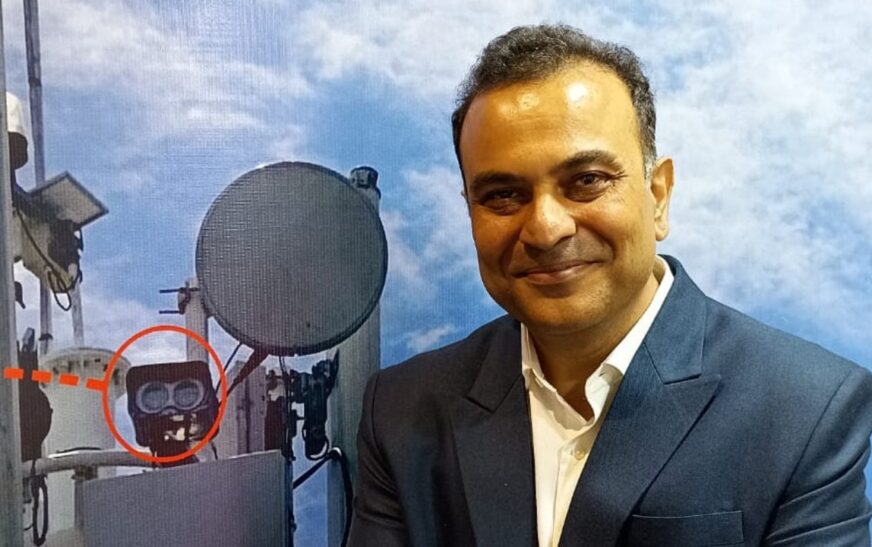
Velmenni R&D Pvt. Ltd. is an India-based deep-tech company that engineers advanced optical wireless communication systems, with a sharp focus on Li-Fi technology. Founded in 2012 and headquartered in New Delhi, the company delivers high-speed, secure data transmission by leveraging both visible and non-visible light spectra. It designs and deploys Li-Fi access points, mesh networks, and embedded communication systems tailored for indoor and industrial environments. Unlike conventional radio-frequency systems, Velmenni’s solutions minimize interference while significantly strengthening data security. As a result, the company positions itself at the forefront of next-generation connectivity, serving telecom, defence, and enterprise sectors. Through scalable, energy-efficient, light-based networking, Velmenni is actively redefining the architecture of wireless communication.
In an exclusive interaction with The Interview World at the 33rd Convergence India Expo, Gaurav Sehgal, Vice President – Sales & Business Development at Velmenni R&D Pvt. Ltd., provides a comprehensive perspective on the company’s innovations. He outlines its 5G-equivalent solutions built on the light spectrum and clearly differentiates them from traditional wireless technologies. Furthermore, he explains how these optical solutions operate without interfering with the electromagnetic spectrum. He also offers insights into the company’s current customer base and pricing strategy. Finally, he highlights the key technological advancements Velmenni plans to develop over the next five years. The following are the most critical takeaways from this substantive and forward-looking discussion.
Q: What specific 5G solutions does Velmenni provide to telecom operators, and how do they compare with current wireless technologies?
A: Velmenni operates as an Indian deep-tech startup that designs, develops, and manufactures its products entirely in India. It builds both hardware and software in-house and, as a result, delivers a highly specialized, point-to-point wireless backhaul solution for telecom operators, enterprises, and government networks.
Crucially, the company anchors its technology in the light spectrum rather than in conventional radio-frequency systems. Consequently, it enables last-mile connectivity in scenarios where fiber deployment proves impractical or cost-prohibitive. In such environments, operators can still scale their networks efficiently by deploying this optical wireless solution for reliable backhauling.
Moreover, the system delivers over-the-air capacity of up to 2 Gbps and beyond. Because it uses light as the transmission medium, it inherently resists interception, jamming, and electromagnetic interference. Therefore, network operators can design and deploy infrastructure with far greater predictability. In turn, they can meet stringent service-level agreements (SLAs) with higher confidence and operational stability, an advantage that directly strengthens enterprise and telecom-grade deployments.
In terms of market validation, Velmenni has already executed multiple proof-of-concept (POC) trials globally with leading operators such as Verizon, BSNL, and Hutch Sri Lanka. In addition, it has completed a live deployment with GMR in Odisha. Following this traction, the company secured recent funding from Pi Ventures in Bengaluru. As a result, it is now scaling its operations aggressively, expanding its reach across global telecom operators, ISPs, and enterprise customers to broaden the footprint of its solution.
Importantly, Velmenni’s approach departs decisively from legacy free-space optics (FSO) systems. Traditional FSO solutions often fail to meet telecom-grade SLAs due to their reliance on laser-based transmission, limited modulation schemes, and poor adaptability to atmospheric attenuation. Velmenni addresses these structural limitations by introducing a multi-carrier modulation technique over the light spectrum. This innovation allows the system to dynamically adapt to environmental conditions such as fog and rain. Specifically, it can scale modulation levels up or down in response to atmospheric changes while maintaining consistent connectivity performance and SLA compliance.
Furthermore, the technology compensates for mechanical instabilities, such as vibrations in poles and towers, an area where conventional FSO systems typically underperform. By integrating these adaptive capabilities directly into its architecture, Velmenni delivers a robust, resilient, and distinctly differentiated solution.
Q: Can your optical wireless systems operate without causing or experiencing interference from RF signals across the electromagnetic spectrum?
A: No light-based communication cannot be interfered with by conventional frequencies. This is because the system operates in the terahertz range, far beyond the spectrum used by typical radio-frequency technologies. To disrupt or jam such a signal, one would need an equally high-frequency source in the terahertz band, an impractical and currently unfeasible requirement.
Moreover, the system transmits data through a narrow, highly directional beam. As a result, interception becomes exceedingly difficult, since any attempt would require precise alignment within that confined optical path. In addition, because the technology leverages the light spectrum in a controlled and advanced manner, it remains inherently secure. To date, no comparable capability exists that can effectively interfere with or compromise such a transmission.
Q: Are major Indian telecom operators currently deploying your solutions as part of their 5G networks?
A: Yes, telecom operators constitute a core customer segment for us. More specifically, they represent a high-value, niche market because they actively deploy multiple backhaul technologies to support their 4G and 5G base stations.
Traditionally, these operators have relied on licensed spectrum solutions such as microwave and millimeter-wave systems. However, these technologies face inherent limitations. They remain susceptible to interference, operate within constrained spectrum availability, and encounter capacity ceilings that restrict scalability.
Consequently, many operators have begun exploring unlicensed RF-based radios. Yet, these alternatives introduce a different set of challenges. Their performance often proves inconsistent and unpredictable, which undermines reliability, especially for mission-critical network operations.
In contrast, our solution delivers deterministic performance. It ensures predictable throughput and stability while offering significantly higher capacity than comparable technologies. Therefore, it presents a compelling and differentiated use case for telecom operators. Given these advantages, we see substantial adoption potential within the telco ecosystem.
Q: Can you explain your pricing model and how it impacts total cost of ownership compared to alternative technologies?
A: We have engineered this solution specifically for telecom operators and similar large-scale network users. At its core, it leverages an LED-based architecture, which ensures cost efficiency without compromising performance. As a result, it remains fully competitive with existing alternatives while retaining strong commercial viability for telcos.
Moreover, as deployment volumes increase, the economics improve further. This scale advantage enables us to deliver a significantly lower total cost of ownership. Consequently, operators can achieve both performance gains and cost optimization within the same framework.
Q: What new technologies or innovations are you planning to develop over the next five years?
A: At present, we are prioritizing telecom operators and enterprise customers. However, in parallel, we are actively advancing this technology for defence applications. Given its inherent security and reliance on the light spectrum, it offers a compelling fit for mission-critical defence use cases.
Accordingly, we are developing a long-range optical wireless solution that delivers up to 10 Gbps over distances of approximately 20 kilometers. Defence stakeholders strongly value this approach because it combines high capacity with a fundamentally secure transmission medium. As a result, we are already engaged in extensive collaboration within the defence sector.
Looking ahead, we intend to deepen our presence in this domain. Furthermore, as requirements evolve, we are fully capable of engineering solutions that support even longer ranges and higher performance thresholds.