

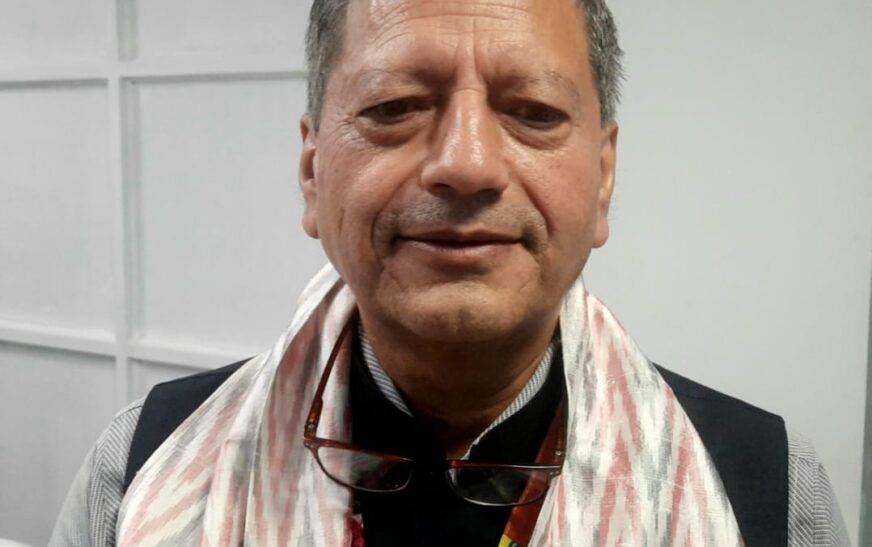
The Last Beggar: From Donation to Dignity stands as perhaps the first definitive work in India to address the scourge of begging with tested, implementable solutions. Edited by Dr. Sanjeev Chopra, former Director of the Lal Bahadur Shastri National Academy of Administration (LBSNAA), and published by Bloomsbury, the book traverses a vast intellectual terrain. It traces the religio-cultural origins and historical roots of begging. It examines the legal framework, government initiatives, and pragmatic models for eradication. It identifies potential funding sources and outlines a meticulous roadmap toward a Beggars-Free India—all through the contributions of economists, research scholars, and subject-matter experts.
Among its most compelling features is a detailed case study on the Beggars Corporation model, authored by economist Dr. Sreevas Sahasranamam of the Adam Smith Business School, University of Glasgow. Far from perpetuating dependency, the book challenges the outdated paradigms of charity. Instead, it introduces the bold concept of a “for-profit with purpose” enterprise—one that treats beggars not as passive recipients of aid but as empowered economic participants.
At its core, The Last Beggar is more than a book—it is a movement. It calls for a societal shift from handouts to dignity, from pity to empowerment.
In an exclusive conversation with The Interview World during the book’s launch—an event hosted by Beggars Corporation—Dr. Sanjeev Chopra distills the essence of this vision. He outlines the transformative economic potential of reintegrating beggars into productive livelihoods. He underscores the profound social dividends of eliminating begging from India’s streets. And he leaves no doubt: this is not merely an academic exercise, but a clarion call for systemic change.
Here are the most striking takeaways from that compelling exchange.
Q: Your book The Last Beggar: From Donation to Dignity has an intriguing title. Could you share what it captures and the key ideas it conveys?
A: The book brings together a compelling collection of articles that confront the stark realities of begging in India. It begins with an unflinching look at the facts—there are 4.5 lakh beggars in the country today. That is the statistical truth.
From there, it examines the legal landscape—state-specific acts, national legislation, and the policy framework that governs this issue. It delves into the tradition of daan—the act of giving—rooted in religious scriptures across faiths: the Bhagavad Gita, the Bible, the Quran, and the Guru Granth Sahib. Each reflects a moral and spiritual engagement with charity.
The narrative then widens its lens. It analyses begging through the prisms of political science, history, sociology, and anthropology, revealing the intricate social, cultural, and economic threads that sustain this phenomenon.
Yet, the book’s heartbeat lies in transformation. At its core is the pioneering work of the Beggars Corporation, beginning in Varanasi, to convert beggars into entrepreneurs. The vision is clear: while most people give alms, the movement urges them to invest—not in handouts, but in human potential. By investing in beggars and in the Beggars Corporation, supporters can help create sustainable, long-term change.
This is not charity. This is economic empowerment with dignity. And it has already begun.
Q: In your book, you explore the historical, legal, social, and statistical facets of begging in India. Could you walk us through these perspectives?
A: We set out to capture the historical dimensions of begging. We examined its legal underpinnings. Most importantly, we charted a concrete path forward—a way to break free from the cycle of destitution and move toward entrepreneurship.
Here, society’s role becomes critical. Change cannot occur in a vacuum. As the minister rightly observed, you cannot speak of Swachh Bharat if there are no toilets. You cannot preach cleanliness if there are no dustbins. The principle is simple: infrastructure enables behaviour. When the right facilities exist, people inevitably adapt to them.
The same logic applies to eradicating begging. People must know there is an alternative. They must see a method of helping beggars that does not trap them in day-to-day dependence. This is where the shift in thinking begins.
It is the age-old parable—do you give a fish, or do you hand over a fishing rod and teach the skill? We choose the latter. We aim to equip beggars with the tools and training to earn, to sustain themselves, and to live with dignity. We are building that scope. We are handing them the fishing rods, and we are showing them how to fish.
Without these options, the cycle remains unbroken. With them, we open the door to transformation.
Q: What economic impact could India witness if all beggars were transitioned into dignified livelihoods?
A: India has barely five lakh beggars. The 2011 Census recorded 4.78 lakh. The number may have risen slightly—or perhaps not at all. Either way, in a nation of 140 crore, this is not an insurmountable figure. With a focused and organized effort, we can eliminate begging within two to five years.
The Minister cited Indore as a precedent—it has already declared itself beggar-free. In Varanasi, the initiative is underway. In Dehradun, the process has begun. Step by step, more cities are joining the movement.
Our approach is deliberate. We engage with municipal corporations, district magistrates, local police, and elected representatives. We bring them into a common mission. With each city that adopts the model, the momentum grows.
At this pace, within three to four years, we can transform India into a beggar-free nation. The goal is ambitious, but entirely achievable—provided we act with commitment, coordination, and urgency.
Q: How do you view this movement in terms of society’s involvement and participation?
A: As India’s middle class expands, it grows more aware of its rights, responsibilities, and duties. This awakening fuels my optimism. I see a future for this nation that is not only brighter, but decisively positive. Making India a beggar-free nation is achievable.








5 Comments
This gave me a whole new perspective on something I thought I already understood. Great explanation and flow!
Your advice is exactly what I needed right now.
You write with so much clarity and confidence. Impressive!
You’ve clearly done your research, and it shows.
I hadn’t considered this angle before. It’s refreshing!
Comments are closed.